JEE Advanced 2015 Physics question — Kepler's laws and planetary motion
A large spherical mass M is fixed at one position and two identical point masses m are kept on a line passing through the centre of M (see figure). The point masses are connected by a rigid massless rod of length / and this assembly is free to move along the line connecting them. All three masses interact only through their mutual gravitational interaction. When the point mass nearer to M is at a distance r = 3l from M, the tension in the rod is zero for . The value of k is
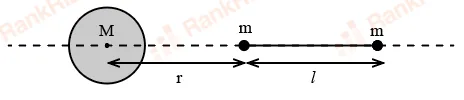
SOLUTION
Key idea: The rod tension is zero only if gravity alone gives both point masses the same acceleration.
The near mass is at from M and the far mass at . Take the direction towards M as positive.
- Near mass (pulled towards M by M, pulled away by the other ):
- Far mass (pulled towards M by both):
- Set : So .
Answer: 7
Tagged Kepler's laws and planetary motion. Machine-assigned, so read it as a strong shortlist rather than a verdict.