JEE MAIN 2026 · 05 APR S1+4 / −1MEDIUMTRANSCRIBED
JEE Main 2026 Physics question — Stress, strain, Hooke's law and Young's modulus
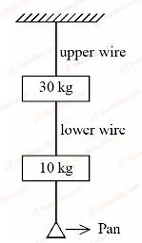
Two wires as shown in the figure below, made of steel and have breaking stress of N/m. Area of cross-section of upper wire is 0.008 cm and of lower wire is 0.004 cm. The maximum mass that can be added to pan without breaking any wire is _______ kg. (take m/s)
SOLUTION
Breaking stress =
Areas:
step 1: max tension each wire can bear
upper wire:
lower wire:
step 2: tensions in wires
let mass added = mmm
lower wire carries:
=100+10m
limit:
upper wire carries total mass:
limit:
step 3: final
smaller limit governs m=38
Tagged Stress, strain, Hooke's law and Young's modulus. Machine-assigned, so read it as a strong shortlist rather than a verdict.