RankRizz

Dual Nature of Radiation & Matter — JEE Main Previous Year Questions

Every Dual Nature of Radiation & Matter question JEE Main has set from 2004–2026, grouped by the idea it tests rather than the order of the syllabus. 216 questions across 4 distinct ideas. Free to read, answer key on every one.

Questions

216

Distinct ideas

4

Share of marks

3.4%

Difficulty

MEDIUM

The ideas inside Dual Nature of Radiation & Matter

A chapter is not one subject — it is a handful of procedures the examiner reuses. These are the ones Dual Nature of Radiation & Matter questions actually test.

Every Dual Nature of Radiation & Matter question

161–180 OF 216 · NEWEST FIRST

JEE MAIN 2019 · 12 JAN S1de Broglie wavelength of matter wavesTRANSCRIBED

A particle A of mass m and charge q is accelerated by a potential difference of 50 V. Another particle B of mass 4m and charge q is accelerated by a potential difference of 2500 V. The ratio of de-Broglie wavelengths λAλB\frac{\lambda_A}{\lambda_B} is close to:

  1. A

    0.07

  2. B

    10.00

  3. C

    4.47

  4. D

    14.14

JEE MAIN 2019 · 12 JAN S2Photoelectric effect and Einstein's equationTRANSCRIBED

When a certain photosensitive surface is illuminated with monochromatic light of frequency ν\nu, the stopping potential of the photo current is −V02-\frac{V_0}{2}. When the surface is illuminated by monochromatic light of frequency ν2\frac{\nu}{2}, the stopping potential is −V0-V_0. The threshold frequency for photoelectric emission is

  1. A

    5ν3\frac{5\nu}{3}

  2. B

    3ν2\frac{3\nu}{2}

  3. C

    43ν\frac{4}{3}\nu

  4. D

    2ν2\nu

JEE MAIN 2019 · 11 JAN S1de Broglie wavelength of matter wavesTRANSCRIBED

If the deBroglie wavelength of an electron is equal to 10−310^{-3} times the wavelength of a photon of frequency 6×10146 \times 10^{14} Hz, then the speed of electron is equal to: (Speed of light =3×108= 3 \times 10^8 m/s, Planck's constant =6.63×10−34= 6.63 \times 10^{-34} J.s, Mass of electron =9.1×10−31= 9.1 \times 10^{-31} kg)

  1. A

    1.1×1061.1 \times 10^6 m/s

  2. B

    1.7×1061.7 \times 10^6 m/s

  3. C

    1.8×1061.8 \times 10^6 m/s

  4. D

    1.45×1061.45 \times 10^6 m/s

JEE MAIN 2019 · 10 APR S1Photoelectric effect and Einstein's equationTRANSCRIBED

In a photoelectric effect experiment, the threshold wavelength of light is 380 nm. If the wavelength of incident light is 260 nm, the maximum kinetic energy of emitted electrons will be
Given E (in eV) = 1237λ(in nm)\frac{1237}{\lambda(\text{in nm})}

  1. A

    4.5 eV

  2. B

    3.0 eV

  3. C

    1.5 eV

  4. D

    15.1 eV

JEE MAIN 2019 · 09 JAN S2Photoelectric effect and Einstein's equationTRANSCRIBED

The magnetic field associated with a light wave is given, at the origin, by B=B0[sin⁡(3.14×10⁷)ct+sin⁡(6.28×10⁷)ct]B = B_0 [\sin(3.14 \times 10^7)ct + \sin(6.28 \times 10^7)ct]. If this light falls on a silver plate having a work function of 4.7 eV, what will be the maximum kinetic energy of the photoelectrons? (c=3×10⁸c = 3 \times 10^8 m s−1^{-1}, h=6.6×10⁻³⁴h = 6.6 \times 10^{-34} J s)

  1. A

    6.82 eV

  2. B

    7.72 eV

  3. C

    12.5 eV

  4. D

    8.52 eV

JEE MAIN 2019 · 11 JAN S2Photoelectric effect and Einstein's equationTRANSCRIBED

In a photoelectric experiment, the wavelength of the light incident on a metal is changed from 300 nm to 400 nm. The decrease in the stopping potential is close to: (hce=1240 nm⋅V)\left(\frac{hc}{e} = 1240 \text{ nm} \cdot V\right)

  1. A

    0.5 V

  2. B

    1.5 V

  3. C

    1.0 V

  4. D

    2.0 V

JEE MAIN 2019 · 10 JAN S1de Broglie wavelength of matter wavesTRANSCRIBED

In an electron microscope, the resolution that can be achieved is of the order of the wavelength of electrons used. To resolve a width of 7.5×10−127.5 \times 10^{-12} m, the minimum electron energy required is close to:

  1. A

    100 keV

  2. B

    25 keV

  3. C

    1 keV

  4. D

    500 keV

JEE MAIN 2019 · 12 JAN S2Photons: energy, momentum and radiation pressureTRANSCRIBED

In a Frank-Hertz experiment, an electron of energy 5.6 eV passes through mercury vapour and emerges with an energy 0.7 eV. The minimum wavelength of photons emitted by mercury atoms is close to:

  1. A

    250 nm

  2. B

    1700 nm

  3. C

    220 nm

  4. D

    2020 nm

JEE MAIN 2019 · 08 APR S1de Broglie wavelength of matter wavesTRANSCRIBED

Two particles move at right angle to each other. Their de Broglie wavelengths are λ1\lambda_1 and λ2\lambda_2 respectively. The particles suffer perfectly inelastic collision. The de Broglie wavelength λ\lambda of the final particle, is given by:

  1. A

    2λ=1λ1+1λ2\frac{2}{\lambda} = \frac{1}{\lambda_1} + \frac{1}{\lambda_2}

  2. B

    λ=λ1+λ22\lambda = \frac{\lambda_1 + \lambda_2}{2}

  3. C

    λ=λ1λ2\lambda = \sqrt{\lambda_1 \lambda_2}

  4. D

    1λ2=1λ12+1λ22\frac{1}{\lambda^{2}} = \frac{1}{\lambda_1^{2}} + \frac{1}{\lambda_2^{2}}

JEE MAIN 2019 · 08 APR S2de Broglie wavelength of matter wavesTRANSCRIBED

A nucleus A, with a finite de-broglie wavelength λA\lambda_A, undergoes spontaneous fission into two nuclei B and C of equal mass. B flies in the same direction as that of A, while C flies in the opposite direction with a velocity equal to half of that of B. The de-Broglie wavelengths λB\lambda_B and λC\lambda_C of B and C are respectively:

  1. A

    λA,λA2\lambda_A, \frac{\lambda_A}{2}

  2. B

    λA2,λA\frac{\lambda_A}{2}, \lambda_A

  3. C

    λA,2λA\lambda_A, 2\lambda_A

  4. D

    2λA,λA2\lambda_A, \lambda_A

JEE MAIN 2019 · 10 APR S2Photons: energy, momentum and radiation pressureTRANSCRIBED

A 2 mW laser operates at a wavelength of 500 nm. The number of photons that will be emitted per second is:
[Given Planck's constant h = 6.6×10−346.6 \times 10^{-34} J s, speed of light c = 3.0×1083.0 \times 10^8 m/s]

  1. A

    1.5×10161.5 \times 10^{16}

  2. B

    5×10155 \times 10^{15}

  3. C

    2×10162 \times 10^{16}

  4. D

    1×10161 \times 10^{16}

JEE MAIN 2019 · 09 APR S1Photoelectric effect and Einstein's equationTRANSCRIBED

The electric field of light wave is given as E⃗=10−3cos⁡(2πx5×10−7−2π×6×1014t)x^NC\vec{E} = 10^{-3} \cos\left(\frac{2\pi x}{5 \times 10^{-7}} - 2\pi \times 6 \times 10^{14}t\right) \hat{x} \frac{N}{C}. This light falls on a metal plate of work function 2 eV. The stopping potential of the photo-electrons is: Given, E (in eV) = 12375λ(in A˚)\frac{12375}{\lambda(\text{in } \mathring{A})}

  1. A

    0.72 V

  2. B

    2.0 V

  3. C

    2.48 V

  4. D

    0.48 V

JEE MAIN 2019 · 12 APR S1Photoelectric effect and Einstein's equationTRANSCRIBED

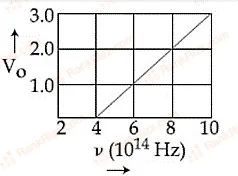
The stopping potential V0_0 (in volt) as a function of frequency (ν\nu) for a sodium emitter, is shown in the figure. The work function of sodium, from the data plotted in the figure, will be:
(Given: Planck's constant h = 6.63×10−346.63 \times 10^{-34} J s, electron charge (e) = 1.6×10−191.6 \times 10^{-19} C)

Figure for JEE Main 2019 Physics question on Photoelectric effect and Einstein's equation
  1. A

    2.12 eV

  2. B

    1.82 eV

  3. C

    1.95 eV

  4. D

    1.66 eV

JEE MAIN 2019 · 10 JAN S2Photoelectric effect and Einstein's equationTRANSCRIBED

A metal plate of area 1×10−41 \times 10^{-4} m2^2 is illuminated by a radiation of intensity 16 m W/m2^2. The work function of the metal is 5 eV. The energy of the incident photons is 10 eV and only 10% of it produces photo electrons. The number of emitted photo electrons per second and their maximum energy, respectively, will be: [1eV=1.6×10−191eV = 1.6 \times 10^{-19} J]

  1. A

    101410^{14} and 10 eV

  2. B

    101210^{12} and 5 eV

  3. C

    101110^{11} and 5 eV

  4. D

    101010^{10} and 5 eV

JEE MAIN 2019 · 09 APR S2de Broglie wavelength of matter wavesTRANSCRIBED

A particle 'P' is formed due to a completely inelastic collision of particles 'x' and 'y' having de-Broglie wavelengths 'λx\lambda_x' and 'λy\lambda_y' respectively. If x and y were moving in opposite directions, then the de-Broglie wavelength of 'P' is:

  1. A

    λx−λy\lambda_x - \lambda_y

  2. B

    λxλyλx+λy\frac{\lambda_x \lambda_y}{\lambda_x + \lambda_y}

  3. C

    λxλy∣λx−λy∣\frac{\lambda_x \lambda_y}{|\lambda_x - \lambda_y|}

  4. D

    λx+λy\lambda_x + \lambda_y

JEE MAIN 2019 · 09 JAN S1Photoelectric effect and Einstein's equationTRANSCRIBED

The surface of certain metal is first illuminated with light of wavelength λ1=350\lambda_1 = 350 nm and then, by a light of wavelength λ2=540\lambda_2 = 540 nm. It is found that the maximum speed of the photoelectrons in the two cases differ by a factor of 2. The work function of the metal (in eV) is close to (Energy of photon =1240λ  in  nm= \frac{1240}{\lambda \; in \; nm} eV)

  1. A

    2.5

  2. B

    1.8

  3. C

    5.6

  4. D

    1.4

JEE MAIN 2018 · 15 APR S1de Broglie wavelength of matter wavesTRANSCRIBED

Two electrons are moving with non-relativistic speeds perpendicular to each other. If corresponding de Broglie wavelengths are λ1\lambda_1 and λ2\lambda_2, their de Broglie wavelength in the frame of reference attached to their centre of mass is:

  1. A

    λCM=λ1=λ2\lambda_{CM} = \lambda_1 = \lambda_2

  2. B

    1λCM=1λ1+1λ2\frac{1}{\lambda_{CM}} = \frac{1}{\lambda_1} + \frac{1}{\lambda_2}

  3. C

    λCM=2λ1λ2λ12+λ22\lambda_{CM} = \frac{2\lambda_1\lambda_2}{\sqrt{\lambda_1^2 + \lambda_2^2}}

  4. D

    λCM=λ1+λ22\lambda_{CM} = \frac{\lambda_1 + \lambda_2}{2}

JEE MAIN 2018 · 15 APR S2de Broglie wavelength of matter wavesTRANSCRIBED

If the de Broglie wavelengths associated with a proton and an α\alpha-particle are equal, then the ratio of velocities of the proton and the α\alpha-particle will be:

  1. A

    1 : 4

  2. B

    1 : 2

  3. C

    4 : 1

  4. D

    2 : 1

JEE MAIN 2018 · 16 APR ONLINEde Broglie wavelength of matter wavesTRANSCRIBED

The de-Broglie wavelength (λB\lambda_B) associated with the electron orbiting in the second excited state of hydrogen atom is related to that in the ground state (λG\lambda_G) by:

  1. A

    λB=3λG\lambda_B = 3\lambda_G

  2. B

    λB=2λG\lambda_B = 2\lambda_G

  3. C

    λB=λG/3\lambda_B = \lambda_{G/3}

  4. D

    λB=λG/2\lambda_B = \lambda_{G/2}

JEE MAIN 2017 · 02 APR OFFLINEde Broglie wavelength of matter wavesTRANSCRIBED

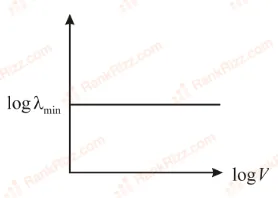
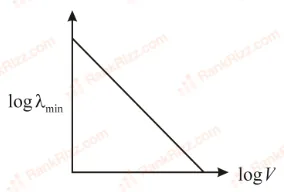
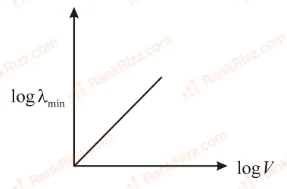
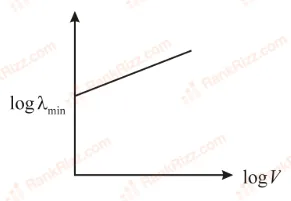
An electron beam is accelerated by a potential difference VV to hit a metallic target to produce X-rays. It produces continuous as well as characteristic X-rays. If λmin\lambda_{min} is the smallest possible wavelength of X-ray in the spectrum, the variation of log⁡λmin\log\lambda_{min} with log⁡V\log V is correctly represented in:

  1. A
    Figure for JEE Main 2017 Physics question on de Broglie wavelength of matter waves
  2. B
    Figure for JEE Main 2017 Physics question on de Broglie wavelength of matter waves
  3. C
    Figure for JEE Main 2017 Physics question on de Broglie wavelength of matter waves
  4. D
    Figure for JEE Main 2017 Physics question on de Broglie wavelength of matter waves