RankRizz

Dual Nature of Radiation & Matter — JEE Main Previous Year Questions

Every Dual Nature of Radiation & Matter question JEE Main has set from 2004–2026, grouped by the idea it tests rather than the order of the syllabus. 216 questions across 4 distinct ideas. Free to read, answer key on every one.

Questions

216

Distinct ideas

4

Share of marks

3.4%

Difficulty

MEDIUM

The ideas inside Dual Nature of Radiation & Matter

A chapter is not one subject — it is a handful of procedures the examiner reuses. These are the ones Dual Nature of Radiation & Matter questions actually test.

Every Dual Nature of Radiation & Matter question

61–80 OF 216 · NEWEST FIRST

JEE MAIN 2023 · 13 APR S2Photoelectric effect and Einstein's equationTRANSCRIBED

Given below are two statements:
Statement I : Out of microwaves, infrared rays and ultraviolet rays, ultraviolet rays are the most effective for the emission of electrons from a metallic surface
Statement II : Above the threshold frequency, the maximum kinetic energy of photoelectrons is inversely proportional to the frequency of the incident light
In the light of above statements, choose the correct answer from the options given below

  1. A

    Statement I is false but Statement II is true

  2. B

    Statement I is true but Statement II is false

  3. C

    Both Statement I and Statement II are true

  4. D

    Both Statement I and Statement II are false
JEE MAIN 2023 · 31 JAN S1Davisson-Germer experimentTRANSCRIBED

Given below are two statements: One is labelled as Assertion A and the other is labelled as Reason R
Assertion A: The beam of electrons shows wave nature and exhibit interference and diffraction.
Reason R: Davisson Germer Experimentally verified the wave nature of electrons.
In the light of the above statements. Choose the most appropriate answer from the options given below:

  1. A

    A is correct but R is not correct

  2. B

    A is not correct but R is correct

  3. C

    Both A and R are correct but R is Not the correct explanation of A

  4. D

    Both A and R are correct and R is the correct explanation of A

JEE MAIN 2023 · 29 JAN S1Photoelectric effect and Einstein's equationTRANSCRIBED

The threshold wavelength for photoelectric emission from a material is 55005500 A˚\text{\AA}. Photoelectrons will be emitted, when this material is illuminated with monochromatic radiation from a
A. 75 W infra-red lamp
B. 10 W infra-red lamp
C. 75 W ultra-violet lamp
D. 10 W ultra-violet lamp
Choose the correct answer from the options given below:

  1. A

    B and C only

  2. B

    A and D only

  3. C

    C only

  4. D

    C and D only

JEE MAIN 2023 · 06 APR S1de Broglie wavelength of matter wavesTRANSCRIBED

The kinetic energy of an electron, α\alpha-particle and a proton are given as 4K, 2K and K respectively. The de-Broglie wavelength associated with electron (λe)(\lambda_e), α\alpha-particle (λα)(\lambda_\alpha) and the proton (λp)(\lambda_p) are as follows:

  1. A

    λα=λp>λe\lambda_\alpha = \lambda_p > \lambda_e

  2. B

    λα<λp<λe\lambda_\alpha < \lambda_p < \lambda_e

  3. C

    λα=λp<λe\lambda_\alpha = \lambda_p < \lambda_e

  4. D

    λα>λp>λe\lambda_\alpha > \lambda_p > \lambda_e

JEE MAIN 2023 · 30 JAN S2de Broglie wavelength of matter wavesTRANSCRIBED

An electron accelerated through a potential difference V1V_1 has a de-Broglie wavelength of λ\lambda. When the potential is changed to V2V_2, its de-Broglie wavelength increases by 50%50\%. The value of (V1V2)\left(\frac{V_1}{V_2}\right) is equal to:

  1. A

    33

  2. B

    94\frac{9}{4}

  3. C

    32\frac{3}{2}

  4. D

    44

JEE MAIN 2023 · 10 APR S2Photoelectric effect and Einstein's equationTRANSCRIBED

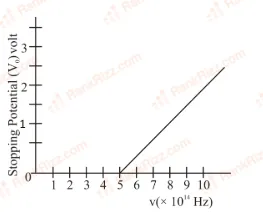
The variation of stopping potential V0V_0 as a function of the frequency (ν)(\nu) of the incident light for a metal is shown in figure. The work function of the surface is

Figure for JEE Main 2023 Physics question on Photoelectric effect and Einstein's equation
  1. A

    2.98 eV

  2. B

    2.07 eV

  3. C

    1.36 eV

  4. D

    18.6 eV

JEE MAIN 2023 · 24 JAN S1Photoelectric effect and Einstein's equationTRANSCRIBED

From the photoelectric effect experiment, following observations are made. Identify which of these are correct
A. The stopping potential depends only on the work function of the metal.
B. The saturation current increases as the intensity of incident light increases.
C. The maximum kinetic energy of a photo electron depends on the intensity of the incident light.
D. Photoelectric effect can be explained using wave theory of light.
Choose the correct answer from the options given below:

  1. A

    B, C only

  2. B

    A, C, D only

  3. C

    B only

  4. D

    A, B, D only

JEE MAIN 2023 · 24 JAN S1Photoelectric effect and Einstein's equationTRANSCRIBED

From the photoelectric effect experiment, following observations are made. Identify which of these are correct:
A. The stopping potential depends only on the work function of the metal.
B. The saturation current increases as the intensity of incident light increases.
C. The maximum kinetic energy of a photo electron depends on the intensity of the incident light.
D. Photoelectric effect can be explained using wave theory of light.
Choose the correct answer from the options given below:

  1. A

    B, C only

  2. B

    A, C, D only

  3. C

    B only

  4. D

    A, B, D only

JEE MAIN 2023 · 31 JAN S1Photons: energy, momentum and radiation pressureTRANSCRIBED

If a source of electromagnetic radiation having power 15 kW produces 101610^{16} photons per second, the radiation belongs to a part of spectrum is:
(Take Planck constant h=6×10⁻³⁴h = 6 \times 10^{-34} J s)

  1. A

    Micro waves

  2. B

    Ultraviolet rays

  3. C

    Gamma rays

  4. D

    Radio waves

JEE MAIN 2023 · 01 FEB S2Photoelectric effect and Einstein's equationTRANSCRIBED

The threshold frequency of metal is f0f_0. When the light of frequency 2f02f_0 is incident on the metal plate, the maximum velocity of photoelectron is v1v_1. When the frequency of incident radiation is increased to 5f05f_0, the maximum velocity of photoelectrons emitted is v2v_2. The ratio of v1v_1 to v2v_2 is:

  1. A

    v1v2=12\frac{v_1}{v_2} = \frac{1}{2}

  2. B

    v1v2=18\frac{v_1}{v_2} = \frac{1}{8}

  3. C

    v1v2=116\frac{v_1}{v_2} = \frac{1}{16}

  4. D

    v1v2=14\frac{v_1}{v_2} = \frac{1}{4}

JEE MAIN 2023 · 12 APR S1de Broglie wavelength of matter wavesTRANSCRIBED

A proton and an α\alpha-particle are accelerated from rest by 22 V and 44 V potentials, respectively. The ratio of their de-Broglie wavelength is :

  1. A

    8:18 : 1

  2. B

    2:12 : 1

  3. C

    4:14 : 1

  4. D

    16:116 : 1

JEE MAIN 2023 · 24 JAN S2de Broglie wavelength of matter wavesTRANSCRIBED

An α\alpha particle, a proton and an electron have the same kinetic energy. Which one of the following is correct in case of their de-Broglie wavelength:

  1. A

    λα>λp>λe\lambda_{\alpha} > \lambda_p > \lambda_e

  2. B

    λα<λp<λe\lambda_{\alpha} < \lambda_p < \lambda_e

  3. C

    λα=λp=λe\lambda_{\alpha} = \lambda_p = \lambda_e

  4. D

    λα>λp<λe\lambda_{\alpha} > \lambda_p < \lambda_e

JEE MAIN 2023 · 13 APR S1Photoelectric effect and Einstein's equationTRANSCRIBED

The difference between threshold wavelengths for two metal surfaces AA and BB having work function ϕA=9\phi_A = 9 eV and ϕB=4.5\phi_B = 4.5 eV in nm is:
{Given, hc=1242hc = 1242 eV nm}

  1. A

    540540

  2. B

    276276

  3. C

    264264

  4. D

    138138

JEE MAIN 2023 · 31 JAN S2Photoelectric effect and Einstein's equationTRANSCRIBED

If the two metals AA and BB are exposed to radiation of wavelength 350 nm. The work functions of metals AA and BB are 4.8 eV and 2.2 eV. Then choose the correct option

  1. A

    Metal B will not emit photo-electrons

  2. B

    Both metals A and B will emit photo-electrons

  3. C

    Both metals A and B will not emit photoelectrons

  4. D

    Metal A will not emit photo-electrons

JEE MAIN 2023 · 25 JAN S1de Broglie wavelength of matter wavesTRANSCRIBED

Electron beam used in an electron microscope, when accelerated by a voltage of 20 kV has a de-Broglie wavelength of λ0\lambda_0. If the voltage is increased to 40 kV then the de-Broglie wavelength associated with the electron beam would be:

  1. A

    3λ03\lambda_0

  2. B

    9λ09\lambda_0

  3. C

    λ02\frac{\lambda_0}{2}

  4. D

    λ02\frac{\lambda_0}{\sqrt{2}}

JEE MAIN 2023 · 30 JAN S1Photons: energy, momentum and radiation pressureTRANSCRIBED

A small object at rest, absorbs a light pulse of power 2020 mW and duration 300300 ns. Assuming speed of light as 3×1083 \times 10^8 m s−1^{-1}. The momentum of the object becomes equal to:

  1. A

    0.5×10−170.5 \times 10^{-17} kg m s−1^{-1}

  2. B

    2×10−172 \times 10^{-17} kg m s−1^{-1}

  3. C

    3×10−173 \times 10^{-17} kg m s−1^{-1}

  4. D

    1×10−171 \times 10^{-17} kg m s−1^{-1}

JEE MAIN 2023 · 08 APR S2Photoelectric effect and Einstein's equationTRANSCRIBED

In photoelectric effect
A. The photocurrent is proportional to the intensity of the incident radiation.
B. Maximum kinetic energy with which photoelectrons are emitted depends on the intensity of incident light.
C. Max K.E. with which photoelectrons are emitted depends on the frequency of incident light.
D. The emission of photoelectrons require a minimum threshold intensity of incident radiation.
E. Max K.E. of the photoelectrons is independent of the frequency of the incident light.
Choose the correct option from the options given below:

  1. A

    A and B only

  2. B

    A and E only

  3. C

    A and C only

  4. D

    B and C only

JEE MAIN 2023 · 01 FEB S1de Broglie wavelength of matter wavesTRANSCRIBED

A proton moving with one tenth of velocity of light has a certain de Broglie wavelength of λ\lambda. An alpha particle having certain kinetic energy has the same de-Broglie wavelength λ\lambda. The ratio of kinetic energy of proton and that of alpha particle is:

  1. A

    2 : 1

  2. B

    4 : 1

  3. C

    1 : 2

  4. D

    1 : 4

JEE MAIN 2023 · 10 APR S1de Broglie wavelength of matter wavesTRANSCRIBED

The de Broglie wavelength of a molecule in a gas at room temperature 300 K is λ1\lambda_1. If the temperature of the gas is increased to 600 K, then the de Broglie wavelength of the same gas molecule becomes

  1. A

    12λ1\frac{1}{2}\lambda_1

  2. B

    2λ1\sqrt{2}\lambda_1

  3. C

    12λ1\frac{1}{\sqrt{2}}\lambda_1

  4. D

    2λ12\lambda_1

JEE MAIN 2023 · 08 APR S1de Broglie wavelength of matter wavesTRANSCRIBED

Proton (P) and electron (e) will have same de-Broglie wavelength when the ratio of their momentum is (assume, mp=1849mem_p = 1849 m_e)

  1. A

    1 : 1

  2. B

    1 : 1849

  3. C

    1 : 43

  4. D

    43 : 1