RankRizz

Dual Nature of Radiation & Matter — JEE Main Previous Year Questions

Every Dual Nature of Radiation & Matter question JEE Main has set from 2004–2026, grouped by the idea it tests rather than the order of the syllabus. 216 questions across 4 distinct ideas. Free to read, answer key on every one.

Questions

216

Distinct ideas

4

Share of marks

3.4%

Difficulty

MEDIUM

The ideas inside Dual Nature of Radiation & Matter

A chapter is not one subject — it is a handful of procedures the examiner reuses. These are the ones Dual Nature of Radiation & Matter questions actually test.

Every Dual Nature of Radiation & Matter question

21–40 OF 216 · NEWEST FIRST

JEE MAIN 2025 · 22 JAN S1de Broglie wavelength of matter wavesTRANSCRIBED

An electron in the ground state of the hydrogen atom has the orbital radius of 5.3×10⁻¹¹m5.3\times 10^{-11} m while that for the electron in third excited state is 8.48×10⁻¹⁰m.8.48\times 10^{-10}m. The ratio of the de Broglie wavelengths of electron in the excited state to that in the ground state is

  1. A

    3

  2. B

    16

  3. C

    9

  4. D

    4

JEE MAIN 2025 · 02 APR S2de Broglie wavelength of matter wavesTRANSCRIBED

An electron with mass 'm' with an initial velocity (t=0)(t = 0) v⃗=v0i^\vec{v} = v_0\hat{i} (v0>0)(v_0 \gt 0) enters a magnetic field B⃗=B0j^\vec{B} = B_0\hat{j}. If the initial de-Broglie wavelength at t=0t = 0 is λ0\lambda_0 then its value after time 't' would be :

  1. A

    λ01−e2B02t2m2\frac{\lambda_0}{\sqrt{1 - \frac{e^2 B_0^2 t^2}{m^2}}}

  2. B

    λ01+e2B02t2m2\frac{\lambda_0}{\sqrt{1 + \frac{e^2 B_0^2 t^2}{m^2}}}

  3. C

    λ01+e2B02t2m2\lambda_0\sqrt{1 + \frac{e^2 B_0^2 t^2}{m^2}}

  4. D

    λ0\lambda_0

JEE MAIN 2025 · 24 JAN S1de Broglie wavelength of matter wavesTRANSCRIBED

An electron of mass mm with an initial velocity  v⃗=v0i^  (v0>0)\vec v=v_0\hat{i}\;(v_0>0) enters an electric field E⃗=−E0k^.\vec E=-E_0\hat{k}. If the initial de Broglie wavelength is  λ0,\lambda_0, the value after time tt would be:

  1. A

    λ01+e2E02t2m2v02\frac{\lambda_0}{\sqrt{1+\dfrac{e^2E_0^2t^2} {m^2v_0^2}}}

  2. B

    λ01+e2E02t2m2v02\lambda_0\sqrt{1+\dfrac{e^2E_0^2t^2}{m^2v_0^2}}

  3. C

    λ01+e2E02t2m2v02\frac{\lambda_0}{\sqrt{1+\dfrac{e^2E_0^2t^2}{m^2v_0^2}}}

  4. D

    λ0\lambda_0

JEE MAIN 2025 · 24 JAN S2Photoelectric effect and Einstein's equationTRANSCRIBED

In photoelectric effect, the stopping potential (V0)(V_0) v/sv/s frequency  (ν)(\nu) curve is plotted. ( hh is Planck's constant and  ϕ0\phi_0  is work function of the metal) (A) V0(A)  V_0  v/s νv/s  \nu  is linear. (B)(B) } The slope of } V0V_0  v/s νv/s  \nu  curve =ϕ0h (C) h constant is related to the slope of the\text{ curve } = \frac{\phi_0}{h}\text{ (C) } h \text{ constant is related to the slope of the}  V0V_0  v/s  ν\nu line.(D) The value of electric charge of electron is not required to determine  hh using the  V0V_0 v/s  ν\nu  curve. (E)(E) The work function can be estimated without knowing the value of  h.Choose the correct answer from the options given below:

  1. A

    (C) and (D) only

  2. B

    (A), (C) and (E) only

  3. C

    (A), (B) and (C) only

  4. D

    (D) and (E) only

JEE MAIN 2025 · 29 JAN S1de Broglie wavelength of matter wavesTRANSCRIBED

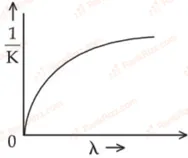
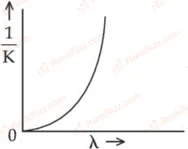
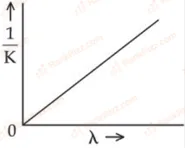
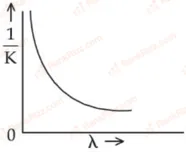
If λ\lambda and KK are de Broglie wavelength and kinetic energy, respectively, of a particle with constant mass. The correct graphical representation for the particle will be

  1. A
    Figure for JEE Main 2025 Physics question on de Broglie wavelength of matter waves
  2. B
    Figure for JEE Main 2025 Physics question on de Broglie wavelength of matter waves
  3. C
    Figure for JEE Main 2025 Physics question on de Broglie wavelength of matter waves
  4. D
    Figure for JEE Main 2025 Physics question on de Broglie wavelength of matter waves
JEE MAIN 2025 · 29 JAN S1Photoelectric effect and Einstein's equationTRANSCRIBED

Given below are two statements : one is labelled as Assertion (A) and the other is labelled as Reason (R). Assertion (A) : Emission of electrons in photoelectric effect can be suppressed by applying a sufficiently negative electron potential to the photoemissive substance. Reason (R) : A negative electric potential, which stops the emission of electrons from the surface of a photoemissive substance, varies linearly with frequency of incident radiation. In the light of the above statements, choose the most appropriate answer from the options given below :

  1. A

    (A) is false but (R) is true

  2. B

    (A) is true but (R) is false

  3. C

    Both (A) and (R) are true and (R) is the correct explanation of (A)

  4. D

    Both (A) and (R) are true but (R) is not the correct explanation of (A)

JEE MAIN 2025 · 23 JAN S1de Broglie wavelength of matter wavesTRANSCRIBED

A sub-atomic particle of mass 10−3010^{-30}kg is moving with a velocity 2.21×1062.21\times10^{6} m/s . Under the matter wave consideration, the particle will behave closely like
(h=6.63×10⁻³⁴J.s)\left(h=6.63\times10^{-34}J.s\right)

  1. A

    Visible radiation

  2. B

    Gamma rays

  3. C

    Infra-red radiation

  4. D

    X-rays

JEE MAIN 2025 · 04 APR S1Photoelectric effect and Einstein's equationTRANSCRIBED

Given below are two statements:
Assertion A: In photoelectric effect, on increasing the intensity of incident light the stopping potential increases.
Reason R: Increase in intensity of light increases the rate of photoelectrons emitted, provided the frequency of incident light is greater than threshold frequency.
Choose the correct answer:

  1. A

    Both A and R are true but R is NOT the correct explanation of A

  2. B

    A is false but R is true

  3. C

    A is true but R is false

  4. D

    Both A and R are true and R is the correct explanation of A

JEE MAIN 2025 · 29 JAN S2Photoelectric effect and Einstein's equationTRANSCRIBED

In an experiment with photoelectric effect, the stopping potential,

  1. A

    increases with increase in the intensity of the incident light

  2. B

    decreases with increase in the intensity of the incident light

  3. C

    increases with increase in the wavelength of the incident light

  4. D

    is 1e\frac{1}{e} times the maximum kinetic energy of the emitted photoelectrons

JEE MAIN 2025 · 22 JAN S1Photoelectric effect and Einstein's equationTRANSCRIBED

The work functions of cesium (Cs) and lithium (Li) metals are 1.9 eV and 2.5 eV , respectively. If we incident a light of wavelength 550 nm on these two metal surfaces, then photo-electric effect is possible for the case of

  1. A

    Both Cs and Li

  2. B

    Neither Cs nor Li

  3. C

    Cs only

  4. D

    Li only

JEE MAIN 2025 · 28 JAN S2Photons: energy, momentum and radiation pressureTRANSCRIBED

Which of the following phenomena can not be explained by wave theory of light?

  1. A

    Compton effect

  2. B

    Refraction of light

  3. C

    Reflection of light

  4. D

    Diffraction of light

JEE MAIN 2025 · 03 APR S1Photoelectric effect and Einstein's equationTRANSCRIBED

The work function of a metal is 3eV3 eV. The color of the visible light that is required to cause emission of photoelectrons is

  1. A

    Green

  2. B

    Blue

  3. C

    Red

  4. D

    Yellow

JEE MAIN 2025 · 22 JAN S2Photoelectric effect and Einstein's equationTRANSCRIBED

light source of wavelength λ\lambda illuminates a metal surface and electrons are ejected with maximum kinetic energy of 2 eV . If the same surface is illuminated by a light source of wavelength λ2\frac{\lambda}{2}, then the maximum kinetic energy of ejected electrons will be (The work function of metal is 1 eV )

  1. A

    3 eV

  2. B

    2 eV

  3. C

    6 eV

  4. D

    5 eV

JEE MAIN 2025 · 23 JAN S2Photoelectric effect and Einstein's equationTRANSCRIBED

In photoelectric effect an em-wave is incident on a metal surface and electrons are ejected from the surface. If the work function of the metal is 2.14 eV and stopping potential is 2 V , what is the wavelength of the emwave ? (Given hc = 1242eVnm where h is the Planck's constant and c is the speed of light in vaccum.)

  1. A

    300 nm

  2. B

    400 nm

  3. C

    600 nm

  4. D

    200 nm

JEE MAIN 2025 · 28 JAN S1de Broglie wavelength of matter wavesTRANSCRIBED

A proton of mass ′mp′'m_{p}'has same energy as that of a photon of wavelength ′λ′'\lambda'. If the proton is moving at non- relativistic speed, then ratio of its deBroglie wavelength to the wavelength of photon is.

  1. A

    1cEmp\frac{1}{c}\sqrt{\frac{E}{m_{p}}}

  2. B

    1c2Emp\frac{1}{c}\sqrt{\frac{2E}{m_{p}}}

  3. C

    12cEmp\frac{1}{2c}\sqrt{\frac{E}{m_{p}}}

  4. D

    1cE2mp\frac{1}{c}\sqrt{\frac{E}{2m_{p}}}

JEE MAIN 2025 · 02 APR S1Photoelectric effect and Einstein's equationTRANSCRIBED

A monochromatic light is incident on a metallic plate having work function ϕ\phi. An electron, emitted normally to the plate from a point A with maximum kinetic energy, enters a constant magnetic field, perpendicular to the initial velocity of electron. The electron passes through a curve and hits back the plate at a point B. The distance between A and B is:

(Given: The magnitude of charge of an electron is e and mass is m, h is Planck's constant and c is velocity of light. Take the magnetic field exists throughout the path of electron)

  1. A

    2m(hcλ−ϕ)eB\frac{\sqrt{2m\left(\frac{hc}{\lambda} - \phi\right)}}{eB}

  2. B

    m(hcλ−ϕ)eB\frac{\sqrt{m\left(\frac{hc}{\lambda} - \phi\right)}}{eB}

  3. C

    8m(hcλ−ϕ)eB\frac{\sqrt{8m\left(\frac{hc}{\lambda} - \phi\right)}}{eB}

  4. D

    2m(hcλ−ϕ)eB\frac{2\sqrt{m\left(\frac{hc}{\lambda} - \phi\right)}}{eB}

JEE MAIN 2025 · 24 JAN S2Photons: energy, momentum and radiation pressureTRANSCRIBED

The ratio of the power of a light source  S1S_1 to that of the light source S2S_2 is  2.S1S_1 is emitting  2×10152\times10^{15} photons per second at  600,nm. If the wavelength of the source  S2S_2  is  300, nm,then the number of photons per second emitted by  S2S_2 is ‾\underline {\hspace{2cm}} ×1014.\times 10^{14}.

JEE MAIN 2025 · 08 APR S2de Broglie wavelength of matter wavesTRANSCRIBED

An electron is released from rest near an infinite non-conducting sheet of uniform charge density '−σ-\sigma'. The rate of change of de-Broglie wave length associated with the electron varies inversely as nthn^{th} power of time. The numerical value of n is _____.

JEE MAIN 2025 · 07 APR S2de Broglie wavelength of matter wavesTRANSCRIBED

A photo-emissive substance is illuminated with a radiation of wavelength λi\lambda_i so that it releases electrons with de-Broglie wavelength λe\lambda_e. The longest wavelength of radiation that can emit photoelectron is λ0\lambda_0. Expression for de-Broglie wavelength is given by : (m : mass of the electron, h : Planck's constant and c : speed of light)

  1. A

    λe=h2hmc(1λi−1λ0)\lambda_e = \frac{h}{\sqrt{2hmc\left(\frac{1}{\lambda_i} - \frac{1}{\lambda_0}\right)}}

  2. B

    λe=hλ02mc\lambda_e = \sqrt{\frac{h\lambda_0}{2mc}}

  3. C

    λe=h2hmc(1λi−1λ0)\lambda_e = \frac{h}{\sqrt{2hmc}\left(\frac{1}{\lambda_i} - \frac{1}{\lambda_0}\right)}

  4. D

    λe=hλi2mc\lambda_e = \sqrt{\frac{h\lambda_i}{2mc}}

JEE MAIN 2024 · 30 JAN S2Photons: energy, momentum and radiation pressureTRANSCRIBED

If the total energy transferred to a surface in time tt is 6.48×1056.48 \times 10^5 J, then the magnitude of the total momentum delivered to this surface for complete absorption will be:

  1. A

    2.46×10−32.46 \times 10^{-3} kg m s−1^{-1}

  2. B

    2.16×10−32.16 \times 10^{-3} kg m s−1^{-1}

  3. C

    1.58×10−31.58 \times 10^{-3} kg m s−1^{-1}

  4. D

    4.32×10−34.32 \times 10^{-3} kg m s−1^{-1}