RankRizz

Photoelectric effect and Einstein's equation — JEE Main Previous Year Questions

Every JEE Main question on Photoelectric effect and Einstein's equation, one of the ideas inside Dual Nature of Radiation & Matter: 98 questions from 2004–2026, 52 of them in the last five years. Newest first, answer key on every one. Free to read.

Questions

98

Years asked

19

Since

2004

Of the chapter

45%

When JEE Main asked it

Questions on Photoelectric effect and Einstein's equation in each year it was asked, the latest 12 of 19.

20268
20259
202412
202312
202211
202112
20207
20198
20171
20163
20141
20133

Every Photoelectric effect and Einstein's equation question

1–20 OF 98 · NEWEST FIRST

JEE MAIN 2026Photoelectric effect and Einstein's equationTRANSCRIBED

In the photoelectric experiment, if we use a monochromatic light, the I-VI\text{-}V curve is as shown. If the work function of the metal is 2 eV2\ \mathrm{eV}, estimate the power of light used.

(Assume efficiency of photo emission = 10−3%10^{-3}\%, i.e. the number of photoelectrons emitted are 10−3%10^{-3}\% of the number of photons incident on the metal.)
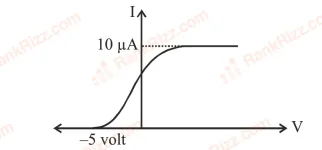
Physics
  1. A

    2 W2\ \mathrm{W}

  2. B

    7 W7\ \mathrm{W}

  3. C

    10 W10\ \mathrm{W}

  4. D

    5 W5\ \mathrm{W}

JEE MAIN 2026 · 24 JAN S2Photoelectric effect and Einstein's equationTRANSCRIBED

When a light of a given wavelength falls on a metallic surface the stopping potential for photoelectrons is 3.2 V. If a second light having wavelength twice of first light is used, the stopping potential drops to 0. 7 V. The wavelength of first light is ___ m.
(h=6.63×10⁻³⁴J.s,e=1.6×10⁻¹⁹C,c=3×10⁸m/s)(h= 6.63\times10^{-34}J.s,e=1.6\times10^{-19}C,c=3\times10^{8}m/s)

  1. A

    2.2×10−82.2\times10^{-8}

  2. B

    2.5×10−72.5\times10^{-7}

  3. C

    2.9×10−82.9\times10^{-8}

  4. D

    3.1×10−73.1\times10^{-7}

JEE MAIN 2026 · 22 JAN S2Photoelectric effect and Einstein's equationTRANSCRIBED

Light is incident on a metallic plate having work function 110×10−20J110 \times 10^{-20}J. If the produced photoelectrons have zero kinetic energy then the angular frequency of the incident light is ___ rad/s. (h = 6.63×10⁻³⁴J.s.6.63 \times 10^{-34}J.s.).

  1. A

    1.04×10161.04 \times 10^{16}

  2. B

    1.66×10151.66 \times 10^{15}

  3. C

    1.66×10161.66 \times 10^{16}

  4. D

    1.04×10131.04 \times 10^{13}

JEE MAIN 2026 · 04 APR S1Photoelectric effect and Einstein's equationTRANSCRIBED

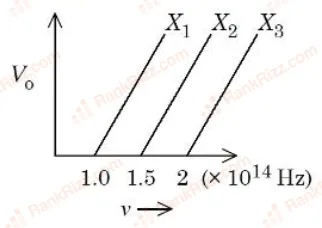
The graph shows variation of stopping potential V0V_0 with the frequency ν\nu of the incident radiation for three photosensitive metals X1X_1, X2X_2 and X3X_3. Which metal will give out electrons with greater kinetic energy, for the same wavelength of incident radiation?

Figure for JEE Main 2026 Physics question on Photoelectric effect and Einstein's equation
  1. A

    X1X_1

  2. B

    X2X_2

  3. C

    X3X_3

  4. D

    All same

JEE MAIN 2026 · 21 JAN S1Photoelectric effect and Einstein's equationTRANSCRIBED

A light wave described by E=60[sin⁡(3×10¹⁵)t+sin⁡(12×1015)t]E=60[\sin(3\times10^{15})t+\sin(12\times10^{15})t] (in SI units) falls on a metal surface of work function 2.8 eV. The maximum kinetic energy of ejected photoelectron is (approximately) ___ eV. (h=6.6×10⁻³⁴J.s and e=1.6×10¹⁹C)(h=6.6\times10^{-34}J.s\text{ and }e=1.6\times10^{19}C)

  1. A

    7.8

  2. B

    6.0

  3. C

    3.8

  4. D

    5.1

JEE MAIN 2026 · 05 APR S1Photoelectric effect and Einstein's equationTRANSCRIBED

Light source having wavelength 331 nm is used to generate photo-electrons whose stopping potential is 0.2 V. The work function of the used metal in the experiment is α×10−19\alpha \times 10^{-19} J. The value of α\alpha is _______. (h = 6.62×10−346.62 \times 10^{-34} J s, e = 1.6×10−191.6 \times 10^{-19} C and c = 3×1083 \times 10^8 m/s)

  1. A

    3.683.68

  2. B

    4.684.68

  3. C

    5.685.68

  4. D

    2.682.68

JEE MAIN 2026 · 02 APR S1Photoelectric effect and Einstein's equationTRANSCRIBED

For a certain metal, when monochromatic light of wavelength λ\lambda is incident, the stopping potential for photoelectrons is 3V03V_0. When the same metal is illuminated by light of wavelength 2λ2\lambda, then the stopping potential becomes V0V_0. The threshold wavelength for photoelectric emission for the given metal is αλ\alpha \lambda. The value of α\alpha is __________.

  1. A

    11

  2. B

    44

  3. C

    22

  4. D

    33

JEE MAIN 2026 · 08 APR S2Photoelectric effect and Einstein's equationTRANSCRIBED

K1K_1 and K2K_2 be the maximum kinetic energies of photoelectrons emitted from a surface of a given material for the light of wavelength λ1\lambda_1 and λ2\lambda_2, respectively. If λ1=2λ2\lambda_1 = 2\lambda_2 then the work function of material is given by :

  1. A

    K2+2K1K_2 + 2K_1

  2. B

    2K2−K12K_2 - K_1

  3. C

    K1−2K2K_1 - 2K_2

  4. D

    K2−2K1K_2 - 2K_1

JEE MAIN 2025 · 24 JAN S2Photoelectric effect and Einstein's equationTRANSCRIBED

In photoelectric effect, the stopping potential (V0)(V_0) v/sv/s frequency  (ν)(\nu) curve is plotted. ( hh is Planck's constant and  ϕ0\phi_0  is work function of the metal) (A) V0(A)  V_0  v/s νv/s  \nu  is linear. (B)(B) } The slope of } V0V_0  v/s νv/s  \nu  curve =ϕ0h (C) h constant is related to the slope of the\text{ curve } = \frac{\phi_0}{h}\text{ (C) } h \text{ constant is related to the slope of the}  V0V_0  v/s  ν\nu line.(D) The value of electric charge of electron is not required to determine  hh using the  V0V_0 v/s  ν\nu  curve. (E)(E) The work function can be estimated without knowing the value of  h.Choose the correct answer from the options given below:

  1. A

    (C) and (D) only

  2. B

    (A), (C) and (E) only

  3. C

    (A), (B) and (C) only

  4. D

    (D) and (E) only

JEE MAIN 2025 · 29 JAN S1Photoelectric effect and Einstein's equationTRANSCRIBED

Given below are two statements : one is labelled as Assertion (A) and the other is labelled as Reason (R). Assertion (A) : Emission of electrons in photoelectric effect can be suppressed by applying a sufficiently negative electron potential to the photoemissive substance. Reason (R) : A negative electric potential, which stops the emission of electrons from the surface of a photoemissive substance, varies linearly with frequency of incident radiation. In the light of the above statements, choose the most appropriate answer from the options given below :

  1. A

    (A) is false but (R) is true

  2. B

    (A) is true but (R) is false

  3. C

    Both (A) and (R) are true and (R) is the correct explanation of (A)

  4. D

    Both (A) and (R) are true but (R) is not the correct explanation of (A)

JEE MAIN 2025 · 04 APR S1Photoelectric effect and Einstein's equationTRANSCRIBED

Given below are two statements:
Assertion A: In photoelectric effect, on increasing the intensity of incident light the stopping potential increases.
Reason R: Increase in intensity of light increases the rate of photoelectrons emitted, provided the frequency of incident light is greater than threshold frequency.
Choose the correct answer:

  1. A

    Both A and R are true but R is NOT the correct explanation of A

  2. B

    A is false but R is true

  3. C

    A is true but R is false

  4. D

    Both A and R are true and R is the correct explanation of A

JEE MAIN 2025 · 29 JAN S2Photoelectric effect and Einstein's equationTRANSCRIBED

In an experiment with photoelectric effect, the stopping potential,

  1. A

    increases with increase in the intensity of the incident light

  2. B

    decreases with increase in the intensity of the incident light

  3. C

    increases with increase in the wavelength of the incident light

  4. D

    is 1e\frac{1}{e} times the maximum kinetic energy of the emitted photoelectrons

JEE MAIN 2025 · 22 JAN S1Photoelectric effect and Einstein's equationTRANSCRIBED

The work functions of cesium (Cs) and lithium (Li) metals are 1.9 eV and 2.5 eV , respectively. If we incident a light of wavelength 550 nm on these two metal surfaces, then photo-electric effect is possible for the case of

  1. A

    Both Cs and Li

  2. B

    Neither Cs nor Li

  3. C

    Cs only

  4. D

    Li only

JEE MAIN 2025 · 03 APR S1Photoelectric effect and Einstein's equationTRANSCRIBED

The work function of a metal is 3eV3 eV. The color of the visible light that is required to cause emission of photoelectrons is

  1. A

    Green

  2. B

    Blue

  3. C

    Red

  4. D

    Yellow

JEE MAIN 2025 · 22 JAN S2Photoelectric effect and Einstein's equationTRANSCRIBED

light source of wavelength λ\lambda illuminates a metal surface and electrons are ejected with maximum kinetic energy of 2 eV . If the same surface is illuminated by a light source of wavelength λ2\frac{\lambda}{2}, then the maximum kinetic energy of ejected electrons will be (The work function of metal is 1 eV )

  1. A

    3 eV

  2. B

    2 eV

  3. C

    6 eV

  4. D

    5 eV

JEE MAIN 2025 · 23 JAN S2Photoelectric effect and Einstein's equationTRANSCRIBED

In photoelectric effect an em-wave is incident on a metal surface and electrons are ejected from the surface. If the work function of the metal is 2.14 eV and stopping potential is 2 V , what is the wavelength of the emwave ? (Given hc = 1242eVnm where h is the Planck's constant and c is the speed of light in vaccum.)

  1. A

    300 nm

  2. B

    400 nm

  3. C

    600 nm

  4. D

    200 nm

JEE MAIN 2025 · 02 APR S1Photoelectric effect and Einstein's equationTRANSCRIBED

A monochromatic light is incident on a metallic plate having work function ϕ\phi. An electron, emitted normally to the plate from a point A with maximum kinetic energy, enters a constant magnetic field, perpendicular to the initial velocity of electron. The electron passes through a curve and hits back the plate at a point B. The distance between A and B is:

(Given: The magnitude of charge of an electron is e and mass is m, h is Planck's constant and c is velocity of light. Take the magnetic field exists throughout the path of electron)

  1. A

    2m(hcλ−ϕ)eB\frac{\sqrt{2m\left(\frac{hc}{\lambda} - \phi\right)}}{eB}

  2. B

    m(hcλ−ϕ)eB\frac{\sqrt{m\left(\frac{hc}{\lambda} - \phi\right)}}{eB}

  3. C

    8m(hcλ−ϕ)eB\frac{\sqrt{8m\left(\frac{hc}{\lambda} - \phi\right)}}{eB}

  4. D

    2m(hcλ−ϕ)eB\frac{2\sqrt{m\left(\frac{hc}{\lambda} - \phi\right)}}{eB}

JEE MAIN 2024 · 09 APR S2Photoelectric effect and Einstein's equationTRANSCRIBED

UV light of 4.13 eV4.13 \text{ eV} is incident on a photosensitive metal surface having work function 3.13 eV3.13 \text{ eV}. The maximum kinetic energy of ejected photoelectrons will be:

  1. A

    4.13 eV4.13 \text{ eV}

  2. B

    3.13 eV3.13 \text{ eV}

  3. C

    1 eV1 \text{ eV}

  4. D

    7.26 eV7.26 \text{ eV}

JEE MAIN 2024 · 30 JAN S2Photoelectric effect and Einstein's equationTRANSCRIBED

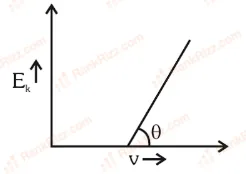
For the photoelectric effect, the maximum kinetic energy EkE_k of the photoelectrons is plotted against the frequency (ν)(\nu) of the incident photons as shown in figure. The slope of the graph give

Figure for JEE Main 2024 Physics question on Photoelectric effect and Einstein's equation
  1. A

    Ratio of Planck's constant to electric charge

  2. B

    Work function of the metal

  3. C

    Charge of electron

  4. D

    Planck's constant

JEE MAIN 2024 · 06 APR S1Photoelectric effect and Einstein's equationTRANSCRIBED

In photoelectric experiment energy of 2.48 eV2.48 \text{ eV} irradiates a photo sensitive material. The stopping potential was measured to be 0.5 V0.5 \text{ V}. Work function of the photo sensitive material is :

  1. A

    1.68 eV1.68 \text{ eV}

  2. B

    2.48 eV2.48 \text{ eV}

  3. C

    1.98 eV1.98 \text{ eV}

  4. D

    0.5 eV0.5 \text{ eV}