RankRizz

Dual Nature of Radiation & Matter — JEE Main Previous Year Questions

Every Dual Nature of Radiation & Matter question JEE Main has set from 2004–2026, grouped by the idea it tests rather than the order of the syllabus. 216 questions across 4 distinct ideas. Free to read, answer key on every one.

Questions

216

Distinct ideas

4

Share of marks

3.4%

Difficulty

MEDIUM

The ideas inside Dual Nature of Radiation & Matter

A chapter is not one subject — it is a handful of procedures the examiner reuses. These are the ones Dual Nature of Radiation & Matter questions actually test.

Every Dual Nature of Radiation & Matter question

201–216 OF 216 · NEWEST FIRST

JEE MAIN 2012Photoelectric effect and Einstein's equationTRANSCRIBED

This question has Statement 1 and Statement 2. Of the four choices given after the Statements, choose the one that best describes the two Statements. Statement 1: A metallic surface is irradiated by a monochromatic light of frequency v>v0v > v_0 (the threshold frequency). If the incident frequency is now doubled, the photocurrent and the maximum kinetic energy are also doubled. Statement 2: The maximum kinetic energy of photoelectrons emitted from a surface is linearly dependent on the frequency of the incident light. The photocurrent depends only on the intensity of the incident light.

  1. A

    Statement 1 is true, Statement 2 is true, Statement 2 is the correct explanation of Statement 1.

  2. B

    Statement 1 is false, Statement 2 is true.

  3. C

    Statement 1 is true, Statement 2 is false.

  4. D

    Statement 1 is true, Statement 2 is true, Statement 2 is not the correct explanation of Statement 1.
JEE MAIN 2012Photons: energy, momentum and radiation pressureTRANSCRIBED

A 1010 kW transmitter emits radio waves of wavelength 500500 m. The number of photons emitted per second by the transmitter is of the order of

  1. A

    103710^{37}

  2. B

    103110^{31}

  3. C

    102510^{25}

  4. D

    104310^{43}

JEE MAIN 2011Photoelectric effect and Einstein's equationTRANSCRIBED

This question has Statement-1 and Statement-2. Of the four choices given after the statements, choose the one that best describes the two statements. Statement-1: A metallic surface is irradiated by a monochromatic light of frequency ν>ν0\nu > \nu_0 (the threshold frequency). The maximum kinetic energy and the stopping potential are Kmax⁡K_{\max} and V0V_0 respectively. If the frequency incident on the surface doubled, both the Kmax⁡K_{\max} and V0V_0 are also doubled. Statement-2: The maximum kinetic energy and the stopping potential of photoelectrons emitted from a surface are linearly dependent on the frequency of incident light.

  1. A

    Statement-1 is true, Statement-2 is true; Statement-2 is the correct explanation of Statement-1.

  2. B

    Statement-1 is true, Statement-2 is true; Statement-2 is not the correct explanation of Statement-1.

  3. C

    Statement-1 is false, Statement-2 is true.

  4. D

    Statement-1 is true, Statement-2 is false.

JEE MAIN 2010Photoelectric effect and Einstein's equationTRANSCRIBED

Statement-1 : When ultraviolet light is incident on a photocell, its stopping potential is V0V_0 and the maximum kinetic energy of the photoelectrons is Kmax⁡K_{\max}. When the ultraviolet light is replaced by X-rays, both V0V_0 and Kmax⁡K_{\max} increase. Statement-2 : Photoelectrons are emitted with speeds ranging from zero to a maximum value because of the range of frequencies present in the incident light. Of the four choices given after the statements, choose the one that best describes the two statements.

  1. A

    Statement-1 is true, Statement-2 is true; Statement-2 is the correct explanation of Statement-1.

  2. B

    Statement-1 is true, Statement-2 is true; Statement-2 is not the correct explanation of Statement-1.

  3. C

    Statement-1 is false, Statement-2 is true.

  4. D

    Statement-1 is true, Statement-2 is false.

JEE MAIN 2009Photoelectric effect and Einstein's equationTRANSCRIBED

The surface of a metal is illuminated with the light of 400400 nm. The kinetic energy of the ejected photoelectrons was found to be 1.681.68 eV. The work function of the metal is (hc =1240= 1240 eVnm)

  1. A

    3.093.09 eV

  2. B

    1.411.41 eV

  3. C

    1.511.51 eV

  4. D

    1.681.68 eV

JEE MAIN 2008Davisson-Germer experimentTRANSCRIBED

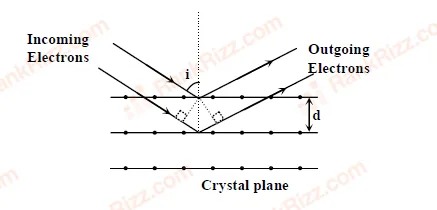
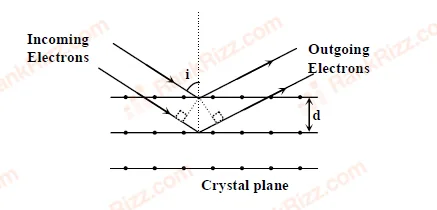
Paragraph: Wave property of electrons implies that they will show diffraction effects. Davisson and Germer demonstrated this by diffracting electrons from crystals. The law governing the diffraction from a crystal is obtained by requiring that electron waves reflected from the planes of atoms in a crystal interfere constructively (see in figure).Figure for JEE Main 2008 Physics question on Davisson-Germer experiment
Question: Electrons accelerated by potential VV are diffracted from a crystal. If d=1 A˚d = 1\ \AA and i=30∘i = 30^\circ, VV should be about (h=6.6×10⁻³⁴ Js, me=9.1×10⁻³¹ kg, e=1.6×10⁻¹⁹ C)(h = 6.6 \times 10^{-34}\ Js,\ m_e = 9.1 \times 10^{-31}\ kg,\ e = 1.6 \times 10^{-19}\ C)

  1. A

    2000 V

  2. B

    50 V

  3. C

    500 V

  4. D

    1000 V

JEE MAIN 2008Davisson-Germer experimentTRANSCRIBED

Paragraph: Wave property of electrons implies that they will show diffraction effects. Davisson and Germer demonstrated this by diffracting electrons from crystals. The law governing the diffraction from a crystal is obtained by requiring that electron waves reflected from the planes of atoms in a crystal interfere constructively (see in figure).Figure for JEE Main 2008 Physics question on Davisson-Germer experiment
Question: If a strong diffraction peak is observed when electrons are incident at an angle 'ii' from the normal to the crystal planes with distance 'dd' between them (see figure), de Broglie wavelength λdB\lambda_{dB} of electrons can be calculated by the relationship (nn is an integer)

  1. A

    dsin⁡i=nλdBd \sin i = n \lambda_{dB}

  2. B

    2dcos⁡i=nλdB2 d \cos i = n \lambda_{dB}

  3. C

    2dsin⁡i=nλdB2 d \sin i = n \lambda_{dB}

  4. D

    dcos⁡i=nλdBd \cos i = n \lambda_{dB}

JEE MAIN 2007Photons: energy, momentum and radiation pressureTRANSCRIBED

Photon of frequency vv has a momentum associated with it. If cc is the velocity of light, the momentum is

  1. A

    v/cv/c

  2. B

    hvchvc

  3. C

    hv/c2hv/c^2

  4. D

    hv/chv/c

JEE MAIN 2006Photoelectric effect and Einstein's equationTRANSCRIBED

The time by a photoelectron to come out after the photon strikes is approximately

  1. A

    10−1 s10^{-1}\,s

  2. B

    10−4 s10^{-4}\,s

  3. C

    10−10 s10^{-10}\,s

  4. D

    10−16 s10^{-16}\,s

JEE MAIN 2006Photoelectric effect and Einstein's equationTRANSCRIBED

The threshold frequency for a metallic surface corresponds to an energy of 6.2 eV6.2\,eV, and the stopping potential for a radiation incident on this surface 5 V5\,V. The incident radiation lies in

  1. A

    X-ray region

  2. B

    ultra-violet region

  3. C

    infra-red region

  4. D

    visible region

JEE MAIN 2006Photoelectric effect and Einstein's equationTRANSCRIBED

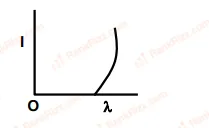
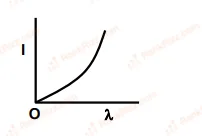
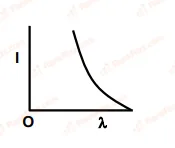
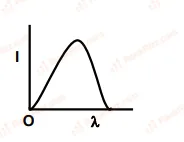
The anode voltage of a photocell is kept fixed. The wavelength λ\lambda of the light falling on the cathode is gradually changed. The plate current II of the photocell varies as follows :

  1. A
    Figure for JEE Main 2006 Physics question on Photoelectric effect and Einstein's equation
  2. B
    Figure for JEE Main 2006 Physics question on Photoelectric effect and Einstein's equation
  3. C
    Figure for JEE Main 2006 Physics question on Photoelectric effect and Einstein's equation
  4. D
    Figure for JEE Main 2006 Physics question on Photoelectric effect and Einstein's equation
JEE MAIN 2005Photoelectric effect and Einstein's equationTRANSCRIBED

A photocell is illuminated by a small bright source placed 11 m away. When the same source of light is placed 12\frac{1}{2} m away, the number of electrons emitted by photo cathode would

  1. A

    decrease by a factor of 4

  2. B

    increase by a factor of 4

  3. C

    decrease by a factor of 2

  4. D

    increase by a factor of 2

JEE MAIN 2005de Broglie wavelength of matter wavesTRANSCRIBED

If the kinetic energy of a free electron doubles, its deBroglie wavelength changes by the factor

  1. A

    12\frac{1}{2}

  2. B

    22

  3. C

    12\frac{1}{\sqrt{2}}

  4. D

    2\sqrt{2}

JEE MAIN 2004Photons: energy, momentum and radiation pressureTRANSCRIBED

A radiation of energy EE falls normally on a perfectly reflecting surface. The momentum transferred to the surface is

  1. A

    E/cE/c

  2. B

    2E/c2E/c

  3. C

    EcEc

  4. D

    E/c2E/c^2

JEE MAIN 2004Photoelectric effect and Einstein's equationTRANSCRIBED

According to Einstein's photoelectric equation, the plot of the kinetic energy of the emitted photo electrons from a metal VsV_s the frequency, of the incident radiation gives straight line whose slope

  1. A

    depends on the nature of the metal used

  2. B

    depends on the intensity of the radiation

  3. C

    depends both on the intensity of the radiation and the metal used

  4. D

    is the same for all metals and independent of the intensity of the radiation.

JEE MAIN 2004Photoelectric effect and Einstein's equationTRANSCRIBED

The work function of a substance is 4.04.0 eV. Then longest wavelength of light that can cause photoelectron emission from this substance approximately

  1. A

    540540 nm

  2. B

    400400 nm

  3. C

    310310 nm

  4. D

    220220 nm