RankRizz

Centre of Mass, Momentum & Collisions — JEE Main Previous Year Questions

Every Centre of Mass, Momentum & Collisions question JEE Main has set from 2004–2026, grouped by the idea it tests rather than the order of the syllabus. 135 questions across 8 distinct ideas. Free to read, answer key on every one.

Questions

135

Distinct ideas

8

Share of marks

1.4%

Difficulty

MEDIUM

The ideas inside Centre of Mass, Momentum & Collisions

A chapter is not one subject — it is a handful of procedures the examiner reuses. These are the ones Centre of Mass, Momentum & Collisions questions actually test.

Every Centre of Mass, Momentum & Collisions question

121–135 OF 135 · NEWEST FIRST

JEE MAIN 2012Motion of centre of mass, momentum conservation and explosionsTRANSCRIBED

A projectile moving vertically upwards with a velocity of 200200 ms−1^{-1} breaks into two equal parts at a height of 490490 m. One part starts moving vertically upwards with a velocity of 400400 ms−1^{-1}. How much time it will take, after the break up with the other part to hit the ground?

  1. A

    2102\sqrt{10} s

  2. B

    55 s

  3. C

    1010 s

  4. D

    10\sqrt{10} s

JEE MAIN 2012Two-body systems connected by springsTRANSCRIBED

Two bodies AA and BB of mass mm and 2m2m respectively are placed on a smooth floor. They are connected by a spring of negligible mass. A third body CC of mass mm is placed on the floor. The body CC moves with a velocity v0v_0 along the line joining AA and BB and collides elastically with AA. At a certain time after the collision it is found that the instantaneous velocities of AA and BB are same and the compression of the spring is x0x_0. The spring constant kk will be

  1. A

    mv02x02m\dfrac{v_0^2}{x_0^2}

  2. B

    mv02x0m\dfrac{v_0}{2x_0}

  3. C

    2mv0x02m\dfrac{v_0}{x_0}

  4. D

    23m(v0x0)2\dfrac{2}{3}m\left(\dfrac{v_0}{x_0}\right)^2

JEE MAIN 2012Motion of centre of mass, momentum conservation and explosionsTRANSCRIBED

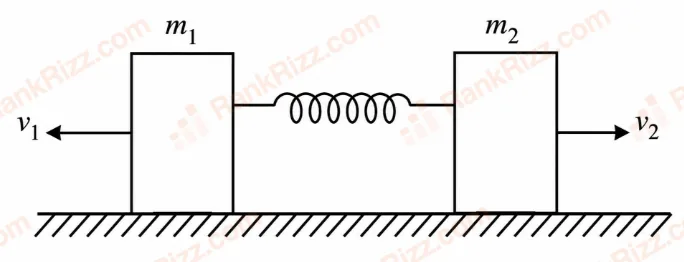
A spring is compressed between two blocks of masses m1m_1 and m2m_2 placed on a horizontal frictionless surface as shown in the figure. When the blocks are released, they have initial velocity of v1v_1 and v2v_2 as shown. The blocks travel distances x1x_1 and x2x_2 respectively before coming to rest. The ratio (x1x2)\left(\dfrac{x_1}{x_2}\right) is

Figure for JEE Main 2012 Physics question on Motion of centre of mass, momentum conservation and explosions
  1. A

    m2m1\dfrac{m_2}{m_1}

  2. B

    m1m2\dfrac{m_1}{m_2}

  3. C

    m2m1\sqrt{\dfrac{m_2}{m_1}}

  4. D

    m1m2\sqrt{\dfrac{m_1}{m_2}}

JEE MAIN 2010Head-on collisions and coefficient of restitutionTRANSCRIBED

Out of the four choices given after the statements, choose the one that best describes the two statements.

Statement-1 : Two particles moving in the same direction do not lose all their energy in a completely inelastic collision.

Statement-2 : Principle of conservation of momentum holds true for all kinds of collisions.

  1. A

    Statement-1 is true, Statement-2 is true; Statement-2 is the correct explanation of Statement-1.

  2. B

    Statement-1 is true, Statement-2 is true; Statement-2 is not the correct explanation of Statement-1.

  3. C

    Statement-1 is false, Statement-2 is true.

  4. D

    Statement-1 is true, Statement-2 is false.

JEE MAIN 2010Impulse and impulse-momentum theoremTRANSCRIBED

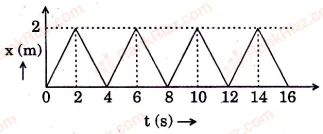
The figure shows the position - time (x−t)(x - t) graph of one-dimensional motion of a body of mass 0.40.4 kg. The magnitude of each impulse is
Figure for JEE Main 2010 Physics question on Impulse and impulse-momentum theorem

  1. A

    0.40.4 Ns

  2. B

    0.80.8 Ns

  3. C

    1.61.6 Ns

  4. D

    0.20.2 Ns

JEE MAIN 2008Centre of mass of continuous bodies and cavitiesTRANSCRIBED

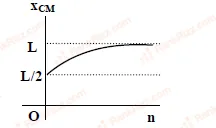
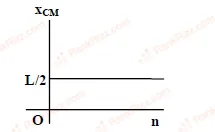
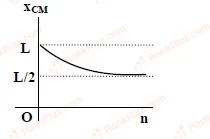
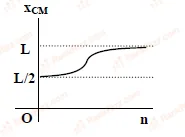
A thin rod of length 'LL' is lying along the xx-axis with its ends at x=0x = 0 and x=Lx = L. Its linear density (mass/length) varies with xx as k(xL)nk\left(\frac{x}{L}\right)^n, where nn can be zero or any positive number. If the position xCMx_{CM} of the centre of mass of the rod is plotted against 'nn', which of the following graphs best approximates the dependence of xCMx_{CM} on nn?

  1. A
    Figure for JEE Main 2008 Physics question on Centre of mass of continuous bodies and cavities
  2. B
    Figure for JEE Main 2008 Physics question on Centre of mass of continuous bodies and cavities
  3. C
    Figure for JEE Main 2008 Physics question on Centre of mass of continuous bodies and cavities
  4. D
    Figure for JEE Main 2008 Physics question on Centre of mass of continuous bodies and cavities
JEE MAIN 2008Head-on collisions and coefficient of restitutionTRANSCRIBED

A block of mass 0.50 kg is moving with a speed of 2.00 m/s on a smooth surface. It strikes another mass of 1.00 kg and then they move together as a single body. The energy loss during the collision is

  1. A

    0.16 J

  2. B

    1.00 J

  3. C

    0.67 J

  4. D

    0.34 J

JEE MAIN 2007Centre of mass of continuous bodies and cavitiesTRANSCRIBED

A circular disc of radius RR is removed from a bigger circular disc of radius 2R2R such that the circumferences of the discs coincide. The centre of mass of the new disc is α/R\alpha/R from the centre of the bigger disc. The value of α\alpha is

  1. A

    1/31/3

  2. B

    1/21/2

  3. C

    1/61/6

  4. D

    1/41/4

JEE MAIN 2006Impulse and impulse-momentum theoremTRANSCRIBED

A player caught a cricket ball of mass 150 g150\,g moving at a rate of 20 m/s20\,m/s. If the catching process is completed in 0.1 s0.1\,s, the force of the blow exerted by the ball on the hand of the player is equal to

  1. A

    300 N

  2. B

    150 N

  3. C

    3 N

  4. D

    30 N

JEE MAIN 2006Motion of centre of mass, momentum conservation and explosionsTRANSCRIBED

A bomb of mass 16 kg16\,kg at rest explodes into two pieces of masses of 4 kg4\,kg and 12 kg12\,kg. The velocity of the 12 kg12\,kg mass is 4 ms−14\,ms^{-1}. The kinetic energy of the other mass is

  1. A

    96 J

  2. B

    144 J

  3. C

    288 J

  4. D

    192 J

JEE MAIN 2006Centre of mass of a system of particlesTRANSCRIBED

Consider a two particle system with particles having masses m1m_1 and m2m_2. If the first particle is pushed towards the centre of mass through a distance dd, by what distance should the second particle be moved, so as to keep the centre of mass at the same position?

  1. A

    dd

  2. B

    m2m1d\dfrac{m_2}{m_1}d

  3. C

    m1m1+m2d\dfrac{m_1}{m_1+m_2}d

  4. D

    m1m2d\dfrac{m_1}{m_2}d

JEE MAIN 2005Motion of centre of mass, momentum conservation and explosionsTRANSCRIBED

A body AA of mass MM while falling vertically downwards under gravity breaks into two parts; a body BB of mass 1/3M1/3 M and a body CC of mass 2/3M2/3 M. The centre of mass of bodies BB and CC taken together shifts compared to that of body AA towards

  1. A

    depends on height of breaking

  2. B

    does not shift

  3. C

    body CC

  4. D

    body BB

JEE MAIN 2005Oblique collisions in two dimensionsTRANSCRIBED

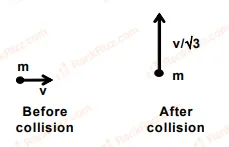
A mass 'mm' moves with a velocity vv and collides inelastically with another identical mass. After collision the 1st1^{st} mass moves with velocity v/3v/\sqrt{3} in a direction perpendicular to the initial direction of motion. Find the speed of the 2nd2^{nd} mass after collision Figure for JEE Main 2005 Physics question on Oblique collisions in two dimensions

  1. A

    vv

  2. B

    3v\sqrt{3}v

  3. C

    2v/32v/\sqrt{3}

  4. D

    v/3v/\sqrt{3}

JEE MAIN 2005Centre of mass of continuous bodies and cavitiesTRANSCRIBED

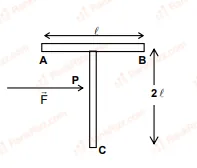
A 'T' shaped object with dimensions shown in the figure, is lying on a smooth floor. A force FF is applied at the point PP parallel to ABAB, such that the object has only the translational motion without rotation. Find the location of PP with respect to CC Figure for JEE Main 2005 Physics question on Centre of mass of continuous bodies and cavities

  1. A

    23ℓ\frac{2}{3}\ell

  2. B

    32ℓ\frac{3}{2}\ell

  3. C

    43ℓ\frac{4}{3}\ell

  4. D

    ℓ\ell

JEE MAIN 2004Impulse and impulse-momentum theoremTRANSCRIBED

A machine gun fires a bullet of mass 4040 g with a velocity 1200 ms−11200 \text{ ms}^{-1}. The man holding it can exert a maximum force of 144144 N on the gun. How many bullets can he fire per second at the most?

  1. A

    one

  2. B

    four

  3. C

    two

  4. D

    three