JEE MAIN 2020 · 06 SEP S2Centre of mass of continuous bodies and cavitiesTRANSCRIBED
The centre of mass of a solid hemisphere of radius is from the centre of the flat surface. Then value of is___
Every Centre of Mass, Momentum & Collisions question JEE Main has set from 2004–2026, grouped by the idea it tests rather than the order of the syllabus. 135 questions across 8 distinct ideas. Free to read, answer key on every one.
Questions
135
Distinct ideas
8
Share of marks
1.4%
Difficulty
MEDIUM
A chapter is not one subject — it is a handful of procedures the examiner reuses. These are the ones Centre of Mass, Momentum & Collisions questions actually test.
81–100 OF 135 · NEWEST FIRST
The centre of mass of a solid hemisphere of radius is from the centre of the flat surface. Then value of is___
Two bodies of the same mass are moving with the same speed, but in different directions in a plane. They have a completely inelastic collision and move together thereafter with a final speed which is half of their initial velocities of the two bodies (in degree) is ___
A body A of mass kg has an initial velocity of m s. It collides elastically with another body B of the same mass which has an initial velocity of m s. After the collision, A moves with a velocity m s. The energy of B after the collision is written as J. The value of is
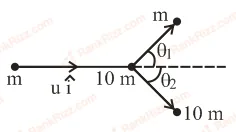
A particle of mass m is moving along the x-axis with initial velocity . It collides elastically with a particle of mass 10m at rest and then moves with half its initial kinetic energy (see figure). If , then value of n is ___________.
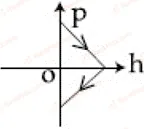
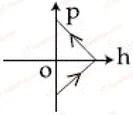
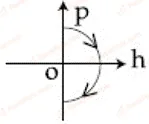
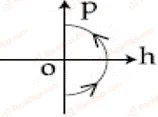
A ball is thrown vertically up (taken as +z-axis) from the ground. The correct momentum-height (p-h) diagram is:
Two particles, of masses and , moving, as shown, with speeds of and , collide elastically at the origin. After the collision, they move along the indicated directions with speeds and , respectively. The values of and are nearly :
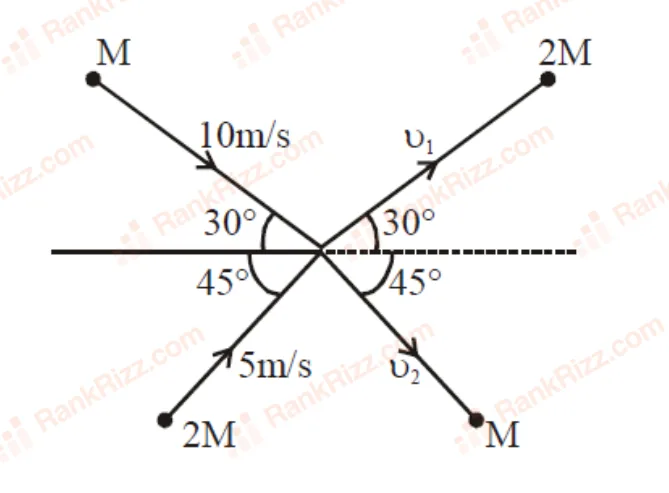
6.5 m s and 6.3 m s
3.2 m s and 12.6 m s
13.02 m s and 19.7 m s
3.2 m s and 6.3 m s
A particle of mass m is moving in a straight line with momentum p. Starting at time , a force acts in the same direction on the moving particle during time interval T so that its momentum changes from p to 3p. Here k is a constant. The value of T is
A simple pendulum, made of a string of length and a bob of mass , is released from a small angle . It strikes a block of mass , kept on horizontal surface at its lowest point of oscillations, elastically. It bounces back and goes up to an angle . Then M is given by:
A body of mass 1 kg falls freely from a height of 100 m, on a platform of mass 3 kg which is mounted on a spring having spring constant N/m. The body sticks to the platform and the spring's maximum compression is found to be . Given that , the value of will be close to:
40 cm
4 cm
80 cm
8 cm
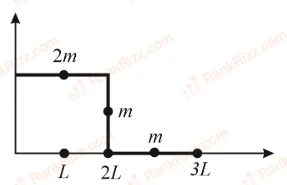
The position vector of the center of mass of an asymmetric uniform bar of negligible area of cross-section as shown in figure is:
A man (mass = 50 kg) and his son (mass = 20 kg) are standing on a frictionless surface facing each other. The man pushes his son so that he starts moving at a speed of 0.70 m s with respect to the man. The speed of the man with respect to the surface is:
0.20 m s
0.14 m s
0.47 m s
0.28 m s
A wedge of mass lies on a frictionless plane. A particle of mass approaches the wedge with speed . There is no friction between the particle and the plane or between the particle and the wedge. The maximum height climbed by the particle on the wedge is given by:
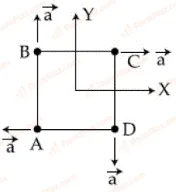
Four particles A, B, C and D with masses , , and are at the corners of a square. They have accelerations of equal magnitude with directions as shown. The acceleration of the centre of mass of the particles is:
Zero
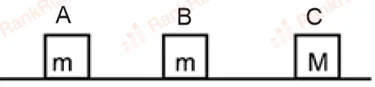
Three blocks A, B and C are lying on a smooth horizontal surface, as shown in the figure. A and B have equal masses, while C has mass . Block A is given an initial speed towards B due to which it collides with B perfectly inelastically. The combined mass collides with C, also perfectly inelastically. th of the initial kinetic energy is lost in the whole process. What is the value of ?
3
4
5
2
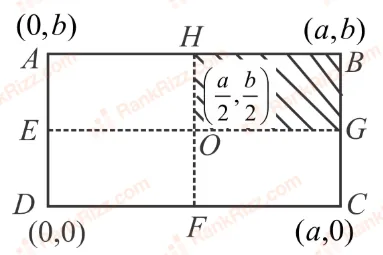
A uniform rectangular thin sheet of mass has length and breadth , as shown in the figure. If the shaded portion is cut-off, the coordinates of the centre of mass of the remaining portion will be:
A piece of wood of mass 0.03 kg is dropped from the top of a 100 m height building. At the same time, a bullet of mass 0.02 kg is fired vertically upward, with a velocity 100 ms, from the ground. The bullet gets embedded in the wood. Then the maximum height to which the combined system reaches above the top of the building before falling below is: ( ms)
40 m
20 m
10 m
30 m
A body of mass 2 kg makes an elastic collision with a second body at rest and continues to move in the original direction but with one fourth of its original speed. What is the mass of the second body?
1.8 kg
1.2 kg
1.0 kg
1.5 kg
A particle of mass is moving with speed and collides with a mass moving with speed in the same direction. After the collision, the first mass is stopped completely while the second one splits into two particles each of mass , which move at an angle 45° with respect to the original direction. The speed of each of the moving particle will be:
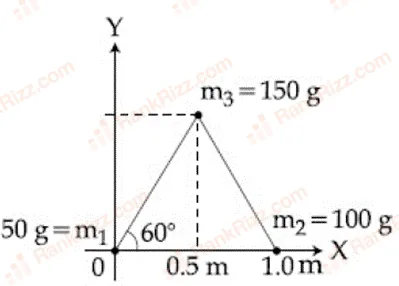
Three particles of masses 50 g, 100 g and 150 g are placed at the vertices of an equilateral triangle of side 1 m (as shown in the figure). The (x, y) coordinates of the centre of mass will be:
A body of mass moving with an unknown velocity of , undergoes a collinear collision with a body of mass moving with a velocity . After the collision, and move with velocities of and , respectively. If and , then is:
JEE Advanced has set 12 Centre of Mass, Momentum & Collisions questions too. Centre of Mass, Momentum & Collisions JEE Advanced PYQs →
OTHER PHYSICS CHAPTERS