RankRizz

Centre of Mass, Momentum & Collisions — JEE Main Previous Year Questions

Every Centre of Mass, Momentum & Collisions question JEE Main has set from 2004–2026, grouped by the idea it tests rather than the order of the syllabus. 135 questions across 8 distinct ideas. Free to read, answer key on every one.

Questions

135

Distinct ideas

8

Share of marks

1.4%

Difficulty

MEDIUM

The ideas inside Centre of Mass, Momentum & Collisions

A chapter is not one subject — it is a handful of procedures the examiner reuses. These are the ones Centre of Mass, Momentum & Collisions questions actually test.

Every Centre of Mass, Momentum & Collisions question

101–120 OF 135 · NEWEST FIRST

JEE MAIN 2019 · 12 JAN S2Head-on collisions and coefficient of restitutionTRANSCRIBED

An alpha-particle of mass m suffers 1-dimensional elastic collision with a nucleus at rest of unknown mass. It is scattered directly backwards losing 64% of its initial kinetic energy. The mass of the nucleus is

  1. A

    1.5m

  2. B

    4m

  3. C

    3.5m

  4. D

    5m

JEE MAIN 2018 · 08 APR OFFLINEHead-on collisions and coefficient of restitutionTRANSCRIBED

It is found that if a neutron suffers an elastic collinear collision with a deuterium at rest, the fractional loss of its energy is PdP_d, while for its similar collision with a carbon nucleus at rest, the fractional loss of energy is PcP_c. The values of PdP_d and PcP_c are respectively:

  1. A

    0, 1

  2. B

    0.89, 0.28

  3. C

    0.28, 0.89

  4. D

    0, 0

JEE MAIN 2018 · 15 APR S2Head-on collisions and coefficient of restitutionTRANSCRIBED

A proton of mass m collides elastically with a particle of unknown mass at rest. After the collision, the proton and the unknown particle are seen moving at an angle of 90∘^\circ with respect to each other. The mass of unknown particle is:

  1. A

    m3\frac{m}{\sqrt{3}}

  2. B

    m2\frac{m}{2}

  3. C

    2m2m

  4. D

    mm

JEE MAIN 2017 · 09 APR ONLINEHead-on collisions and coefficient of restitutionTRANSCRIBED

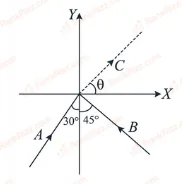
Two particles AA and BB of equal mass MM are moving with the same speed vv as shown in figure. They collide completely inelastic and move as a single particle CC. The angle θ\theta that the path of CC makes with the X-axis is given by-

Figure for JEE Main 2017 Physics question on Head-on collisions and coefficient of restitution
  1. A

    tan⁡θ=3−21−2\tan \theta = \dfrac{\sqrt{3} - \sqrt{2}}{1 - \sqrt{2}}

  2. B

    tan⁡θ=1−22(1+3)\tan \theta = \dfrac{1 - \sqrt{2}}{\sqrt{2}(1 + \sqrt{3})}

  3. C

    tan⁡θ=1−31+2\tan \theta = \dfrac{1 - \sqrt{3}}{1 + \sqrt{2}}

  4. D

    tan⁡θ=3+21−2\tan \theta = \dfrac{\sqrt{3} + \sqrt{2}}{1 - \sqrt{2}}

JEE MAIN 2016 · 10 APR ONLINECentre of mass of continuous bodies and cavitiesTRANSCRIBED

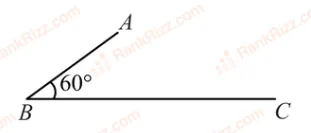
In the figure shown ABCABC is a uniform wire. If the center of mass of the wire lies vertically below point AA, then BCAB\frac{BC}{AB} is close to

Figure for JEE Main 2016 Physics question on Centre of mass of continuous bodies and cavities
  1. A

    1.85

  2. B

    1.5

  3. C

    1.37

  4. D

    3

JEE MAIN 2015 · 10 APR ONLINEHead-on collisions and coefficient of restitutionTRANSCRIBED

A block of mass m=10m = 10 kg rests on a horizontal table. The coefficient of friction between the block and the table is 0.05. When hit by a bullet of mass 50 g moving with speed vv, that gets embedded in it, the block moves and comes to stop after moving a distance of 2 m on the table. If a freely falling object were to acquire speed v10\frac{v}{10} after being dropped from height HH, then neglecting energy losses and taking g=10g = 10 m s−2^{-2}, the value of HH is close to

  1. A

    0.2 km.

  2. B

    0.5 km.

  3. C

    0.4 km.

  4. D

    None of these.

JEE MAIN 2015 · 04 APR OFFLINECentre of mass of continuous bodies and cavitiesTRANSCRIBED

Distance of the centre of mass of a solid uniform cone from its vertex is z0z_0. If the radius of its base is RR and its height is hh then z0z_0 is equal to

  1. A

    3h28R\frac{3h^2}{8R}

  2. B

    h24R\frac{h^2}{4R}

  3. C

    3h4\frac{3h}{4}

  4. D

    5h8\frac{5h}{8}

JEE MAIN 2015 · 04 APR OFFLINEHead-on collisions and coefficient of restitutionTRANSCRIBED

A particle of mass mm moving in the xx direction with speed 2v2v is hit by another particle of mass 2m2m moving in the yy direction with speed vv. If the collision is perfectly inelastic, the percentage loss in the energy during the collision is close to

  1. A

    62%

  2. B

    44%

  3. C

    50%

  4. D

    56%

JEE MAIN 2015 · 11 APR ONLINEImpulse and impulse-momentum theoremTRANSCRIBED

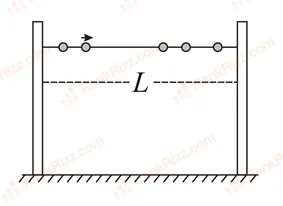
A large number (n)(n) of identical beads, each of mass mm and radius rr are strung on a thin smooth rigid horizontal rod of length L(L≫r)L(L \gg r) and are at rest at random positions. The rod is mounted between two rigid supports (see the figure below). If one of the beads is now given a speed vv, the average force experienced by each support after a long time is (assume all collisions are elastic):

Figure for JEE Main 2015 Physics question on Impulse and impulse-momentum theorem
  1. A

    mv2L−nr\frac{mv^2}{L-nr}

  2. B

    mv2L−2nr\frac{mv^2}{L-2nr}

  3. C

    mv22(L−nr)\frac{mv^2}{2(L-nr)}

  4. D

    Zero

JEE MAIN 2015 · 11 APR ONLINECentre of mass of continuous bodies and cavitiesTRANSCRIBED

A uniform thin rod AB of length LL has linear mass density μ(x)=a+bxL\mu(x) = a + \frac{bx}{L}, where xx is measured from A. If the CM of the rod lies at a distance of (712L)\left(\frac{7}{12}L\right) from A, then aa and bb are related as:

  1. A

    2a=b2a = b

  2. B

    a=2ba = 2b

  3. C

    a=ba = b

  4. D

    3a=2b3a = 2b

JEE MAIN 2014 · 12 APR ONLINEHead-on collisions and coefficient of restitutionTRANSCRIBED

A bullet of mass 4 g is fired horizontally with a speed of 300 m/s into 0.8 kg block of wood at rest on a table. If the coefficient of friction between the block and the table is 0.3, how far will the block slide approximately?

  1. A

    0.19 m

  2. B

    0.379 m

  3. C

    0.569 m

  4. D

    0.758 m

JEE MAIN 2014 · 11 APR ONLINECentre of mass of continuous bodies and cavitiesTRANSCRIBED

A thin bar of length L has a mass per unit length λ\lambda, that increases linearly with distance from one end. If its total mass is M and its mass per unit length at the lighter end is λ0\lambda_0, then the distance of the centre of mass from the lighter end is:

  1. A

    L2−λ0L24M\frac{L}{2} - \frac{\lambda_0 L^2}{4M}

  2. B

    L3+λ0L28M\frac{L}{3} + \frac{\lambda_0 L^2}{8M}

  3. C

    L3+λ0L24M\frac{L}{3} + \frac{\lambda_0 L^2}{4M}

  4. D

    2L3−λ0L26M\frac{2L}{3} - \frac{\lambda_0 L^2}{6M}

JEE MAIN 2014 · 12 APR ONLINEHead-on collisions and coefficient of restitutionTRANSCRIBED

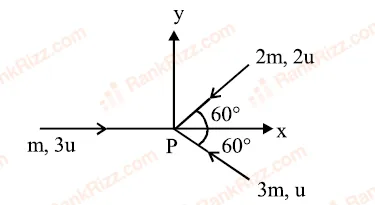
Three masses m, 2m and 3m are moving in the x-y plane with speeds 3u, 2u and u respectively as shown in the figure. The three masses collide at the same point at P and stick together. The velocity of the resulting mass will be:

Figure for JEE Main 2014 Physics question on Head-on collisions and coefficient of restitution
  1. A

    u12(i^+3j^)\frac{u}{12}(\hat{i} + \sqrt{3}\hat{j})

  2. B

    u12(i^−3j^)\frac{u}{12}(\hat{i} - \sqrt{3}\hat{j})

  3. C

    u12(−i^+3j^)\frac{u}{12}(-\hat{i} + \sqrt{3}\hat{j})

  4. D

    u12(−i^−3j^)\frac{u}{12}(-\hat{i} - \sqrt{3}\hat{j})

JEE MAIN 2013 · 23 APR ONLINEMotion of centre of mass, momentum conservation and explosionsTRANSCRIBED

A boy of mass 20 kg is standing on a 80 kg free to move long cart. There is negligible friction between cart and ground. Initially, the boy is standing 25 m from a wall. If he walks 10 m on the cart towards the wall, then the final distance of the boy from the wall will be

  1. A

    15 m

  2. B

    12.5 m

  3. C

    15.5 m

  4. D

    17 m

JEE MAIN 2013 · 07 APR ONLINEHead-on collisions and coefficient of restitutionTRANSCRIBED

This question has Statement - I and Statement - II. Of the four choices given after the Statements, choose the one that best describes the two Statements.
Statement - I: A point particle of mass mm moving with speed vv collides with stationary point particle of mass MM. If the maximum energy loss possible is given as f(12mv2)f\left(\frac{1}{2}mv^2\right) then f=(mM+m)f = \left(\frac{m}{M+m}\right).
Statement - II: Maximum energy loss occurs when the particles get stuck together as a result of the collision.

  1. A

    Statement-I is true, Statement-II is false.

  2. B

    Statement-I is false, Statement-II is true.

  3. C

    Statement-I is true, Statement-II is true, Statement-II is a correct explanation of Statement-I.

  4. D

    Statement-I is true, Statement-II is true, Statement-II is not a correct explanation of Statement-I.

JEE MAIN 2013 · 23 APR ONLINEMotion of centre of mass, momentum conservation and explosionsTRANSCRIBED

A projectile of mass M is fired so that the horizontal range is 4 km. At the highest point the projectile explodes in two parts of masses M/4 and 3M/4 respectively and the heavier part starts falling down vertically with zero initial speed. The horizontal range (distance from point of firing) of the lighter part is :

  1. A

    16 km

  2. B

    1 km

  3. C

    10 km

  4. D

    2 km

JEE MAIN 2012Impulse and impulse-momentum theoremTRANSCRIBED

An engine pumps water continuously through a hose. Water leaves the hose with velocity vv and mm is mass per unit length of the water jet. If this jet hits a surface and came to rest instantaneously, the force on the surface is

  1. A

    mv3mv^3

  2. B

    mv2mv^2

  3. C

    12mv2\tfrac{1}{2}mv^2

  4. D

    12mv3\tfrac{1}{2}mv^3

JEE MAIN 2012Variable mass systems and rocketsTRANSCRIBED

A satellite moving with velocity vv in a force free space collects stationary interplanetary dust at a rate of dMdt=αv\frac{dM}{dt} = \alpha v where MM is the mass (of satellite + dust) at that instant. The instantaneous acceleration of the satellite is

  1. A

    −αv22M-\frac{\alpha v^2}{2M}

  2. B

    −αv2M-\frac{\alpha v^2}{M}

  3. C

    −αv2-\alpha v^2

  4. D

    −2αv2M-\frac{2\alpha v^2}{M}

JEE MAIN 2012Variable mass systems and rocketsTRANSCRIBED

Sand is being dropped on a conveyer belt at the rate of 22 kg per second. The force necessary to keep the belt moving with a constant speed of 33 ms−1^{-1} will be

  1. A

    1212 N

  2. B

    66 N

  3. C

    zero

  4. D

    1818 N

JEE MAIN 2012Head-on collisions and coefficient of restitutionTRANSCRIBED

A moving particle of mass mm, makes a head on elastic collision with another particle of mass 2m2m, which is initially at rest. The percentage loss in energy of the colliding particle on collision, is close to

  1. A

    33%33\%

  2. B

    67%67\%

  3. C

    90%90\%

  4. D

    10%10\%