JEE MAIN 2024 · 27 JAN S1Impulse and impulse-momentum theoremTRANSCRIBED
A body of mass kg is moving horizontally with a velocity . If kg extra mass is added, the final velocity (in ) is:
- A
6
- B
2
- C
3
- D
5
Every JEE Main question on Impulse and impulse-momentum theorem, one of the ideas inside Centre of Mass, Momentum & Collisions: 24 questions from 2004–2024, 16 of them in the last five years. Newest first, answer key on every one. Free to read.
Questions
24
Years asked
10
Since
2004
Of the chapter
18%
Questions on Impulse and impulse-momentum theorem in each year it was asked.
1–20 OF 24 · NEWEST FIRST
A body of mass kg is moving horizontally with a velocity . If kg extra mass is added, the final velocity (in ) is:
6
2
3
5
Figures (a), (b), (c) and (d) show variation of force with time.
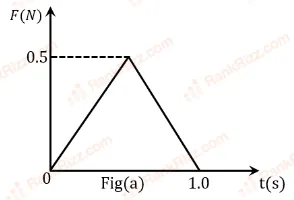
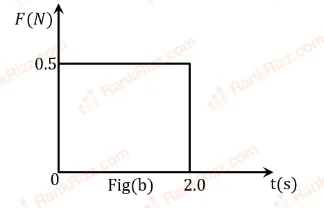
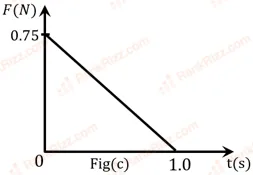
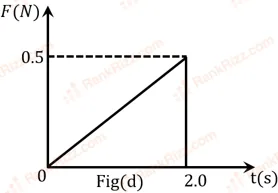
The impulse is highest in figure.
Fig (c)
Fig (b)
Fig (a)
Fig (d)
The figure represents the momentum time curve for a particle moving along an axis under the influence of the force. Identify the regions on the graph where the magnitude of the force is maximum and minimum respectively?
If
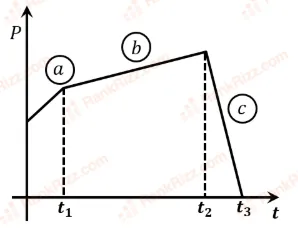
c and a
b and c
c and b
a and b
100 balls each of mass moving with speed simultaneously strike a wall normally and reflected back with same speed, in time s. The total force exerted by the balls on the wall is
An average force of 125 N is applied on a machine gun firing bullets each of mass 10 g at the speed of 250 m s to keep it in position. The number of bullets fired per second by the machine gun is:
50
25
100
5
A ball of mass g rests on a vertical post of height m. A bullet of mass g, travelling in horizontal direction, hits the centre of the ball. After collision both travels independently. The ball hits the ground at a distance m and the bullet at a distance of m from the foot of the post. The value of initial velocity of the bullet will be (if m s):
m s
m s
m s
m s
A machine gun of mass kg fires g bullets at the rate of bullets per minute with a speed of m s each. The recoil velocity of the gun is:
m s
m s
m s
m s
A bullet of g leaves the barrel of gun with a velocity of m s. If the barrel of gun is cm long and mass of gun is kg, then value of impulse supplied to the gun will be:
N s
N s
N s
N s
An object is thrown vertically upwards. At its maximum height, which of the following quantity becomes zero?
Momentum
Potential energy
Acceleration
Force
A ball of mass hits the wall with its initial speed of and bounces back without changing its initial speed. If the force applied by the wall on the ball during the contact is , calculate the time duration of the contact of ball with the wall.
In two different experiments, an object of mass 5 kg moving with a speed of 25 ms hits two different walls and comes to rest within (i) 3 second, (ii) 5 seconds, respectively. Choose the correct option out of the following:
Impulse and average force acting on the object will be same for both the cases.
Impulse will be same for both the cases but the average force will be different.
Average force will be same for both the cases but the impulse will be different.
Average force and impulse will be different for both the cases.
A batsman hits back a ball of mass kg straight in the direction of the bowler without changing its initial speed of m s. The impulse imparted to the ball is ______ N s.
A man of kg is running on the road and suddenly jumps into a stationary trolly car of mass kg. Then the trolly car starts moving with velocity m s. The velocity of the running man was ______ m s, when he jumps into the car.
A bullet of 4 g mass is fired from a gun of mass 4 kg. If the bullet moves with the muzzle speed of 50 ms, the impulse imparted to the gun and velocity of recoil of gun are
0.4 kg m s, 0.1 m s
0.2 kg m s, 0.05 m s
0.2 kg m s, 0.1 m s
0.4 kg m s, 0.05 m s
Two billiard balls of equal mass 30 g strike a rigid wall with same speed of 108 kmph (as shown) but at different angles. If the balls get reflected with the same speed, then the ratio of the magnitude of impulses imparted to ball a and ball b by the wall along X direction is:
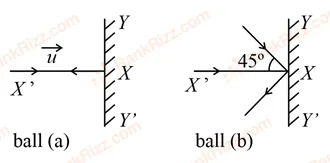
1 : 1
: 1
2 : 1
1 :
The projectile motion of a particle of mass 5 g is shown in the figure.
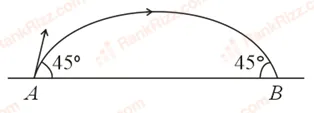
The initial velocity of the particle is ms and the air resistance is assumed to be negligible. The magnitude of the change in momentum between the points A and B is kgms. The value of , to the nearest integer, is ___.
A ball is thrown vertically up (taken as +z-axis) from the ground. The correct momentum-height (p-h) diagram is:
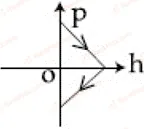
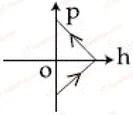
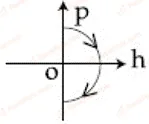
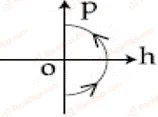
A particle of mass m is moving in a straight line with momentum p. Starting at time , a force acts in the same direction on the moving particle during time interval T so that its momentum changes from p to 3p. Here k is a constant. The value of T is
A man (mass = 50 kg) and his son (mass = 20 kg) are standing on a frictionless surface facing each other. The man pushes his son so that he starts moving at a speed of 0.70 m s with respect to the man. The speed of the man with respect to the surface is:
0.20 m s
0.14 m s
0.47 m s
0.28 m s
A large number of identical beads, each of mass and radius are strung on a thin smooth rigid horizontal rod of length and are at rest at random positions. The rod is mounted between two rigid supports (see the figure below). If one of the beads is now given a speed , the average force experienced by each support after a long time is (assume all collisions are elastic):
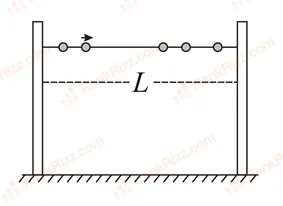
Zero
RELATED CENTRE OF MASS, MOMENTUM & COLLISIONS TOPICS