JEE Main 2012 Physics question — Motion of centre of mass, momentum conservation and explosions
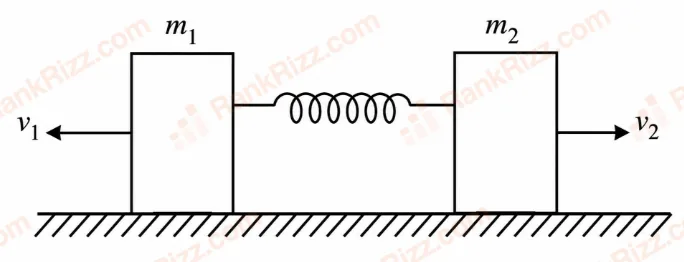
A spring is compressed between two blocks of masses and placed on a horizontal frictionless surface as shown in the figure. When the blocks are released, they have initial velocity of and as shown. The blocks travel distances and respectively before coming to rest. The ratio is
SOLUTION
If the surface is entirely frictionless, but both blocks are brought to rest by an identical external retarding force () acting against their motion, the problem can be solved using the Work-Energy Theorem directly.
1. Work-Energy Theorem
The work done by the constant retarding force over the respective stopping distances and must equal the initial kinetic energy of each block:
Dividing the two equations gives the ratio of their stopping distances:
2. Substituting Momentum Conservation
By the Law of Conservation of Linear Momentum, the magnitude of momentum for both blocks immediately after release is equal:
We can rewrite the distance ratio equation to explicitly separate out these momentum terms:
Since , these terms cancel out, simplifying the expression to a ratio of their velocities:
3. Final Ratio Calculation
From the momentum equation, we know that the velocity ratio is inversely proportional to the mass ratio (). Substituting this back into our simplified distance ratio yields:
Tagged Motion of centre of mass, momentum conservation and explosions. Machine-assigned, so read it as a strong shortlist rather than a verdict.