JEE MAIN 2005TRANSCRIBED
JEE Main 2005 Physics question — Oblique collisions in two dimensions
A mass '' moves with a velocity and collides inelastically with another identical mass. After collision the mass moves with velocity in a direction perpendicular to the initial direction of motion. Find the speed of the mass after collision 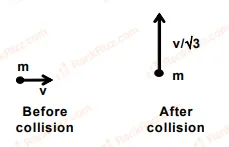
SOLUTION
Key idea: Momentum is conserved in every collision, elastic or not. Apply it separately along and .
From the figure: mass 1 moves along with speed ; after the collision it moves along with speed . Mass 2 is initially at rest.
- Along : , so .
- Along : , so .
- Speed of mass 2:
Answer: (C)
Tagged Oblique collisions in two dimensions. Machine-assigned, so read it as a strong shortlist rather than a verdict.