JEE Main 2015 Physics question — Impulse and impulse-momentum theorem
A large number of identical beads, each of mass and radius are strung on a thin smooth rigid horizontal rod of length and are at rest at random positions. The rod is mounted between two rigid supports (see the figure below). If one of the beads is now given a speed , the average force experienced by each support after a long time is (assume all collisions are elastic):
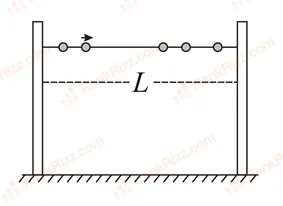
SOLUTION
In elastic collisions between identical masses (), the two bodies simply exchange velocities.
Since the beads have a finite radius , they occupy space on the rod. Diameter of one bead . Total length occupied by beads .
The actual free distance the momentum has to travel between the two supports is
The time interval between two consecutive collisions with the same support is
change in momentum () during one collision is
Tagged Impulse and impulse-momentum theorem. Machine-assigned, so read it as a strong shortlist rather than a verdict.