JEE MAIN 2020 · 06 SEP S2Colour and magnetic behaviour of complexes from CFTTRANSCRIBED
For a metal ion in an octahedral field, the correct electronic configuration is:
- A
when
- B
when
- C
when
- D
when
Every Coordination Compounds question JEE Main has set from 2004–2026, grouped by the idea it tests rather than the order of the syllabus. 373 questions across 10 distinct ideas. Free to read, answer key on every one.
Questions
373
Distinct ideas
10
Share of marks
7.7%
Difficulty
MEDIUM
A chapter is not one subject — it is a handful of procedures the examiner reuses. These are the ones Coordination Compounds questions actually test.
261–280 OF 373 · NEWEST FIRST
For a metal ion in an octahedral field, the correct electronic configuration is:
when
when
when
when
The one that can exhibit highest paramagnetic behaviour among the following is: gly = glycinato; bpy = 2, 2'-bipyridine
The theory that can completely/properly explain the nature of bonding in [Ni(CO)] is:
Werner's theory
Molecular orbital theory
Crystal field theory
Valence bond theory
has number of geometrical isomers. Then, the spin-only magnetic moment and crystal field stabilization energy [CFSE] of , respectively, are:
[Note: Ignore the pairing energy]
2.84 BM and
5.92 BM and 0
1.73 BM and
0 BM and
The electronic spectrum of shows a single broad peak with a maximum at 20,300 cm. The crystal field stabilization energy (CFSE) of the complex ion, in kJ mol, is: (1 kJ mol = 83.7 cm)
145.5
242.5
83.7
97
Consider that metal ion forms a complex with aqua ligands, and the spin only magnetic moment of the complex is 4.90 BM. The geometry and the crystal field stabilization energy of the complex is:
octahedral and
tetrahedral and
octahedral and
tetrahedral and
The complex that can show optical activity is:
trans -
trans -
cis -
cis - (ox = oxalate)
Consider the complex ions, trans- (A) and cis- (B). The correct statement regarding them is:
both (A) and (B) cannot be optically active
(A) can be optically active, but (B) cannot be optically active
both (A) and (B) can be optically active
(A) cannot be optically active, but (B) can be optically active
For octahedral Mn(II) and tetrahedral Ni(II) complexes, consider the following statements:
(I) both the complexes can be high spin.
(II) Ni(II) complex can very rarely be of low spin.
(III) with strong field ligands, Mn(II) complexes can be low spin.
(IV) aqueous solution of Mn(II) ions is yellow in color.
The correct statements are:
(I) and (II) only
(I), (II) and (IV) only
(I), (II) and (III) only
(II), (III) and (IV) only
The species that has a spin-only magnetic moment of 5.9 BM, is: ( = tetrahedral)
(square planar)
()
()
()
The correct order of the calculated spin-only magnetic moments of complexes (A) to (D) is:
(A) Ni(CO)
(B) [Ni(HO)]Cl
(C) Na[Ni(CN)]
(D) PdCl(PPh)
(A) (C) < (B) (D)
(C) < (D) < (B) < (A)
(C) (D) < (B) < (A)
(A) (C) (D) < (B)
The total number of coordination sites in ethylenediaminetetraacetate () is..................
Considering that , the magnetic moment (in BM) of would be
The oxidation states of iron atoms in compounds (A), (B) and (C), respectively, are x, y and z. Then sum of x, y and z is ___________.
(A) (B) (C)
Complexes (ML) of metals Ni and Fe have ideal square pyramidal and trigonal bipyramidal geometries, respectively. The sum of the 90, 120 and 180 L-M-L angles in the two complexes is
The maximum possible denticities of a ligand given below towards a common transition and inner-transition metal ion, respectively, are:
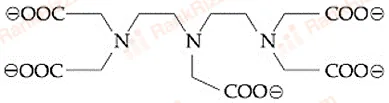
8 and 6
6 and 6
8 and 8
6 and 8
The correct statements among I to III are:
(I) Valence bond theory cannot explain the color exhibited by transition metal complexes.
(II) Valence bond theory can predict quantitatively the magnetic properties of transition metal complexes.
(III) Valence bond theory cannot distinguish ligands as weak and strong field ones.
(I) and (II) only
(II) and (III) only
(I) and (III) only
(I), (II) and (III)
The species that can have a trans-isomer is:
(en = ethane-1, 2-diamine, ox = oxalate)
[Cr(en)(ox)]
[Pt(en)Cl]
[Zn(en)Cl]
[Pt(en)Cl]
Homoleptic octahedral complexes of a metal ion with three monodentate ligands , and absorb wavelengths in the region of green, blue and red respectively. The increasing order of the ligand strength is:
The coordination number of Th in is: ( = oxalato)
14
6
8
10
JEE Advanced has set 46 Coordination Compounds questions too. Coordination Compounds JEE Advanced PYQs →
OTHER CHEMISTRY CHAPTERS