JEE MAIN 2026Oxidation numberTRANSCRIBED
The oxidation number of sulphur in Peroxydisulphuric acid is :
- A
+7
- B
+6
- C
+5
- D
+4
Every Redox Reactions question JEE Main has set from 2004–2026, grouped by the idea it tests rather than the order of the syllabus. 89 questions across 5 distinct ideas. Free to read, answer key on every one.
Questions
89
Distinct ideas
5
Share of marks
1.6%
Difficulty
EASY
A chapter is not one subject — it is a handful of procedures the examiner reuses. These are the ones Redox Reactions questions actually test.
The share of each year’s Chemistry questions that came from Redox Reactions, counted from the 168 papers we hold for the last 10 years, and session by session inside a year.
Rising: 1.9% of Chemistry questions in 2024–2026, up from 1.4% in 2017–2023. Its heaviest year was 2024, at 2.5%. Not asked at all in 2018.
“QS” is Redox Reactions questions out of all Chemistry questions that year. A year with more sittings asks more questions, which is why the share, not the count, is the number to compare.
89 questions from 2004–2026. Over the last 20 papers, Redox Reactions carried about 1.6% of Chemistry marks.
Balancing redox equations (23 questions), Oxidation number (20 questions), Redox titrations (19 questions). Start with these, they are what the examiner keeps coming back to.
Rising: 1.9% of Chemistry questions in 2024–2026, up from 1.4% in 2017–2023. Its heaviest year was 2024, at 2.5%. Not asked at all in 2018. It has carried about 1.6% of Chemistry marks in recent papers, rated easy on our difficulty scale. The year-by-year table above shows how that has moved.
Yes. Every question shows its official answer key, and a worked solution opens on the question’s own page wherever we have one. Reading and checking answers is free, no sign-up needed.
Do one past question per idea first: Redox Reactions has 5 distinct ideas, listed above. Then practise the topics you get wrong, or build a timed test from this chapter.
1–20 OF 89 · NEWEST FIRST
The oxidation number of sulphur in Peroxydisulphuric acid is :
+7
+6
+5
+4
In order to oxidise a mixture of 1 mole each of , , and in acidic medium, the number of moles of required is :
Given below are two statements :
Statement (I) : Oxidising power of halogens decreases in the order F > Cl > Br > I, which is the basis of "Layer test".
Statement (II) : "Layer test" to identify Br and I in aqueous solution involves the oxidation of bromide or iodide into Br or I respectively with Cl, which is a type of displacement redox reaction.
In the light of the above statements, choose the correct answer from the options given below :
Both Statement I and Statement II are true
Both Statement I and Statement II are false
Statement I is true but Statement II is false
Statement I is false but Statement II is true
One mole of was passed into 2 L of cold 2M KOH solution. After the reaction, the concentrations of , and are respectively (assume volume remains constant)
0.5M, 0.5M, lM
0.75M, 0.75M, lM
0.5M, 0.5M, 0.5M
lM, lM, 1M
The oxidation state of chromium in the final product formed in the reaction between and acidified solution is:
+2
+4
+3
+6
500 mL of 1.2 M KI solution is ,mixed with 500 mL of 0.2 M solution in basic medium. The liberated iodine was titrated with standard 0.1 M solution in the presence of starch indicator till the blue color disappeared. The volume (in L) of consumed is_________.(Nearest integer)
X and Y are the number of electrons involved, respectively during the oxidation of to S by acidified . The value of X + Y is __ .
200 cc of potassium dichromate is required to oxidise 750 cc of 0.6 M Mohr's salt solution in acidic mediun.
Here =___________
500 mL of 0.2 M MnO solution in basic medium when mixed with 500 mL of 1.5 M KI solution, oxidises iodide ions to liberate molecular iodine. This liberated iodine is then titrated with a standard M thiosulphate solution in presence of starch till the end point. If 300 mL of thiosulphate was consumed, then the value of is __________.
The species which does not undergo disproportionation reaction is :
Match the LIST-I with LIST-II
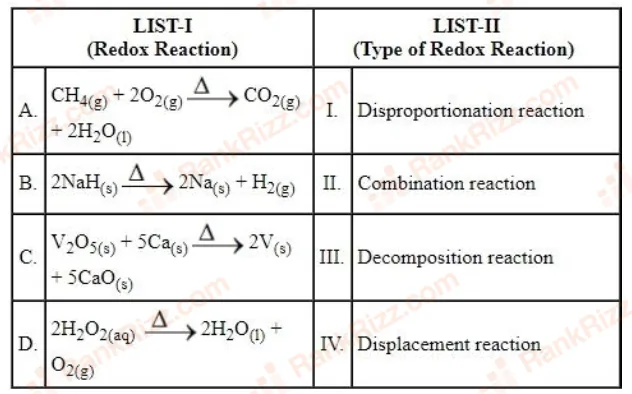
Choose the correct answer from the options given below:
A-II, B-III, C-I, D-IV
A-III, B-IV, C-I, D-II
A-IV, B-I, C-II, D-III
A-II, B-III, C-IV, D-I
Given below are two statements: Statement I: In the oxalic acid vs (in the presence of dil ) titration the solution needs to be heated initially to , but no heating is required in Ferrous ammonium sulphate (FAS) vs (in the presence of dil ) Statement II: In oxalic acid vs titration, the initial formation of takes place at high temperature, which then acts as catalyst for further reaction. In the case of FAS vs , heating oxidizes and by oxygen of air and error may be introduced in the experiment. In the light of the above statements, choose the correct answer from the options given below
Both Statement I and Statement II are false
Both Statement I and Statement II are true
Statement I is false but Statement II is true
Statement I is true but Statement II is false
0.1 M solution of KI reacts with excess of and solutions. According to equation Identify the correct statements : (A) 200 mL of KI solution reacts with 0.004 mol of (B) 200 mL of KI solution reacts with 0.006 mol of (C) 0.5 L of KI solution produced 0.005 mol of (D) Equivalent weight of is equal to ( ) Choose the correct answer from the options given below :
(A) and (D) only
(C) and (D) only
(B) and (C) only
(A) and (B) only
acts as an oxidising agent in acidic medium. 'X' is the difference between the oxidation states of Mn in reactant and product. 'Y' is the number of 'd' electrons present in the brown red precipitate formed at the end of the acetate ion test with neutral ferric chloride. The value of X + Y is ________.
Some gas was kept in a sealed container at a pressure of 1 atm and at 273 K . This entire amount of gas was later passed through an aqueous solution of . The excess unreacted was later neutralized with 0.1 M of 40 mL HCl . If the volume of the sealed container of was , then is ________ (nearest integer). [Given : The entire amount of reacted with exactly half the initial amount of present in the aqueous solution.]
Which of the following cannot function as an oxidising agent?
Chlorine undergoes disproportionation in alkaline medium as shown below :
The values of and in a balanced redox reaction are respectively :
and
and
and
and
The number of ions from the following that are expected to behave as oxidising agent is :
Which of the following reactions are disproportionation reactions? (1) (2) (3) (4) . Choose the correct answer from the options given below:
1, 2
2, 3, 4
1, 2, 4
1, 4
Given below are two statements:
Statement I: solid undergoes disproportionation reaction under alkaline conditions to form and
Statement II: can undergo disproportionation reaction under acidic condition.
In the light of the above statements, choose the most appropriate answer from the options given below:
Statement I is correct but statement II is incorrect
Statement I is incorrect but statement II is correct
Both statement I and statement II are incorrect
Both statement I and statement II are correct
JEE Advanced has set 16 Redox Reactions questions too. Redox Reactions JEE Advanced PYQs →
OTHER CHEMISTRY CHAPTERS