JEE MAIN 2019 · 09 APR S2+4 / −1HARDTRANSCRIBED
JEE Main 2019 Chemistry question — Ligands, denticity and chelation
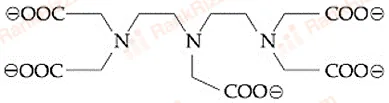
The maximum possible denticities of a ligand given below towards a common transition and inner-transition metal ion, respectively, are:
SOLUTION
Towards a Common Transition Metal Ion (Denticity = 6)
- Steric Constraints and Coordination Numbers: Common transition metals have a relatively small ionic size and usually favor an octahedral geometry with a maximum coordination number of 6.
- Due to steric crowding around the smaller metal center, the ligand cannot comfortably wrap all 8 donor atoms around it. It utilizes 6 donor atoms (typically 3 Nitrogens and 3 Oxygens) to form a highly stable hexadentate complex, leaving two carboxylate groups uncoordinated.
2. Towards an Inner-Transition Metal Ion (Denticity = 8)
- Larger Size and More Available Orbitals: Inner-transition metal ions such as the Lanthanides or Actinides have significantly larger ionic radii and available f-orbitals. Consequently, they regularly accommodate higher coordination numbers, typically 8 or 9.
- Because the central metal ion is large enough to prevent severe steric hindrance, DTPA can completely wrap around it using all of its available donor sites. Therefore, it exhibits its maximum possible denticity of 8 (all 3 Nitrogens + all 5 Oxygens coordinate).
Tagged Ligands, denticity and chelation. Machine-assigned, so read it as a strong shortlist rather than a verdict.