JEE MAIN 2026Preparation of aldehydes and ketonesTRANSCRIBED
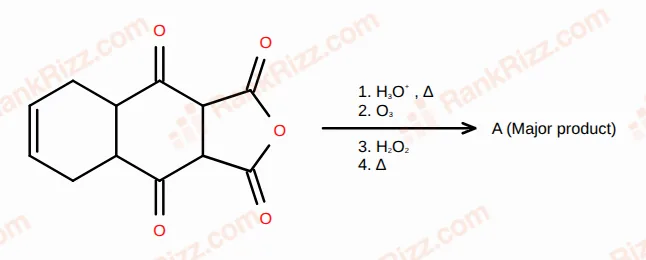
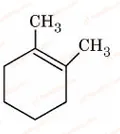
The ratio of number of keto groups to the number of carbons in the major product is:
- A
3 : 1
- B
3 : 8
- C
1 : 3
- D
2 : 3
Every Aldehydes and Ketones question JEE Main has set from 2004–2026, grouped by the idea it tests rather than the order of the syllabus. 214 questions across 5 distinct ideas. Free to read, answer key on every one.
Questions
214
Distinct ideas
5
Share of marks
4.6%
Difficulty
HARD
A chapter is not one subject — it is a handful of procedures the examiner reuses. These are the ones Aldehydes and Ketones questions actually test.
The share of each year’s Chemistry questions that came from Aldehydes and Ketones, counted from the 168 papers we hold for the last 10 years, and session by session inside a year.
Rising: 4.4% of Chemistry questions in 2024–2026, up from 3.5% in 2017–2023. Its heaviest year was 2026, at 4.6%.
“QS” is Aldehydes and Ketones questions out of all Chemistry questions that year. A year with more sittings asks more questions, which is why the share, not the count, is the number to compare.
214 questions from 2004–2026. Over the last 20 papers, Aldehydes and Ketones carried about 4.6% of Chemistry marks.
Nucleophilic addition reactions of carbonyl compounds (138 questions), Distinguishing tests for aldehydes and ketones (34 questions), Preparation of aldehydes and ketones (25 questions). Start with these, they are what the examiner keeps coming back to.
Rising: 4.4% of Chemistry questions in 2024–2026, up from 3.5% in 2017–2023. Its heaviest year was 2026, at 4.6%. It has carried about 4.6% of Chemistry marks in recent papers, rated hard on our difficulty scale. The year-by-year table above shows how that has moved.
Yes. Every question shows its official answer key, and a worked solution opens on the question’s own page wherever we have one. Reading and checking answers is free, no sign-up needed.
Do one past question per idea first: Aldehydes and Ketones has 5 distinct ideas, listed above. Then practise the topics you get wrong, or build a timed test from this chapter.
1–20 OF 214 · NEWEST FIRST
The ratio of number of keto groups to the number of carbons in the major product is:
3 : 1
3 : 8
1 : 3
2 : 3
Match List - I with List - II.
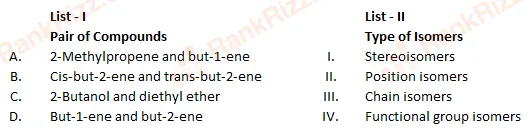
Choose the correct answer from the options given below :
A-III, B-I, C-IV, D-II
A-III, B-I, C-II, D-IV
A-II, B-I, C-IV, D-III
A-I, B-IV, C-III, D-II
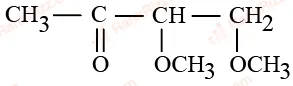
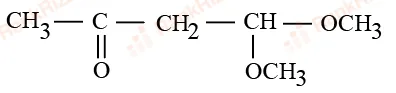
An organic compound "P" of molecular formula gives positive Iodoform test but negative Tollen's test. When "P" is treated with dilute acid, it produces "Q". "Q" gives positive Tollen's test and also iodoform test. The structure of "P" is :
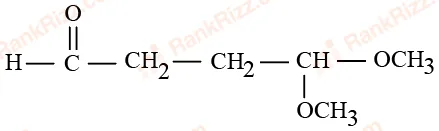
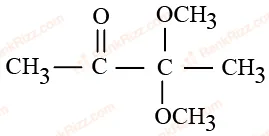
Iodoform test can differentiate between
A. Methanol and Ethanol
B. and
C. Cyclohexene and cyclohexanone
D. Diethyl ether and Pentan-3-one
E. Anisole and acetone
Choose the correct answer from the options given below:
B, C & E Only
A & D Only
A & E Only
A, B & E Only
Given below are two statements:
Statement I: Cross aldol condensation between two different aldehydes will always produce four different products.
Statement II: When semicarbazide reacts with a mixture of benzaldehyde and acetophenone under optimum pH, it fonns a condensation product with acetophenone only.
In the light of the above statements, choose the correct answer from the options given below
Statement I is true but Statement II is false
Both Statement I and Statement II are false
Statement I is false but Statement II is true
Both Statement I and Statement II are true
Given below are two statements for the following reaction sequence.
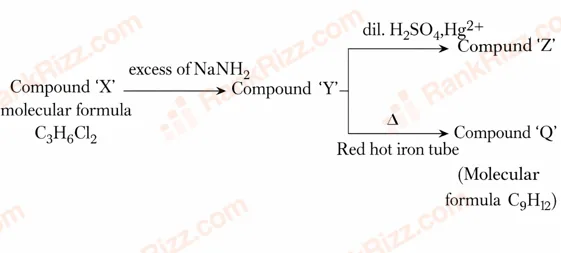
Statement I: Compound 'Z' will give yellow precipitate with NaOI.
Statement II: Compound 'Q' has two different types of'H' atoms (aromatic:aliphatic) in the ratio 1 :3.
In the light of the above statements, choose the correct answer from the options given below:
Statement I is false but Statement II is true
Statement I is true but Statement II is false
Both Statement I and Statement II are false
Both Statement I and Statement II are true
The compound A, reacts with acetophenone to form a single product via cross-Aldol condensation. The compound A on reaction with cone. NaOH forms a substituted benzyl alcohol as one of the two products. The compound A is :
2-hydroxy acetophenone
4-hydroxy benzylaldehyde
4-methyl benzoic acid
4-methoxy benzaldehyde
Given below are the four isomeric compounds (P, Q, R, S)
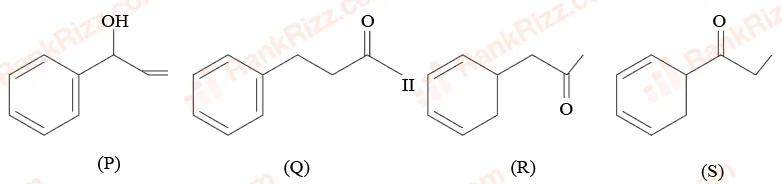
Identify correct statements from below
A. Q, R and S will give precipitate with 2, 4 - DNP.
B. P and Q will give positive Bayer's test.
C. Q and R will give sooty flame.
D. Rand S will give yellow precipitate with .
E. Q alone will deposit silver with Tollen's reagent.
Choose the correct option.
C and E only
A, B, D and E only
A, C and E only
A and E only
'x' is the product which is obtained by the hydrolysis of prop-1-yne in the presence of mercuric sulphate under dilute acidic medium at 333 K. 'y' is the product which is obtained by the reaction of ethane nitrile with methyl magnesium bromide in dry ether followed by hydrolysis. IUPAC name of product obtained from 'x' and 'y' in the presence of barium hydroxide followed by heating is :
2-Methylpent-4-en-3-one
4-Methylpent-3-en-2-one
4-Methylpent-1-ene
2-Methylpent-3-one
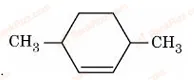
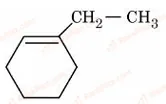
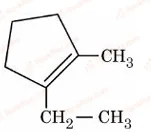
"P" is a hydrocarbon of molecular formula: . On ozonolysis, "P" forms "Q". "Q" on treatment with alkali under reflux condition produces "R", which on treatment with /NaOH gives a yellow precipitate. Acidification of the solution gives "S". The structure of "S" is given below:-
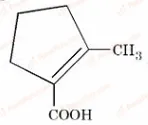
The correct structure of "P" is
Consider the following two reactions A and B.
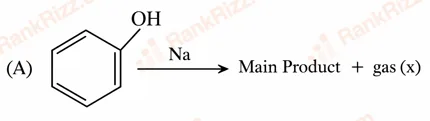
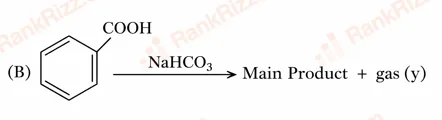
Numerical value of [ molar mass of x + molar mass of y] is __
4
46
160
88
An optically active alkyl bromide CHBr, reacts with ethanolic KOH to form major compound [A] which reacts with bromine to give compound [B]. Compound [B] reacts with ethanolic KOH and sodamide to give compound [C]. One molecule of water adds to compound [C] on warming with mercuric sulphate and dilute sulphuric acid at 333 K to form compound [D]. The functional group in compound D will be confirmed by :
Haloform test
Lucas test
Silver mirror test
Benedict test
Given below are two statements:
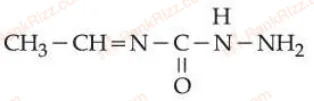
The condensation reaction between and
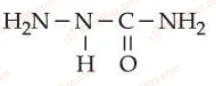
under optimum pH will produce
The molecule
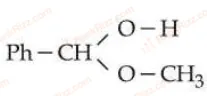
will generate in the presence of dilute acid.
In the light of the above statements, choose the correct answer from the options given below:
Both statements are true
Both statements are false
Statement I is true but Statement II is false
Statement I is false but Statement II is true
A student is given one compound among the following compounds that gives positive test with Tollen's reagent
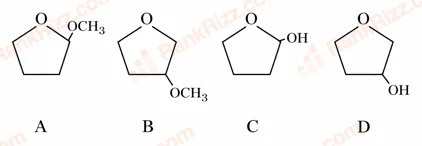
The compound is :
B
C
D
A
Consider the following reaction.
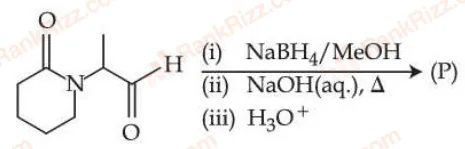
The major product (P) formed is :
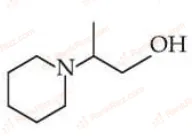
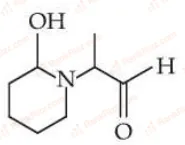
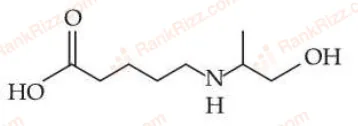
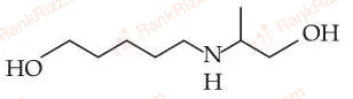
'x' is the product which is obtained &om propanenitrile and stannous chloride in the presence of hydrochloric acid followed by hydrolysis. 'y' is the product which is obtained from the but-2-ene by the ozonolysis followed by hydrolysis. From the followu1g, which product is not obtained when one mole of 'x' and one mole of 'y' react with, each other in the presence of alkali followed by heating?
Pent-2-enal
3-Methylbut-2-enal
2-Methylbut-2-enal
2-Methylpent-2-enal
Match the LIST-I with LIST-II
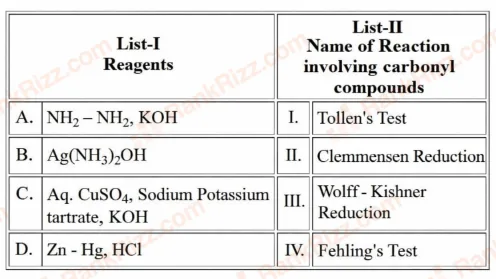
Choose the correct answer from the options given below:
A-III, B-IV, C-I, D-II
A-IV, B-III, C-II, D-I
A-II, B-I, C-IV, D-III
A-III, B-I, C-IV, D-II
The unsaturated ether On acidic hydrolysis produces carbonyl compom1ds as shown below:-
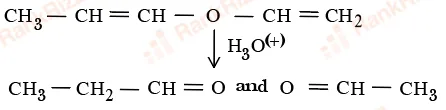
Based On this, predict the solution/reagent that will help to distillguish "P" and "Q" obtained in the following reaction:-
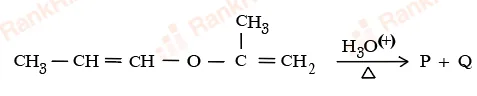
2, 4 - DNP reagent
Fehling solution
Saturated solution
Lucas reagent
Which of the following statements are TRUE about Haloform reaction?:
A. Sodium hypochlorite reacts with KI to give KOI.
B. KOI is a reducing agent.
C. -unsaturated methylketone will give iodoform reaction.
D. Isopropyl alcohol will not give iodoform test.
E. Methanoic acid will give positive iodoform test.
Choose the correct answer from the options given below:
A, B & C Only
A, C & E Only
B, D & E Only
A & C Only
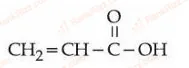
An organic compound "x" where molar ratio of C, O and H are equal, on treatment with 50% KOH under reflux followed by acidification produced "y". The most likely structure of "y" is :
[Molar mass of 'x' is 58 g mol]

JEE Advanced has set 47 Aldehydes and Ketones questions too. Aldehydes and Ketones JEE Advanced PYQs →
OTHER CHEMISTRY CHAPTERS