RankRizz

Alcohols, Phenols and Ethers — JEE Main Previous Year Questions

Every Alcohols, Phenols and Ethers question JEE Main has set from 2004–2026, grouped by the idea it tests rather than the order of the syllabus. 182 questions across 5 distinct ideas. Free to read, answer key on every one.

Questions

182

Distinct ideas

5

Share of marks

2.8%

Difficulty

MEDIUM

The ideas inside Alcohols, Phenols and Ethers

A chapter is not one subject — it is a handful of procedures the examiner reuses. These are the ones Alcohols, Phenols and Ethers questions actually test.

Alcohols, Phenols and Ethers weightage, year by year

The share of each year’s Chemistry questions that came from Alcohols, Phenols and Ethers, counted from the 168 papers we hold for the last 10 years, and session by session inside a year.

Steady: 3.0% of Chemistry questions in 2024–2026 against 3.1% in 2017–2023, and between 1.1% and 4.0% in every year shown.

202613 / 4802.7%JAN 2.8%APR 2.6%
20259 / 4751.9%JAN 2.0%APR 1.8%
202424 / 6004.0%JAN 4.0%APR 4.0%
202323 / 7503.1%JAN 2.6%APR 3.6%
202224 / 6603.6%JUN 3.1%JUL 4.3%
202121 / 7202.9%FEB 2.7%MAR 1.3%JUL 3.8%AUG 3.3%
202012 / 4003.0%JAN 2.0%SEP 3.6%
201915 / 4803.1%JAN 3.8%APR 2.5%
20183 / 1202.5%4 PAPERS, ONE SESSION
20171 / 901.1%3 PAPERS, ONE SESSION

“QS” is Alcohols, Phenols and Ethers questions out of all Chemistry questions that year. A year with more sittings asks more questions, which is why the share, not the count, is the number to compare.

Alcohols, Phenols and Ethers: quick answers

How many Alcohols, Phenols and Ethers questions has JEE Main asked?

182 questions from 2004–2026. Over the last 20 papers, Alcohols, Phenols and Ethers carried about 2.8% of Chemistry marks.

Which Alcohols, Phenols and Ethers topics come up most?

Reactions of phenols (78 questions), Properties and reactions of alcohols (62 questions), Ethers (27 questions). Start with these, they are what the examiner keeps coming back to.

Is Alcohols, Phenols and Ethers important for JEE Main?

Steady: 3.0% of Chemistry questions in 2024–2026 against 3.1% in 2017–2023, and between 1.1% and 4.0% in every year shown. It has carried about 2.8% of Chemistry marks in recent papers, rated medium on our difficulty scale. The year-by-year table above shows how that has moved.

Do these Alcohols, Phenols and Ethers PYQs have answers and solutions?

Yes. Every question shows its official answer key, and a worked solution opens on the question’s own page wherever we have one. Reading and checking answers is free, no sign-up needed.

What’s the fastest way to revise Alcohols, Phenols and Ethers?

Do one past question per idea first: Alcohols, Phenols and Ethers has 5 distinct ideas, listed above. Then practise the topics you get wrong, or build a timed test from this chapter.

Every Alcohols, Phenols and Ethers question

1–20 OF 182 · NEWEST FIRST

JEE MAIN 2026Reactions of phenolsTRANSCRIBED

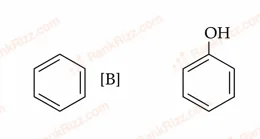
Benzene diazonium salt reacts with ethanol to form compound B, which on treatment with oleum gives compound C. Compound C, when treated with NaOH at 350∘C, followed by hydrolysis, forms compound D. Compound D is then treated with sodium dichromate in the presence of sulphuric acid. The final product is:

  1. A

    1,4- benzoquinone

  2. B

    Hydroquinone

  3. C

    Phenol

  4. D

    1,2- benzoquinone
JEE MAIN 2026 · 24 JAN S1Properties and reactions of alcoholsTRANSCRIBED

A hydroxy compound (X) with molar mass 122 g mol−1mol^{-1} is acetylated with acetic anhydride, using a large excess of the reagent ensuring complete acetylation of all hydroxyl groups. The product obtained has a molar mass of 290 g mol−1mol^{-1}. The number of hydroxyl groups present in compound (X) is:

  1. A

    3

  2. B

    4

  3. C

    2

  4. D

    5

JEE MAIN 2026 · 24 JAN S2Properties and reactions of alcoholsTRANSCRIBED

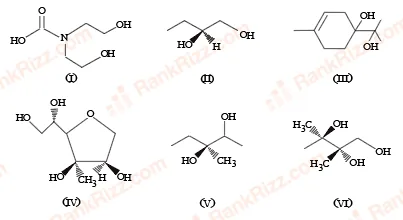
From the following, how many compounds contain at least one secondary alcohol?

Figure for JEE Main 2026 Chemistry question on Properties and reactions of alcohols

Choose the correct answer from the options given below:

  1. A

    Five

  2. B

    Three

  3. C

    Four

  4. D

    Two

JEE MAIN 2026 · 23 JAN S2EthersTRANSCRIBED

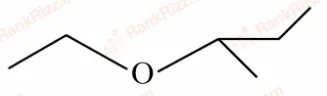
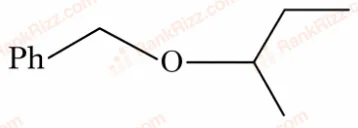
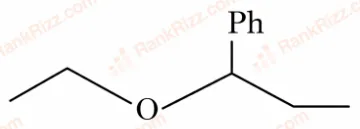
A mixed ether (P), when heated with excess of hot concentrated hydrogen iodide produces two different alkyl iodides which when treated with aq. NaOH give compounds (Q) and (R). Both (Q) and (R) give yellow precipitate with NaOI. Identify the mixed ether (P):

  1. A
    56((1)
  2. B
    56(2)
  3. C
    56(3)
  4. D
    56(4)
JEE MAIN 2026 · 28 JAN S1Reactions of phenolsTRANSCRIBED

Consider the following reaction sequence

Figure for JEE Main 2026 Chemistry question on Reactions of phenols


Compound (y) develops characterstic colour with neutral FeCl3FeCl_{3} solution.
Identify the INCORRECT statement from the following for the above sequence.

  1. A

    Compound y win dissolve in NaHCO3NaHCO_{3} and evolve a gas.

  2. B

    Compotmd x is more acidic than compmmd y.

  3. C

    Both compounds x and y will burn with sooty flame.

  4. D

    Both compounds x and y will dissolve in NaOH.

JEE MAIN 2026 · 22 JAN S1Reactions of phenolsTRANSCRIBED

Given below are two statements:

Statement I: Phenol on treatment with . CHCL3CHCL_{3}/aq. KOHKOH under refluxing condition, followed by acidification produces pp-hydroxy benzaldehyde as the major product and oo-hydroxy benzaldehyde as the minor product.

Statement II: The mixture of pp-hydroxybenzaldehyde and oo-
hydroxybenzaldehyde can be easily separated through steam distillation.

In the light of the above statements, choose the correct answer from the options given below

  1. A

    Statement I is false but Statement II is true

  2. B

    Statement I is true but Statement II is false

  3. C

    Both Statement I and Statement II are true

  4. D

    Both Statement I and Statement II are false

JEE MAIN 2026 · 22 JAN S2Preparation of alcoholsTRANSCRIBED

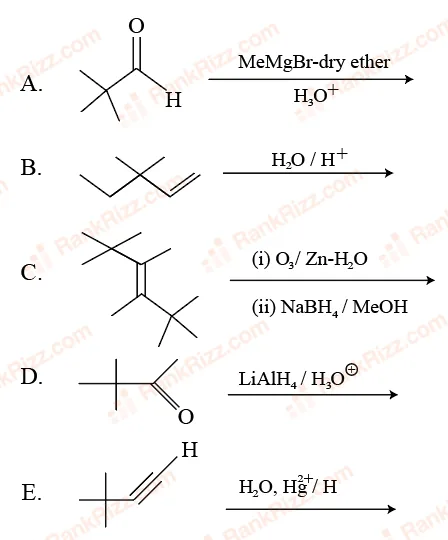
3, 3-Dimethyl-2-butanol cannot be prepared by:

Figure for JEE Main 2026 Chemistry question on Preparation of alcohols

Choose the correct answer from the options given below:

  1. A

    B only 

  2. B

    B and C only 

  3. C

    B and E only 

  4. D

    B, C and E only 

JEE MAIN 2026 · 06 APR S2EthersTRANSCRIBED

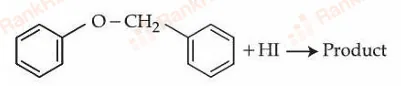
Consider the following reaction.

Figure for JEE Main 2026 Chemistry question on Ethers

Statement I : In the above reaction, product formed will be a mixture of benzyl alcohol and iodobenzene.

Statement II : In the above reaction, the −O−CH2−-O-CH_2- bond is cleaved to give the product.

In the light of the above statements, choose the correct answer from the options given below :

  1. A

    Both Statement I and Statement II are true

  2. B

    Both Statement I and Statement II are false

  3. C

    Statement I is true but Statement II is false

  4. D

    Statement I is false but Statement II is true

JEE MAIN 2026 · 06 APR S1Properties and reactions of alcoholsTRANSCRIBED

Consider the following sequence of reactions

Figure for JEE Main 2026 Chemistry question on Properties and reactions of alcohols

The major product P is:

  1. A
    Figure for JEE Main 2026 Chemistry question on Properties and reactions of alcohols
  2. B
    Figure for JEE Main 2026 Chemistry question on Properties and reactions of alcohols
  3. C
    Figure for JEE Main 2026 Chemistry question on Properties and reactions of alcohols
  4. D
    Figure for JEE Main 2026 Chemistry question on Properties and reactions of alcohols
JEE MAIN 2026 · 05 APR S1Properties and reactions of alcoholsTRANSCRIBED

Consider compounds A, B and C with following structural formulae
A = CH3−CH2−CH2−CH2−CH2−OHCH_3 - CH_2 - CH_2 - CH_2 - CH_2 - OH
B = CH2=CH−CH2−CH2−CH3CH_2 = CH - CH_2 - CH_2 - CH_3
C = HO−CH2−CH2−CH(OH)−CH3HO - CH_2 - CH_2 - CH(OH) - CH_3
For the conversion of B from A, reagent (D) required is _______ and structural formula of product (E) obtained when C undergoes same reaction using excess reagent (D) is _______.

  1. A
    Figure for JEE Main 2026 Chemistry question on Properties and reactions of alcohols
  2. B
    Figure for JEE Main 2026 Chemistry question on Properties and reactions of alcohols
  3. C
    Figure for JEE Main 2026 Chemistry question on Properties and reactions of alcohols
  4. D
    Figure for JEE Main 2026 Chemistry question on Properties and reactions of alcohols
JEE MAIN 2026 · 28 JAN S2Properties and reactions of alcoholsTRANSCRIBED

The reactions which produce alcohol as the product are:
A.CH4+O2→ΔMo2O3B.2CH3CH3+3O2→Δ(CH3COO)2MnC.(CH3)3CH→KMnO4D.2CH4+O2→Cu/523K/100atm.E.CH3−CH=CH−CH3→KMnO4/H+A. CH_{4}+O_{2}\xrightarrow[\Delta]{Mo_{2}O_{3}}\\B.2CH_{3}CH_{3}+3O_{2}\xrightarrow[\Delta]{(CH_{3}COO)_{2}Mn}\\C.(CH_{3})_{3}CH\xrightarrow{KMnO_{4}}\\D.2CH_{4}+O_{2}\xrightarrow{Cu/523K/100atm.}\\E.CH_{3}-CH=CH-CH_{3}\xrightarrow{KMnO_{4}/H^{+}}
Choose the correct answer from the options given below :

  1. A

    C and D Only

  2. B

    A, C and E Only

  3. C

    A and D Only

  4. D

    B, D and E Only

JEE MAIN 2026 · 04 APR S1Reactions of phenolsTRANSCRIBED

Identify the colour of compound 'X' in the sequence of the reaction:

Figure for JEE Main 2026 Chemistry question on Reactions of phenols
  1. A

    Violet

  2. B

    Green

  3. C

    Red

  4. D

    Colourless

JEE MAIN 2026 · 06 APR S1Reactions of phenolsTRANSCRIBED

4.7 g of phenol is heated with Zn to give product X. If this reaction goes to 60% completion then the number of moles of compound X formed will be _______ ×10−2\times 10^{-2}. (Nearest Integer)
(Given molar mass in g mol−1^{-1}: H:1, C:12, O:16)

JEE MAIN 2026 · 05 APR S1Reactions of phenolsTRANSCRIBED

One mole of phenol is treated with dilute HNO3_3 at 298 K to give a mixture of products. The mixture is separated by steam distillation. The steam volatile compound (X) is separated. The increase in percentage of oxygen in (X) with respect to phenol is _______ ×10−1\times 10^{-1} %. (Given molar mass in g mol−1^{-1} H:1, C:12, N:14, O:16)

JEE MAIN 2025 · 23 JAN S2Reactions of phenolsTRANSCRIBED

Identify the products [A] and [B], respectively in the following reaction :

Figure for JEE Main 2025 Chemistry question on Reactions of phenols
  1. A
    Figure for JEE Main 2025 Chemistry question on Reactions of phenols
  2. B
    Figure for JEE Main 2025 Chemistry question on Reactions of phenols
  3. C
    page8_img3
  4. D
    page8_img4
JEE MAIN 2025 · 29 JAN S2Reactions of phenolsTRANSCRIBED

Which one of the following, with HBr will give a phenol?

  1. A
    page10_img1
  2. B
    page10_img2
  3. C
    page10_img3
  4. D
    page10_img4
JEE MAIN 2025 · 23 JAN S1Reactions of phenolsTRANSCRIBED

What amount of bromine will be required to convert 2 g of phenol into 2,4,6-tribromophenol? (Given molar mass in gmol−1gmol^{-1} of C, H, O, Br are 12, 1, 16, 80 respectively)

  1. A

    20.44 g

  2. B

    4.0 g

  3. C

    6.0 g

  4. D

    10.22 g

JEE MAIN 2025 · 07 APR S1EthersTRANSCRIBED

Given below are two statements :
Statement I : Dimethyl ether is completely soluble in water. However, diethyl ether is soluble in water to a very small extent.
Statement II : Sodium metal can be used to dry diethyl ether and not ethyl alcohol.
In the light of  given statements, choose the correct answer from the options given below

  1. A

    Statement I is false but Statement II are true

  2. B

    Both Statement I and Statement II are false

  3. C

    Statement I is true but Statement II is false

  4. D

    Both Statement I and Statement II are true

JEE MAIN 2025 · 04 APR S2Properties and reactions of alcoholsTRANSCRIBED

A toxic compound "A" when reacted with NaCN in aqueous acidic medium yields an edible cooking component and food preservative 'B'. "B" is converted to "C" by diborane and can be used as an additive to petrol to reduce emission. "C" upon reaction with oleum at 140∘140^{\circ} C yields an inhalable anesthetic "D". Identify "A", "B", "C" and "D", respectively.

  1. A

    Methanol; formaldehyde; methyl chloride; chloroform

  2. B

    Ethanol; acetonitrile; ethylamine; ethylene

  3. C

    Methanol; acetic acid; ethanol; diethyl ether

  4. D

    Acetaldehyde; 2-hydroxypropanoic acid; propanoic acid; dipropyl ether

JEE MAIN 2025 · 08 APR S2EthersTRANSCRIBED

Which one of the following reactions will not lead to the desired ether formation in major proportion? (iso-Bu ⇒\Rightarrow isobutyl, sec-Bu ⇒\Rightarrow sec-butyl, nPr ⇒\Rightarrow n-propyl, t^tBu ⇒\Rightarrow tert-butyl, Et ⇒\Rightarrow ethyl)

  1. A
    Figure for JEE Main 2025 Chemistry question on Ethers
  2. B
    Figure for JEE Main 2025 Chemistry question on Ethers
  3. C
    Figure for JEE Main 2025 Chemistry question on Ethers
  4. D

    iso−BuO⊖Na⊕+sec−BuBr→Sec−Bu−O−iso−Buiso-BuO^{\ominus}Na^{\oplus} + sec-BuBr \to Sec-Bu-O-iso-Bu