Stability and applications of coordination compounds — JEE Main Previous Year Questions
Every JEE Main question on Stability and applications of coordination compounds, one of the ideas inside Coordination Compounds: 27 questions from 2004–2026, 16 of them in the last five years. Newest first, answer key on every one. Free to read.
Questions on Stability and applications of coordination compounds in each year it was asked.
20261
20247
20236
20222
20214
20196
20041
Every Stability and applications of coordination compounds question
1–20 OF 27 · NEWEST FIRST
JEE MAIN 2026 · 22 JAN S1Stability and applications of coordination compoundsTRANSCRIBED
A first row transition metal (M) does not liberate H2 gas from dilute HCI. 1 mol of aqueous solution of MSO4 is treated with excess of aqueous KCN and then H2S(g) is passed through the solution. The amount of MS (metal sulphide) formed from the above reaction is _______ mol.
JEE MAIN 2024 · 08 APR S1Stability and applications of coordination compoundsTRANSCRIBED
Given below are two statements: Statement I: N(CH3)3 and P(CH3)3 can act as ligands to form transition metal complexes. Statement II: As N and P are from same group, the nature of bonding of N(CH3)3 and P(CH3)3 is always same with transition metals. In the light of the above statements, choose the most appropriate answer from the options given below:
A
Statement I is correct but Statement II is incorrect.
B
Statement I is incorrect but Statement II is correct.
JEE MAIN 2024 · 30 JAN S1Stability and applications of coordination compoundsTRANSCRIBED
Choose the correct Statements from the following: (A) Ethane-1,2-diamine is a chelating ligand. (B) Metallic aluminium is produced by electrolysis of aluminium oxide in presence of cryolite. (C) Cyanide ion is used as ligand for leaching of silver. (D) Phosphine acts as a ligand in Wilkinson catalyst. (E) The stability constants of Ca2+ and Mg2+ are similar with EDTA complexes.
JEE MAIN 2024 · 01 FEB S2Stability and applications of coordination compoundsTRANSCRIBED
Given below are two statements: Statement (I): Dimethyl glyoxime forms a six membered covalent chelate when treated with NiCl2 solution in presence of NH4OH. Statement (II): Prussian blue precipitate contains iron both in +2 and +3 oxidation states. In the light of the above statements, choose the most appropriate answer from the options given below:
JEE MAIN 2024 · 06 APR S2Stability and applications of coordination compoundsTRANSCRIBED
Consider the following reactions NiS+HNO3+HCl→A+NO+S+H2O. A+NH4OH+H3C−C(=N−OH)−C(=N−OH)−H3C→B+NH4Cl+H2O. The number of protons that do not involve in hydrogen bonding in the product B is ___________.
JEE MAIN 2023 · 30 JAN S1Stability and applications of coordination compoundsTRANSCRIBED
To inhibit the growth of tumours, identify the compounds used from the following: (A) EDTA (B) Coordination Compounds of Pt (C) D-Penicillamine (D) Cis - Platin Choose the correct answer from the option given below:
JEE MAIN 2023 · 13 APR S1Stability and applications of coordination compoundsTRANSCRIBED
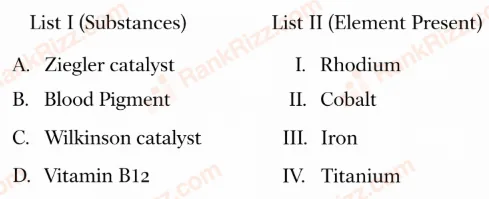
The mismatched combinations are A. Chlorophyll − Co B. Water hardness − EDTA C. Photography − [Ag(CN)2]− D. Wilkinson catalyst − [(Ph3P)3RhCl] E. Chelating ligand − D − Penicillamine Choose the correct answer from the options given below.
JEE MAIN 2021 · 24 FEB S1Stability and applications of coordination compoundsTRANSCRIBED
The stepwise formation of [Cu(NH3)4]2+ is given below: Cu2++NH3K1[Cu(NH3)]2+ [Cu(NH3)]2++NH3K2[Cu(NH3)2]2+ [Cu(NH3)2]2++NH3K3[Cu(NH3)3]2+ [Cu(NH3)3]2++NH3K4[Cu(NH3)4]2+ The value of stability constants K1, K2, K3 and K4 are 104, 1.58×10³, 5×10² and 102 respectively. The overall equilibrium constant for dissociation of [Cu(NH3)4]2+ is x×10−12. The value of x is ______ (Rounded off to the nearest integer)
JEE MAIN 2021 · 27 AUG S1Stability and applications of coordination compoundsTRANSCRIBED
The number of moles of NH3, that must be added to 2 L of 0.80 M AgNO3 in order to reduce the concentration of Ag+ ions to 5.0×10⁻⁸ M (Kformation for [Ag(NH3)2]+=1.0×10⁸) is _________. (Nearest integer) [Assume no volume change on adding NH3]