RankRizz

Coordination Compounds — JEE Main Previous Year Questions

Every Coordination Compounds question JEE Main has set from 2004–2026, grouped by the idea it tests rather than the order of the syllabus. 373 questions across 10 distinct ideas. Free to read, answer key on every one.

Questions

373

Distinct ideas

10

Share of marks

7.7%

Difficulty

MEDIUM

The ideas inside Coordination Compounds

A chapter is not one subject — it is a handful of procedures the examiner reuses. These are the ones Coordination Compounds questions actually test.

Every Coordination Compounds question

41–60 OF 373 · NEWEST FIRST

JEE MAIN 2025 · 22 JAN S2Colour and magnetic behaviour of complexes from CFTTRANSCRIBED

The correct order of the following complexes in terms of their crystal field stabilization energies is :

  1. A

    [Co(NH3)4]2+<[Co(NH3)6]2+<[Co(en)3]3+<[Co(NH3)6]3+[Co(NH_{3})_{4}]^{2+} < [Co(NH_{3})_{6}]^{2+} < [Co(en)_{3}]^{3+} < [Co(NH_{3})_{6}]^{3+}

  2. B

    [Co(NH3)6]2+<[Co(NH3)6]3+<[Co(NH3)4]2+<[Co(en)3]3+[Co(NH_{3})_{6}]^{2+} < [Co(NH_{3})_{6}]^{3+} < [Co(NH_{3})_{4}]^{2+} < [Co(en)_{3}]^{3+}

  3. C

    [Co(en)3]3+<[Co(NH3)6]3+<[Co(NH3)6]2+<[Co(NH3)4]2+[Co(en)_{3}]^{3+} < [Co(NH_{3})_{6}]^{3+} < [Co(NH_{3})_{6}]^{2+} < [Co(NH_{3})_{4}]^{2+}

  4. D

    [Co(NH3)4]2+<[Co(NH3)6]2+<[Co(NH3)6]3+<[Co(en)3]3+[Co(NH_{3})_{4}]^{2+} < [Co(NH_{3})_{6}]^{2+} < [Co(NH_{3})_{6}]^{3+} < [Co(en)_{3}]^{3+}

JEE MAIN 2025 · 24 JAN S2Colour and magnetic behaviour of complexes from CFTTRANSCRIBED

When Ethane-1,2-diamine is added progressively to an aqueous solution of Nickel (II) chloride, the sequence of colour change observed will be :

  1. A

    Violet→Blue→Pale Blue→Green\text{Violet} \rightarrow \text{Blue} \rightarrow \text{Pale Blue} \rightarrow \text{Green}

  2. B

    Pale Blue→Blue→Green→Violet\text{Pale Blue} \rightarrow \text{Blue} \rightarrow \text{Green} \rightarrow \text{Violet}

  3. C

    Green→Pale Blue→Blue→Violet\text{Green} \rightarrow \text{Pale Blue} \rightarrow \text{Blue} \rightarrow \text{Violet}

  4. D

    Pale Blue→Blue→Violet→Green\text{Pale Blue} \rightarrow \text{Blue} \rightarrow \text{Violet} \rightarrow \text{Green}

JEE MAIN 2025 · 29 JAN S2Colour and magnetic behaviour of complexes from CFTTRANSCRIBED

Identify the homoleptic complexes with odd number of d electrons in the central metal : (A) [FeO4]2−[FeO_4]^{2-} (B) [Fe(CN)6]3−[Fe(CN)_6]^{3-} (C) [Fe(CN)5NO]2−[Fe(CN)_5NO]^{2-} (D) [CoCl4]2−[CoCl_4]^{2-} (E) [Co(H2O)3F3][Co(H_2O)_3F_3] Choose the correct answer from the options given below :

  1. A

    (A), (B) and (D) only

  2. B

    (C) and (E) only

  3. C

    (B) and (D) only

  4. D

    (A), (C) and (E) only

JEE MAIN 2025 · 04 APR S1Colour and magnetic behaviour of complexes from CFTTRANSCRIBED

Which one of the following complexes will have Δ0=0\Delta_0 = 0 and μ=5.96\mu = 5.96 B.M.?

  1. A

    [Fe(CN)6]4−[Fe(CN)_6]^{4-}

  2. B

    [CO(NH3)6]3+[CO(NH_3)_6]^{3+}

  3. C

    [FeF6]4−[FeF_6]^{4-}

  4. D

    [Mn(SCN)6]4−[Mn(SCN)_6]^{4-}

JEE MAIN 2025 · 08 APR S2Structural isomerism in complexesTRANSCRIBED

Given below are two statements :
Statement I :
A homoleptic octahedral complex, formed using monodentate ligands, will not show stereoisomerism.
Statement II : cis- and trans-platin are heteroleptic complexes of Pd.
Choose the correct answer from the options given below.

  1. A

    Both Statement I and Statement II are false.

  2. B

    Statement I is false but Statement II is true.

  3. C

    Both Statement I and Statement II are true.

  4. D

    Statement I is true but Statement II is false.

JEE MAIN 2025 · 02 APR S2Valence bond theory of complexesTRANSCRIBED

The type of hybridization and the magnetic property of [MnCl6]3−[MnCl_6]^{3-} are :

  1. A

    d2sp3d^2sp^3, paramagnetic with four unpaired electrons

  2. B

    sp3d2sp^3d^2, paramagnetic with four unpaired electrons

  3. C

    d2sp3d^2sp^3, paramagnetic with two unpaired electrons

  4. D

    sp3d2sp^3d^2, paramagnetic with two unpaired electrons

JEE MAIN 2025 · 22 JAN S2Colour and magnetic behaviour of complexes from CFTTRANSCRIBED

Identify the homoleptic complex(es) that is/are low spin. (A)[Fe(CN)5NO]2−(B)[CoF6]3−(C)[Fe(CN)6]4−(D)[Co(NH3)6]3+(E)[Cr(H2O)6]2+(A)[Fe(CN)_{5}NO]^{2-}(B)[CoF_{6}]^{3-}(C)[Fe(CN)_{6}]^{4-}(D)[Co(NH_{3})_{6}]^{3+}(E)[Cr(H_{2}O)_{6}]^{2+} Choose the correct answer from the options given below :

  1. A

    (C) only

  2. B

    (C) and (D) only

  3. C

    (A) and (C) only

  4. D

    (B) and (E) only

JEE MAIN 2025 · 24 JAN S1Valence bond theory of complexesTRANSCRIBED

One mole of the octahedral complex compound  Co(NH3)5Cl3Co(NH_3)_5Cl_3  gives 3 moles of ions on dissolution in water. One mole of the same complex reacts with excess  AgNO3AgNO_3 solution to yield two moles of  AgCl(s).AgCl(s).  The structure of the complex is:

  1. A

    [Co(NH3)4Cl2]⋅Cl⋅NH3[Co(NH_3)_4Cl_2]\cdot Cl \cdot NH_3

  2. B

    [Co(NH3)3Cl3]⋅2NH3[Co(NH_3)_3Cl_3]\cdot 2NH_3

  3. C

    [Co(NH3)5Cl]Cl2[Co(NH_3)_5Cl]Cl_2

  4. D

    [Co(NH3)4Cl]⋅Cl2⋅NH3[Co(NH_3)_4Cl]\cdot Cl_2 \cdot NH_3

JEE MAIN 2025 · 04 APR S1Structural isomerism in complexesTRANSCRIBED

Number of stereoisomers possible for the complexes, [CrCl3(py)3][CrCl_3(py)_3] and [CrCl2(ox)2]3−[CrCl_2(ox)_2]^{3-} are respectively (py = pyridine, ox = oxalate)

  1. A

    3 & 3

  2. B

    2 & 2

  3. C

    2 & 3

  4. D

    1 & 2

JEE MAIN 2025 · 03 APR S2Colour and magnetic behaviour of complexes from CFTTRANSCRIBED

Identify the diamagnetic octahedral complex ions from below:
A. [Mn(CN)6]3−[Mn(CN)_6]^{3-}
B. [Co(NH3)6]3+[Co(NH_3)_6]^{3+}
C. [Fe(CN)6]4−[Fe(CN)_6]^{4-}
D. [Co(H2O)3F3][Co(H_2O)_3F_3]
Choose the correct answer from the options given below: 

  1. A

    B and D Only

  2. B

    A and D Only

  3. C

    A and C Only

  4. D

    B and C Only

JEE MAIN 2025 · 07 APR S2Valence bond theory of complexesTRANSCRIBED

'X' is the number of acidic oxides among VO2VO_2, V2O3V_2O_3, CrO3CrO_3, V2O5V_2O_5 and Mn2O7Mn_2O_7. The primary valency of cobalt in [Co(H2NCH2CH2NH3)3]2(SO4)3[Co(H_2NCH_2CH_2NH_3)_3]_2(SO_4)_3 is Y. The value of X + Y is :

  1. A

    5

  2. B

    4

  3. C

    2

  4. D

    3

JEE MAIN 2025 · 24 JAN S2Colour and magnetic behaviour of complexes from CFTTRANSCRIBED

{The conditions and consequence that favours the  t2ggeg1t_{2gg} e_g^1  configuration in a metal complex are:

  1. A

    weak field ligand, low spin complex

  2. B

    weak field ligand, high spin complex

  3. C

    strong field ligand, high spin complex

  4. D

    strong field ligand, low spin complex

JEE MAIN 2025 · 29 JAN S2Colour and magnetic behaviour of complexes from CFTTRANSCRIBED

The calculated spin-only magnetic moments of K3[Fe(OH)6]K_3[Fe(OH)_6] and K4[Fe(OH)6]K_4[Fe(OH)_6] respectively are :

  1. A

    3.87 and 4.90 B.M.

  2. B

    4.90 and 5.92 B.M.

  3. C

    4.90 and 4.90 B.M.

  4. D

    5.92 and 4.90 B.M.

JEE MAIN 2025 · 04 APR S2Colour and magnetic behaviour of complexes from CFTTRANSCRIBED

The correct order of [FeF6]3−[FeF_6]^{3-}, [CoF6]3−[CoF_6]^{3-}, [Ni(CO)4][Ni(CO)_4] and [Ni(CN)4]2−[Ni(CN)_4]^{2-} complex species based on the number of unpaired electrons present is :

  1. A

    [FeF6]3−>[CoF6]3−>[Ni(CN)4]2−>[Ni(CO)4][FeF_6]^{3-} > [CoF_6]^{3-} > [Ni(CN)_4]^{2-} > [Ni(CO)_4]

  2. B

    [Ni(CN)4]2−>[FeF6]3−>[CoF6]3−>[Ni(CO)4][Ni(CN)_4]^{2-} > [FeF_6]^{3-} > [CoF_6]^{3-} > [Ni(CO)_4]

  3. C

    [CoF6]3−>[FeF6]3−>[Ni(CO)4]>[Ni(CN)4]2−[CoF_6]^{3-} > [FeF_6]^{3-} > [Ni(CO)_4] > [Ni(CN)_4]^{2-}

  4. D

    [FeF6]3−>[CoF6]3−>[Ni(CN)4]2−=[Ni(CO)4][FeF_6]^{3-} > [CoF_6]^{3-} > [Ni(CN)_4]^{2-} = [Ni(CO)_4]

JEE MAIN 2025 · 29 JAN S1Valence bond theory of complexesTRANSCRIBED

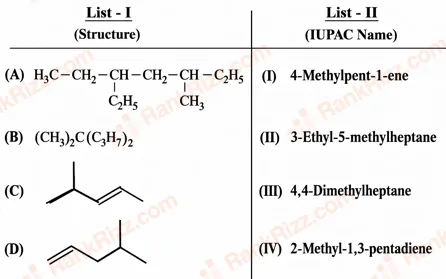
Match List - I with List - II.

Figure for JEE Main 2025 Chemistry question on Valence bond theory of complexes


Choose the correct answer from the options given below :

  1. A

    (A)-(II), (B)-(III), (C)-(IV), (D)-(I)

  2. B

    (A)-(II), (B)-(III), (C)-(I), (D)-(IV)

  3. C

    (A)-(III), (B)-(II), (C)-(I), (D)-(IV)

  4. D

    (A)-(III), (B)-(II), (C)-(IV), (D)-(I)

JEE MAIN 2025 · 07 APR S2Valence bond theory of complexesTRANSCRIBED

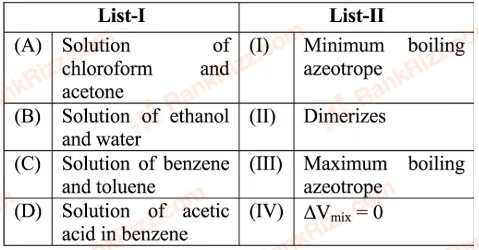
Match List-I with List-II.

Figure for JEE Main 2025 Chemistry question on Valence bond theory of complexes

Choose the correct answer from the options given below :

  1. A

    (A)-(III), (B)-(I), (C)-(IV), (D)-(II)

  2. B

    (A)-(II), (B)-(IV), (C)-(I), (D)-(III)

  3. C

    (A)-(III), (B)-(IV), (C)-(I), (D)-(II)

  4. D

    (A)-(II), (B)-(I), (C)-(IV), (D)-(III)

JEE MAIN 2025 · 03 APR S1Colour and magnetic behaviour of complexes from CFTTRANSCRIBED

The correct order of the complexes [Co(NH3)4(H2O)]3+[Co(NH_3)_4(H_2O)]^{3+} (A), [Co(NH3)6]3+[Co(NH_3)_6]^{3+} (B), [Co(CN)6]3−[Co(CN)_6]^{3-} (C) and [CoCl(NH3)5]2+[CoCl(NH_3)_5]^{2+} (D) in terms of wavelength of light absorbed is :

  1. A

    D>A>B>CD \gt A \gt B \gt C

  2. B

    C>B>D>AC \gt B \gt D \gt A

  3. C

    D>C>B>AD \gt C \gt B \gt A

  4. D

    C>B>A>DC \gt B \gt A \gt D

JEE MAIN 2025 · 02 APR S1Colour and magnetic behaviour of complexes from CFTTRANSCRIBED

Given below are two statements:

Statement (I): In octahedral complexes, when Δo<P\Delta_o \lt P high spin complexes are formed. When Δo>P\Delta_o \gt P low spin complexes are formed.

Statement (II): In tetrahedral complexes because of Δt<P\Delta_t \lt P, low spin complexes are rarely formed.

In the light of the above statements, choose the most appropriate answer from the options given below:

  1. A

    Statement I is correct but Statement II is incorrect.

  2. B

    Both Statement I and Statement II are incorrect

  3. C

    Statement I is incorrect but Statement II is correct

  4. D

    Both Statement I and Statement II are correct

JEE MAIN 2025 · 07 APR S2Colour and magnetic behaviour of complexes from CFTTRANSCRIBED

The number of unpaired electrons responsible for the paramagnetic nature of the following species are respectively : [Fe(CN)6]3−[Fe(CN)_6]^{3-}, [FeF6]3−[FeF_6]^{3-}, [CoF6]3−[CoF_6]^{3-}, [Mn(CN)6]3−[Mn(CN)_6]^{3-}

  1. A

    1, 5, 4, 2

  2. B

    1, 5, 5, 2

  3. C

    1, 1, 4, 2

  4. D

    1, 4, 4, 2

JEE MAIN 2025 · 28 JAN S2Valence bond theory of complexesTRANSCRIBED

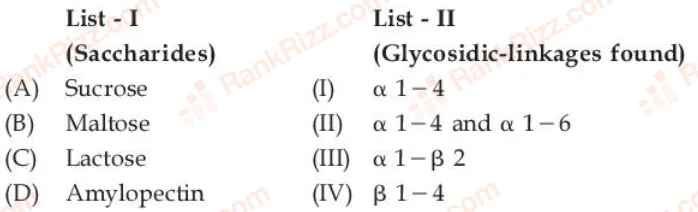
Match List - I with List - II.

page11_img1

Choose the correct answer from the options given below :

  1. A

    (A)-(IV), (B)-(II), (C)-(I), (D)-(III)

  2. B

    (A)-(I), (B)-(II), (C)-(III), (D)-(IV)

  3. C

    (A)-(III), (B)-(I), (C)-(IV), (D)-(II)

  4. D

    (A)-(II), (B)-(IV), (C)-(III), (D)-(I)