JEE Advanced 2025 Physics question — Motion of centre of mass, momentum conservation and explosions
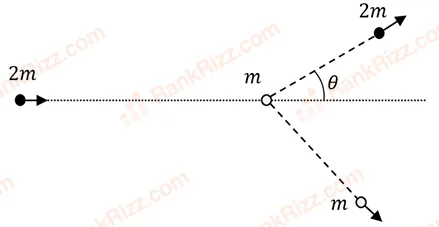
In a scattering experiment, a particle of mass 2m collides with another particle of mass m, which is initially at rest. Assuming the collision to be perfectly elastic, the maximum angular deviation θ of the heavier particle, as shown in the figure, in radians is:
SOLUTION
Let the incident (heavier) particle have mass m1=2m and initial speed u along the +x-axis.
The target particle has mass m2=m and is initially at rest in the laboratory (lab) frame.
Step 1: Velocity of the centre of mass (COM) V=m1+m2m1u+m2×0=2m+m2mu=32u
Step 2: Velocities in the COM frame before collision
Velocity of m1 in COM frame:
u1c=u−V=u−32u=3u (along +x)
Magnitude of this velocity: ∣u1c∣=3u
Step 3: Velocities in the COM frame after an elastic collision
In a perfectly elastic, two-body collision the magnitudes of the velocities in the COM frame remain unchanged; only their directions change.
Hence the heavier particle still has speed 3u in the COM frame, but its direction makes some angle ϕ with the +x-axis.
Write the post-collision COM-frame velocity of m1 as
u1c′=3u(cosϕi^+sinϕj^)
Step 4: Transform back to the lab frame
Lab-frame velocity of m1 after collision:
v1′=V+u1c′=32ui^+3u(cosϕi^+sinϕj^)
Components: vx=32u+3ucosϕvy=3usinϕ
Step 5: Angular deviation of the heavier particle
Let θ be the angle between v1′ and the initial direction (+x). Then
tanθ=vxvy=32u+3ucosϕ3usinϕ=2+cosϕsinϕ−(1)
Step 6: Maximising θ
Because 0<θ<2π, maximising θ is equivalent to maximising tanθ.
Define f(ϕ)=2+cosϕsinϕ.
Differentiating and setting dϕdf=0 gives
dϕdf=(2+cosϕ)2cosϕ(2+cosϕ)+sin2ϕ=(2+cosϕ)22cosϕ+cos2ϕ+sin2ϕ=(2+cosϕ)22cosϕ+1
Setting the numerator to zero: 2cosϕ+1=0⟹cosϕ=−21⟹ϕ=32π
(Only the value within 0≤ϕ≤π is relevant.)
For ϕ<32π, the derivative is positive and for ϕ>32π it is negative, so ϕ=32π indeed gives the maximum.
Step 7: Maximum value of θ
Insert ϕ=32π into equation (1): tanθmax=2+cos(2π/3)sin(2π/3)=2−2123=2323=33=31
Therefore
θmax=tan−1(31)=6π
Option D which is: 6π
Tagged Motion of centre of mass, momentum conservation and explosions. Machine-assigned, so read it as a strong shortlist rather than a verdict.