RankRizz

Thermal Properties of Matter — JEE Main Previous Year Questions

Every Thermal Properties of Matter question JEE Main has set from 2004–2026, grouped by the idea it tests rather than the order of the syllabus. 116 questions across 6 distinct ideas. Free to read, answer key on every one.

Questions

116

Distinct ideas

6

Share of marks

1.6%

Difficulty

MEDIUM

The ideas inside Thermal Properties of Matter

A chapter is not one subject — it is a handful of procedures the examiner reuses. These are the ones Thermal Properties of Matter questions actually test.

Every Thermal Properties of Matter question

101–116 OF 116 · NEWEST FIRST

JEE MAIN 2013 · 25 APR ONLINENewton's law of coolingTRANSCRIBED

A mass of 50 g of water in a closed vessel, with surroundings at a constant temperature from 30°C to 25°C takes 2 minutes to cool. A mass of 100 g of another liquid in an identical vessel with identical surroundings takes the same time to cool from 30°C to 25°C. The specific heat of the liquid is : (The water equivalent of the vessel is 30 g.)

  1. A

    2.0 kcal/kg

  2. B

    7 kcal/kg

  3. C

    3 kcal/kg

  4. D

    0.5 kcal/kg

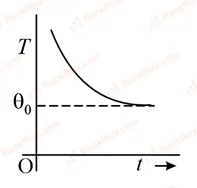
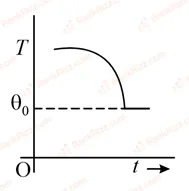
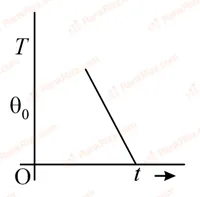
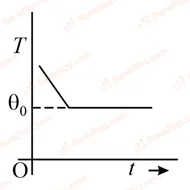
JEE MAIN 2013 · 07 APR ONLINENewton's law of coolingTRANSCRIBED

If a piece of metal is heated to temperature θ\theta and then allowed to cool in a room which is at temperature θ0\theta_0, the graph between the temperature T of the metal and time t will be closest to :

  1. A
    Figure for JEE Main 2013 Physics question on Newton's law of cooling
  2. B
    Figure for JEE Main 2013 Physics question on Newton's law of cooling
  3. C
    Figure for JEE Main 2013 Physics question on Newton's law of cooling
  4. D
    Figure for JEE Main 2013 Physics question on Newton's law of cooling
JEE MAIN 2013 · 09 APR ONLINETemperature scales and thermal expansionTRANSCRIBED

On a linear temperature scale Y, water freezes at −160°-160°Y and boils at −50°-50°Y. On this Y scale, a temperature of 340 K would be read as : (water freezes at 273 K and boils at 373 K)

  1. A

    −73.7°-73.7°Y

  2. B

    −233.7°-233.7°Y

  3. C

    −86.3°-86.3°Y

  4. D

    −106.3°-106.3°Y

JEE MAIN 2013 · 23 APR ONLINETemperature scales and thermal expansionTRANSCRIBED

The ratio of the coefficient of volume expansion of a glass container to that of a viscous liquid kept inside the container is 1 : 4. What fraction of the inner volume of the container should the liquid occupy so that the volume of the remaining vacant space will be same at all temperatures?

  1. A

    2 : 5

  2. B

    1 : 4

  3. C

    1 : 64

  4. D

    1 : 8

JEE MAIN 2013 · 23 APR ONLINEChange of state and latent heatTRANSCRIBED

500 g of water and 100 g of ice at 0°C are in a calorimeter whose water equivalent is 40 g. 10 g of steam at 100°C is added to it. Then water in the calorimeter is : (Latent heat of ice = 80 cal/g, Latent heat of steam = 540 cal/g)

  1. A

    580 g

  2. B

    590 g

  3. C

    600 g

  4. D

    610 g

JEE MAIN 2012Newton's law of coolingTRANSCRIBED

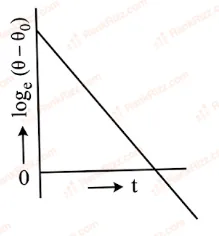
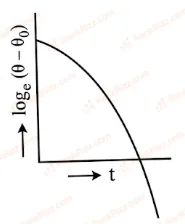
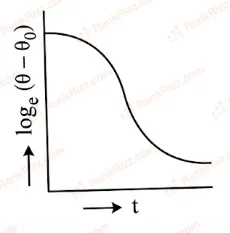
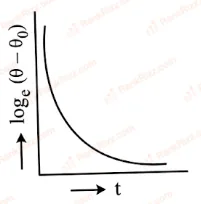
A liquid in a beaker has temperature θ(t)\theta(t) at time tt and θ0\theta_0 is temperature of surroundings, then according to Newton's law of cooling the correct graph between log⁡e(θ−θ0)\log_e(\theta-\theta_0) and tt is

  1. A
    Figure for JEE Main 2012 Physics question on Newton's law of cooling
  2. B
    Figure for JEE Main 2012 Physics question on Newton's law of cooling
  3. C
    Figure for JEE Main 2012 Physics question on Newton's law of cooling
  4. D
    Figure for JEE Main 2012 Physics question on Newton's law of cooling
JEE MAIN 2012Thermal radiation: Stefan's law, Wien's law and Kirchhoff's lawTRANSCRIBED

The heat radiated per unit area in 1 hour by a furnace whose temperature is 3000 K is (σ=5.7×10⁻⁸ W m−2K−4\sigma = 5.7 \times 10^{-8}\ \text{W m}^{-2}\text{K}^{-4})

  1. A

    1.7×10101.7 \times 10^{10} J

  2. B

    1.1×10121.1 \times 10^{12} J

  3. C

    2.8×1082.8 \times 10^{8} J

  4. D

    4.6×1064.6 \times 10^{6} J

JEE MAIN 2012Heat conduction and thermal resistanceTRANSCRIBED

A large cylindrical rod of length LL is made by joining two identical rods of copper and steel of length (L2)\left(\frac{L}{2}\right) each. The rods are completely insulated from the surroundings. If the free end of copper rod is maintained at 100∘C100^\circ C and that of steel at 0∘C0^\circ C then the temperature of junction is (Thermal conductivity of copper is 99 times that of steel)

  1. A

    90∘C90^\circ C

  2. B

    50∘C50^\circ C

  3. C

    10∘C10^\circ C

  4. D

    67∘C67^\circ C

JEE MAIN 2011Calorimetry and specific heat capacityTRANSCRIBED

100 g100 \, \text{g} of water is heated from 30∘C30^\circ \text{C} to 50∘C50^\circ \text{C}. Ignoring the slight expansion of the water, the change in its internal energy is (specific heat of water is 4148 J/kg/K4148 \, \text{J/kg/K}):

  1. A

    8.4 kJ8.4 \, \text{kJ}

  2. B

    84 kJ84 \, \text{kJ}

  3. C

    2.1 kJ2.1 \, \text{kJ}

  4. D

    4.2 kJ4.2 \, \text{kJ}

JEE MAIN 2009Heat conduction and thermal resistanceTRANSCRIBED

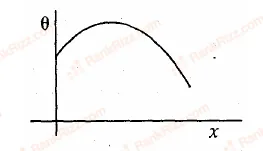
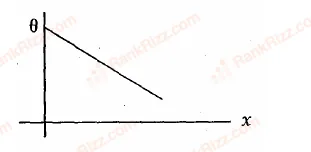
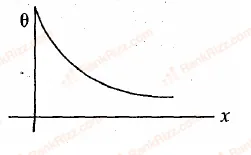
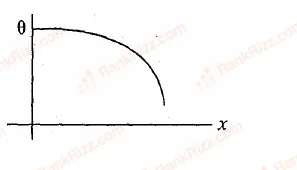
A long metallic bar is carrying heat from one of its ends to the other end under steady-state. The variation of temperature θ\theta along the length xx of the bar from its hot end is best described by which of the following figure.

  1. A
    Figure for JEE Main 2009 Physics question on Heat conduction and thermal resistance
  2. B
    Figure for JEE Main 2009 Physics question on Heat conduction and thermal resistance
  3. C
    Figure for JEE Main 2009 Physics question on Heat conduction and thermal resistance
  4. D
    Figure for JEE Main 2009 Physics question on Heat conduction and thermal resistance
JEE MAIN 2007Heat conduction and thermal resistanceTRANSCRIBED

One end of a thermally insulated rod is kept at a temperature T1T_1 and the other at T2T_2. The rod is composed of two sections of lengths ℓ1\ell_1 and ℓ2\ell_2 and thermal conductivities k1k_1 and k2k_2 respectively. The temperature at the interface of the two sections is

  1. A

    (k2ℓ2T1+k1ℓ1T2)/(k1ℓ1+k2ℓ2)(k_2 \ell_2 T_1 + k_1 \ell_1 T_2)/(k_1 \ell_1 + k_2 \ell_2)

  2. B

    (k2ℓ1T1+k1ℓ1T2)/(k2ℓ1+k1ℓ1)(k_2 \ell_1 T_1 + k_1 \ell_1 T_2)/(k_2 \ell_1 + k_1 \ell_1)

  3. C

    (k1ℓ2T1+k2ℓ1T2)/(k1ℓ2+k2ℓ1)(k_1 \ell_2 T_1 + k_2 \ell_1 T_2)/(k_1 \ell_2 + k_2 \ell_1)

  4. D

    (k1ℓ1T1+k2ℓ2T2)/(k1ℓ1+k2ℓ2)(k_1 \ell_1 T_1 + k_2 \ell_2 T_2)/(k_1 \ell_1 + k_2 \ell_2)

JEE MAIN 2006Thermal radiation: Stefan's law, Wien's law and Kirchhoff's lawTRANSCRIBED

Assuming the sun to be a spherical body of radius RR at a temperature of T KT\,K, evaluate the total radiant power, incident on Earth, at a distance rr from the Sun.

  1. A

    R2σT4r2\dfrac{R^2\sigma T^4}{r^2}

  2. B

    4πr02R2σT4r2\dfrac{4\pi r_0^2 R^2 \sigma T^4}{r^2}

  3. C

    πr02R2σT4r2\dfrac{\pi r_0^2 R^2 \sigma T^4}{r^2}

  4. D

    r02R2σT44πr2\dfrac{r_0^2 R^2 \sigma T^4}{4\pi r^2}

JEE MAIN 2005Heat conduction and thermal resistanceTRANSCRIBED

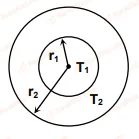
The figure shows a system of two concentric spheres of radii r1r_1 and r2r_2 and kept at temperatures T1T_1 and T2T_2 respectively. The radial rate of flow of heat in a substance between the two concentric sphere is proportional to Figure for JEE Main 2005 Physics question on Heat conduction and thermal resistance

  1. A

    r2−r1r1r2\frac{r_2 - r_1}{r_1 r_2}

  2. B

    ln⁡(r2r1)\ln\left(\frac{r_2}{r_1}\right)

  3. C

    r1r2r2−r1\frac{r_1 r_2}{r_2 - r_1}

  4. D

    ln⁡(r2−r1)\ln(r_2 - r_1)

JEE MAIN 2004Thermal radiation: Stefan's law, Wien's law and Kirchhoff's lawTRANSCRIBED

If the temperature of the sun were to increase from TT to 2T2T and its radius from RR to 2R2R, then the ratio of the radiant energy received on earth to what it was previously will be

  1. A

    44

  2. B

    1616

  3. C

    3232

  4. D

    6464

JEE MAIN 2004Heat conduction and thermal resistanceTRANSCRIBED

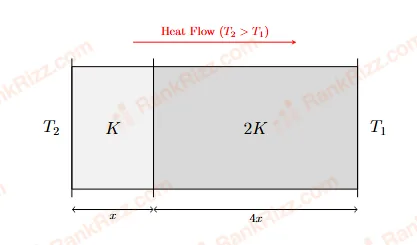
The temperature of two outer surfaces of a composite slab, consisting of two materials having coefficients of thermal conductivity KK and 2K2K and thickness xx and 4x4x, respectively are T2T_2 and T1T_1 (T2>T1)(T_2 > T_1). The rate of heat transfer through the slab, in a steady state is (A(T2−T1)Kx)f\left(\frac{A(T_2 - T_1)K}{x}\right)f, with ff equal to

Figure for JEE Main 2004 Physics question on Heat conduction and thermal resistance
  1. A

    11

  2. B

    1/21/2

  3. C

    2/32/3

  4. D

    1/31/3

JEE MAIN 2004Calorimetry and specific heat capacityTRANSCRIBED

Time taken by a 836836 W heater to heat one litre of water from 10∘10^\circC to 40∘40^\circC is

  1. A

    5050 s

  2. B

    100100 s

  3. C

    150150 s

  4. D

    200200 s