JEE MAIN 2025 · 29 JAN S2Newton's law of coolingTRANSCRIBED
A cup of coffee cools from to in t minutes when the room temperature is . The time taken by the similar cup of coffee to cool from to at the same room temperature is :
- A
- B
- C
- D
Every JEE Main question on Newton's law of cooling, one of the ideas inside Thermal Properties of Matter: 18 questions from 2012–2025, 10 of them in the last five years. Newest first, answer key on every one. Free to read.
Questions
18
Years asked
10
Since
2012
Of the chapter
16%
Questions on Newton's law of cooling in each year it was asked.
1–18 OF 18 · NEWEST FIRST
A cup of coffee cools from to in t minutes when the room temperature is . The time taken by the similar cup of coffee to cool from to at the same room temperature is :
The temperature of a body in air falls from to in 4 minutes. The temperature of the air is . The temperature of the body in the next 4 minutes will be:
A body cools from C to in minutes. The temperature for the surrounding is C. The time it takes to cool from C to C is
s
s
s
s
A bowl filled with very hot soup cools from 98°C to 86°C in 2 minutes when the room temperature is 22°C. How long it will take to cool from 75°C to 69°C?
2 minute
1.4 minute
0.5 minute
1 minute
A body cools in 7 minutes from 60°C to 40°C. The temperature of the surrounding is 10°C. The temperature of the body after the next 7 minutes will be
30°C
32°C
34°C
28°C
A body cools from C to C in minutes. If, temperature of surroundings is C. Then, after the next 6 minutes, its temperature will be ______ °C.
Read the following statements:
A. When small temperature difference between a liquid and its surrounding is doubled the rate of loss of heat of the liquid becomes twice.
B. Two bodies P and Q having equal surface areas are maintained at temperature and . The thermal radiation emitted in a given time by P and Q are in the ratio .
C. A Carnot Engine working between and has an efficiency of .
D. When small temperature difference between a liquid and its surrounding is quadrupled, the rate of loss of heat of the liquid becomes twice.
Choose the correct answer from the options given below:
A, B, C only
A, B only
A, C only
B, C, D only
In an experiment to verify Newton's law of cooling, a graph is plotted between the temperature difference of the water and surroundings and time as shown in figure. The initial temperature of water is taken as C. The value of as mentioned in the graph will be ______
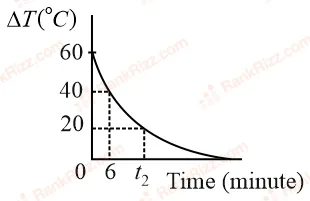
A body takes 4 min to cool from 61°C to 59°C. If the temperature of the surroundings is 30°C, the time taken by the body to cool from 51°C to 49°C is:
4 min.
3 min.
8 min.
6 min.
In 5 minutes, a body cools from 75 C to 65 C at room temperature of 25 C. The temperature of body at the end of next 5 minutes is ___ C.
A metallic sphere cools from 50°C to 40°C in 300 s. If atmospheric temperature around is 20°C, then the sphere's temperature after the next 5 minutes will be close to:
31°C
33°C
28°C
35°C
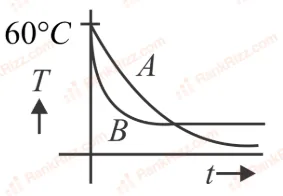
Two identical beakers A and B contain equal volumes of two different liquids at 60°C each and left to cool down. Liquid in A has density of kg m and specific heat of 2000 J kgK while the liquid in B has density kg m and specific heat of 4000 J kgK. Which of the following best describes their temperature versus time graph schematically? (assume the emissivity of both the beakers to be the same)
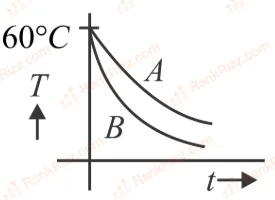
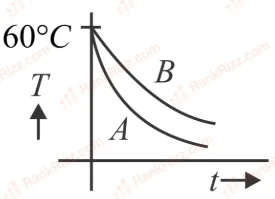
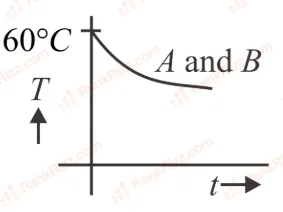
A body takes 10 minutes to cool from 60C to 50C. The temperature of surroundings is constant at 25C. Then, the temperature of the body after next 10 minutes will be approximately
43C
47C
41C
45C
A hot body, obeying Newton's law of cooling is cooling down from its peak value 80°C to an ambient temperature of 30°C. It takes 5 minutes in cooling down from 80°C to 40°C. How much time will it take to cool down from 62°C to 32°C? (Given ln 2 = 0.693, ln 5 = 1.609)
3.75 minutes
8.6 minutes
9.6 minutes
6.5 minutes
Hot water cools from 60°C to 50°C in the first 10 minutes and to 42°C in the next 10 minutes. The temperature of the surroundings is:
25°C
10°C
15°C
20°C
A mass of 50 g of water in a closed vessel, with surroundings at a constant temperature from 30°C to 25°C takes 2 minutes to cool. A mass of 100 g of another liquid in an identical vessel with identical surroundings takes the same time to cool from 30°C to 25°C. The specific heat of the liquid is : (The water equivalent of the vessel is 30 g.)
2.0 kcal/kg
7 kcal/kg
3 kcal/kg
0.5 kcal/kg
If a piece of metal is heated to temperature and then allowed to cool in a room which is at temperature , the graph between the temperature T of the metal and time t will be closest to :
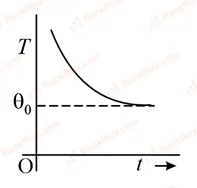
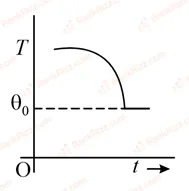
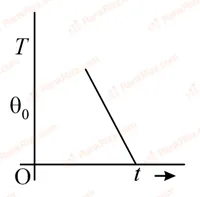
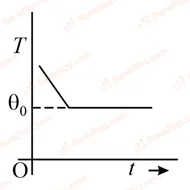
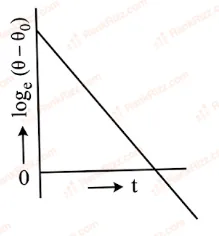
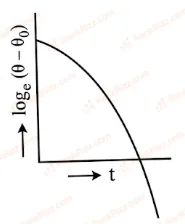
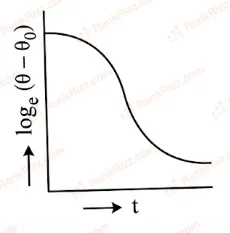
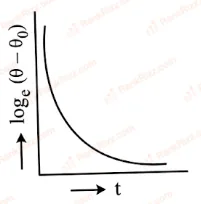
A liquid in a beaker has temperature at time and is temperature of surroundings, then according to Newton's law of cooling the correct graph between and is