JEE Main 2004 Physics question — Heat conduction and thermal resistance
The temperature of two outer surfaces of a composite slab, consisting of two materials having coefficients of thermal conductivity and and thickness and , respectively are and . The rate of heat transfer through the slab, in a steady state is , with equal to
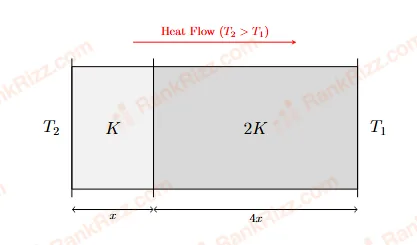
SOLUTION
In a steady state, the rate of heat transfer () through a composite slab consisting of two layers in series is constant throughout both layers. We can solve this using the thermal resistance analogy, where thermal resistance () is given by:
Where:
is the thickness of the material.
is the coefficient of thermal conductivity.
is the cross-sectional area of the slab (assumed to be the same for both layers).
Let's calculate the individual thermal resistances for the two slabs:
1. For the first slab layer:
2. For the second slab layer:
3. Equivalent Thermal Resistance ():
Since the two layers are joined in series, their individual thermal resistances simply add up:
4. Rate of Heat Transfer ():
The total rate of heat transfer through the entire composite slab driven by the outer temperature difference is:
Substitute the value of into the equation:
5. Finding the value of :
The problem states that the rate of heat transfer is given by:
Comparing our derived expression with the given equation, we find:
The value of is equal to .
Tagged Heat conduction and thermal resistance. Machine-assigned, so read it as a strong shortlist rather than a verdict.