A gas based geyser heats water flowing at the rate of 5.0 litres per minute from 27°C to 87°C. The rate of consumption of the gas is ___ g/s. (take heat of combustion of ) specific heat capacity of water =4200 J/ kg.°C
- A
0.42
- B
0.21
- C
2.1
- D
4.2
Every JEE Main question on Calorimetry and specific heat capacity, one of the ideas inside Thermal Properties of Matter: 23 questions from 2004–2026, 6 of them in the last five years. Newest first, answer key on every one. Free to read.
Questions
23
Years asked
13
Since
2004
Of the chapter
20%
Questions on Calorimetry and specific heat capacity in each year it was asked, the latest 12 of 13.
1–20 OF 23 · NEWEST FIRST
A gas based geyser heats water flowing at the rate of 5.0 litres per minute from 27°C to 87°C. The rate of consumption of the gas is ___ g/s. (take heat of combustion of ) specific heat capacity of water =4200 J/ kg.°C
0.42
0.21
2.1
4.2
Water falls from a height of 200 m into a pool. Calculate the rise in temperature of the water assuming no heat dissipation from the water in the pool. (Take m/s, specific heat of water = 4200 J/(kg K))
0.23 K
0.36 K
0.14 K
0.48 K
Match List-I with List-II.
List-I
(A) Heat capacity of body
(B) Specific heat capacity of body
(C) Latent heat
(D) Thermal conductivity
List-II
(I) J kg
(II) J K
(III) J kg K
(IV) J m K s
Choose the correct answer from the options given below :
(A)-(III), (B)-(I), (C)-(II), (D)-(IV)
(A)-(IV), (B)-(III), (C)-(II), (D)-(I)
(A)-(III), (B)-(IV), (C)-(I), (D)-(II)
(A)-(II), (B)-(III), (C)-(I), (D)-(IV)
A water heater of power 2000 W is used to heat water. The specific heat capacity of water is 4200 J kg K. The efficiency of heater is 70%. Time required to heat 2 kg of water from 10°C to 60°C is ______ s. (Assume that the specific heat capacity of water remains constant over the temperature range of the water).
A g of iron nail is hit by a kg hammer striking at a velocity of ms. What will be the rise in the temperature of the nail if one fourth of energy of the hammer goes into heating the nail? [Specific heat capacity of iron J g °C]
C
C
C
C
A geyser heats water flowing at a rate of kg per minute from C to C. If geyser operates on a gas burner, the rate of combustion of fuel will be ______ g min.
[Heat of combustion J g, Specific heat of water J g °C]
The height of victoria's falls is 63 m. What is the difference in the temperature of water at the top and at the bottom of the fall? [Given 1 cal = 4.2 J and specific heat of water = 1 cal g °C]
14.76 °C
1.476 °C
0.147 °C
0.014 °C
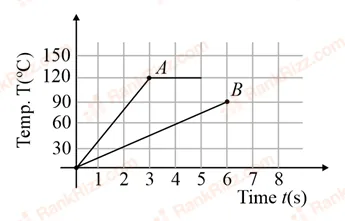
Two different metal bodies A and B of equal mass are heated at a uniform rate under similar conditions. The variation of temperature of the bodies is graphically represented as shown in the figure. The ratio of specific heat capacities is:

The temperature of equal masses of three different liquids , and are 10°C, 20°C and 30°C respectively. The temperature of mixture when is mixed with is 16°C and that when is mixed with is 26°C. The temperature of mixture when and are mixed will be:
25.62°C
20.28°C
28.32°C
23.84°C
A bullet of mass , travelling with a speed of , strikes a fixed wooden target. One half of its kinetic energy is converted into heat in the wood. The rise of temperature of the bullet if the specific heat of its material is () close to:
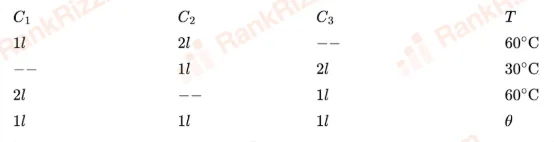
Three containers , and have water at different temperatures. The table below shows the final temperature T when different amounts of water (given in liters) are taken from each container and mixed (assume no loss of heat during the process)
The value of (in C to the nearest integer) is__________
An unknown metal of mass 192 g heated to a temperature of 100C was immersed into a brass calorimeter of mass 128 g containing 240 g of water at a temperature of 8.4C. Calculate the specific heat of the unknown metal if water temperature stabilizes at 21.5C. (Specific heat of brass is 394 J kgK)
916 J kg K
458 J kg K
654 J kg K
1232 J kg K
When 100 g of a liquid A at is added to 50 g of a liquid B at temperature , the temperature of the mixture becomes . The temperature of the mixture, if 100 g of liquid A at is added to 50 g of liquid B at , will be:
A metal ball of mass 0.1 kg is heated upto and dropped into a vessel of heat capacity and containing 0.5 kg water. The initial temperature of water and vessel is . What is the approximate percentage increment in the temperature of the water? [Specific Heat Capacities of water and metal are, respectively, and ]
15%
30%
25%
20%
A massless spring (k = 800 N/m), attached with a mass (500 g) is completely immersed in 1 kg of water. The spring is stretched by 2 cm and released so that it starts vibrating. What would be the order of magnitude of the change in the temperature of water when the vibrations stop completely? (Assume that the water container and spring receive negligible heat and specific heat of mass = 400 J/kg K, water = 4184 J/kg K)
K
K
K
K
The mass of a hydrogen molecule is kg. If hydrogen molecules strike, per second, a fixed wall of the area 2 cm at an angle of 45 to the normal, and rebound elastically with a speed of m s, then the pressure on the wall is nearly:
N m
N m
N m
N m
Two moles of an ideal monoatomic gas occupies a volume V at 27C. The gas expands adiabatically to a volume 2V. Calculate (a) the final temperature of the gas and (b) change in its internal energy.
(a) 195 K (b) 2.7 kJ
(a) 189 K (b) 2.7 kJ
(a) 195 K (b) -2.7 kJ
(a) 189 K (b) -2.7 kJ
A copper ball of mass 100 g is at a temperature . It is dropped in a copper calorimeter of mass 100 g, filled with 170 g of water at room temperature. Subsequently, the temperature of the system is found to be 75°C. is given by:
(Given: room temperature = 30°C, specific heat of copper = 0.1 cal g °C)
825°C
800°C
885°C
1250°C
In an experiment, a sphere of aluminium of mass 0.20 kg is heated up to 150°C. Immediately, it is put into water of volume 150 cc at 27°C kept in a calorimeter of water equivalent to 0.025 kg. The final temperature of the system is 40°C. The specific heat of the aluminium is (take 4.2 Joule = 1 calorie):
434 J kg °C
378 J kg °C
315 J kg °C
476 J kg °C
200 g water is heated from 40°C to 60°C. Ignoring the slight expansion of water, the change in its internal energy is close to (Given specific heat of water = 4184 J kg K):
167.4 kJ
8.4 kJ
4.2 kJ
16.7 kJ