RankRizz

Moving Charges & Magnetism — JEE Main Previous Year Questions

Every Moving Charges & Magnetism question JEE Main has set from 2004–2026, grouped by the idea it tests rather than the order of the syllabus. 249 questions across 8 distinct ideas. Free to read, answer key on every one.

Questions

249

Distinct ideas

8

Share of marks

3.8%

Difficulty

MEDIUM

The ideas inside Moving Charges & Magnetism

A chapter is not one subject — it is a handful of procedures the examiner reuses. These are the ones Moving Charges & Magnetism questions actually test.

01Biot-Savart law: straight wires and moving chargesset 75×
02Magnetic field of circular loops, arcs and coilsset 5×
03Ampere's circuital law: cylinders, solenoids and toroidsset 19×04Motion of charged particles in a magnetic fieldset 69×
05Charged particles in combined electric and magnetic fieldsset 6×
06Force on current-carrying conductors and between parallel wiresset 4×
07Magnetic dipole moment of current loops and torque on loopsset 61×08Moving coil galvanometerset 10×

Every Moving Charges & Magnetism question

161–180 OF 249 · NEWEST FIRST

JEE MAIN 2020 · 02 SEP S2Magnetic dipole moment of current loops and torque on loopsTRANSCRIBED

A wire carrying current I is bent in the shape ABCDEFA as shown, where rectangle ABCDA and ADEFA are perpendicular to each other. If the sides of the rectangles are of lengths a and b, then the magnitude and direction of magnetic moment of the loop ABCDEFA is:
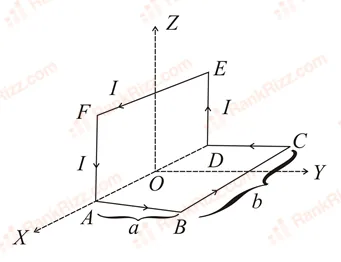
Figure for JEE Main 2020 Physics question on Magnetic dipole moment of current loops and torque on loops
  1. A

    2abI\sqrt{2}abI along (j^2+k^2)\left(\frac{\hat{j}}{\sqrt{2}} + \frac{\hat{k}}{\sqrt{2}}\right)

  2. B

    abIabI along (j^2+k^2)\left(\frac{\hat{j}}{\sqrt{2}} + \frac{\hat{k}}{\sqrt{2}}\right)

  3. C

    2abI\sqrt{2}abI along (j^5+2k^5)\left(\frac{\hat{j}}{\sqrt{5}} + \frac{2\hat{k}}{\sqrt{5}}\right)

  4. D

    abIabI along (j^5+k^5)\left(\frac{\hat{j}}{\sqrt{5}} + \frac{\hat{k}}{\sqrt{5}}\right)

JEE MAIN 2020 · 09 JAN S1Ampere's circuital law: cylinders, solenoids and toroidsTRANSCRIBED

A long, straight wire of radius aa carries a current distributed uniformly over its cross-section. The ratio of the magnetic fields due to the wire at distance a3\frac{a}{3} and 2a2a, respectively from the axis of the wire is:

  1. A

    23\frac{2}{3}

  2. B

    2

  3. C

    12\frac{1}{2}

  4. D

    32\frac{3}{2}

JEE MAIN 2020 · 04 SEP S1Biot-Savart law: straight wires and moving chargesTRANSCRIBED

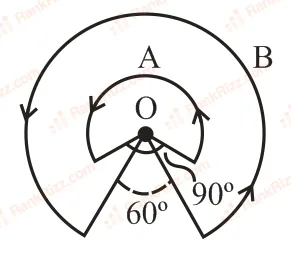
A wire A, bent in the shape of an arc of a circle, carrying a current of 2 A and having radius 2 cm and another wire B, also bent in the shape of an arc of a circle, carrying a current of 3 A and having radius of 4 cm, are placed as shown in the figure. The ratio of the magnetic fields due to the wires A and B at the common centre O is:

Figure for JEE Main 2020 Physics question on Biot-Savart law: straight wires and moving charges
  1. A

    4 : 6

  2. B

    6 : 4

  3. C

    2 : 5

  4. D

    6 : 5

JEE MAIN 2020 · 08 JAN S1Motion of charged particles in a magnetic fieldTRANSCRIBED

Proton with kinetic energy of 1 MeV moves from south to north. It gets an acceleration of 101210^{12} m/s2^2 by an applied magnetic field (west to east). The value of magnetic field: (Rest mass of proton is 1.6×10−271.6 \times 10^{-27} kg)

  1. A

    0.71 mT

  2. B

    7.1 mT

  3. C

    0.071 mT

  4. D

    71 mT

JEE MAIN 2020 · 08 JAN S2Biot-Savart law: straight wires and moving chargesTRANSCRIBED

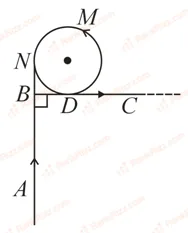
A very long wire ABDMNDC is shown in figure carrying current I. AB and BC parts are straight, long and at right angle. At D wire forms a circular turn DMND of radius R. AB, BC parts are tangential to circular turn at N and D. Magnetic field at the center of circle is:

Figure for JEE Main 2020 Physics question on Biot-Savart law: straight wires and moving charges
  1. A

    μ0I2πR(π+12)\frac{\mu_0 I}{2\pi R}\left(\pi + \frac{1}{\sqrt{2}}\right)

  2. B

    μ0I2πR(π−12)\frac{\mu_0 I}{2\pi R}\left(\pi - \frac{1}{\sqrt{2}}\right)

  3. C

    μ0I2πR(π+1)\frac{\mu_0 I}{2\pi R}(\pi + 1)

  4. D

    μ0I2R\frac{\mu_0 I}{2R}

JEE MAIN 2020 · 09 JAN S1Charged particles in combined electric and magnetic fieldsTRANSCRIBED

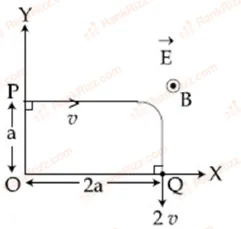
A charged particle of mass 'm' and charge 'q' moving under the influence of uniform electric field Ei^E\hat{i} and a uniform magnetic field Bk^B\hat{k} follows a trajectory from point P to Q as shown in figure. The velocities at P and Q are respectively, vi^v\hat{i} and −2vj^-2v\hat{j}. Then which of the following statements (A, B, C, D) are the correct? (Trajectory shown is schematic and not to scale)

Figure for JEE Main 2020 Physics question on Charged particles in combined electric and magnetic fields


(A) E=34(mv2qa)E = \frac{3}{4}\left(\frac{mv^2}{qa}\right)
(B) Rate of work done by the electric field at P is 34(mv3a)\frac{3}{4}\left(\frac{mv^3}{a}\right)
(C) Rate of work done by both the fields at Q is zero
(D) The difference between the magnitude of angular momentum of the particle at P and Q is 2mav2mav.

  1. A

    (A),(C),(D)(A), (C), (D)

  2. B

    (B),(C),(D)(B), (C), (D)

  3. C

    (A),(B),(C)(A), (B), (C)

  4. D

    (A),(B),(C),(D)(A), (B), (C), (D)

JEE MAIN 2020 · 06 SEP S2Magnetic dipole moment of current loops and torque on loopsTRANSCRIBED

A charged particle going around in a circle can be considered to be a current loop. A particle of a mass mm carrying charge qq is moving in a plane with speed vv under the influence of magnetic field B⃗\vec{B}. The magnetic moment of this moving particle is:

  1. A

    mv2B⃗2B2\frac{mv^2\vec{B}}{2B^2}

  2. B

    −mv2B⃗2πB2-\frac{mv^2\vec{B}}{2\pi B^2}

  3. C

    −mv2B⃗B2-\frac{mv^2\vec{B}}{B^2}

  4. D

    −mv2B⃗2B2-\frac{mv^2\vec{B}}{2B^2}

JEE MAIN 2020 · 04 SEP S2Magnetic dipole moment of current loops and torque on loopsTRANSCRIBED

A circular coil has moment of inertia 0.8 kg m2^2 around any diameter and is carrying current to produce a magnetic moment of 20 Am2^2. The coil is kept initially in a vertical position and it can rotate freely around a horizontal diameter. When a uniform magnetic field of 4 T is applied along the vertical, it starts rotating around its horizontal diameter. The angular speed the coil acquires after rotating by 60° will be:

  1. A

    10 rad s−1^{-1}

  2. B

    10π10\pi rad s−1^{-1}

  3. C

    20π20\pi rad s−1^{-1}

  4. D

    20 rad s−1^{-1}

JEE MAIN 2020 · 06 SEP S2Magnetic dipole moment of current loops and torque on loopsTRANSCRIBED

A square loop of side 2a2a and carrying current I is kept in xz plane with its centre at origin. A long wire carrying the same current I is placed parallel to z-axis and passing through point (0,b,0)(0, b, 0), (b>>a)(b >> a). The magnitude of torque on the loop about z-axis will be:

  1. A

    2μ0I2a2πb\frac{2\mu_0 I^2 a^2}{\pi b}

  2. B

    2μ0I2a2bπ(a2+b2)\frac{2\mu_0 I^2 a^2 b}{\pi(a^2+b^2)}

  3. C

    μ0I2a2b2π(a2+b2)\frac{\mu_0 I^2 a^2 b}{2\pi(a^2+b^2)}

  4. D

    μ0I2a22πb\frac{\mu_0 I^2 a^2}{2\pi b}

JEE MAIN 2020 · 05 SEP S1Magnetic dipole moment of current loops and torque on loopsTRANSCRIBED

A square loop of side 2a2a, and carrying current II, is kept in XZXZ plane with its centre at origin. A long wire carrying the same current II is placed parallel to the zz-axis and passing through the point (0,b,0)(0, b, 0), (b>>a)(b >> a). The magnitude of the torque on the loop about zz-axis is given by:

  1. A

    μ0I2a22πb\frac{\mu_0 I^2 a^2}{2\pi b}

  2. B

    μ0I2a22πb2\frac{\mu_0 I^2 a^2}{2\pi b^2}

  3. C

    2μ0I2a2πb\frac{2\mu_0 I^2 a^2}{\pi b}

  4. D

    2μ0I2a3πb2\frac{2\mu_0 I^2 a^3}{\pi b^2}

JEE MAIN 2020 · 03 SEP S2Moving coil galvanometerTRANSCRIBED

A galvanometer coil has 500 turns and each turn has an average area of 3×10−43 \times 10^{-4} m2^2. If a torque of 1.5 Nm is required to keep this coil parallel to a magnetic field when a current of 0.5A is flowing through it, the strength of the field (in T) is __________.

JEE MAIN 2019 · 10 JAN S2Magnetic dipole moment of current loops and torque on loopsTRANSCRIBED

A hoop and a solid cylinder of same mass and radius are made of a permanent magnetic material with their respective axes. But the magnetic moment of hoop is twice of solid cylinder. They are placed in a uniform magnetic field in such a manner that their magnetic moments make a small angle with the field. If the oscillation periods of hoop and cylinder are ThT_h and TcT_c respectively, then:

  1. A

    Th=2TcT_h = 2T_c

  2. B

    Th=TcT_h = T_c

  3. C

    Th=0.5TcT_h = 0.5T_c

  4. D

    Th=1.5TcT_h = 1.5T_c

JEE MAIN 2019 · 08 APR S1Magnetic dipole moment of current loops and torque on loopsTRANSCRIBED

A circular coil having N turns and radius r carries a current I. It is held in the XZ plane in a magnetic field Bi^B\hat{i}. The torque on the coil due to the magnetic field is:

  1. A

    Bπr2INB\pi r^{2}IN

  2. B

    Br2IπN\frac{Br^{2}I}{\pi N}

  3. C

    Bπr2IN\frac{B\pi r^{2}I}{N}

  4. D

    Zero

JEE MAIN 2019 · 11 JAN S1Motion of charged particles in a magnetic fieldTRANSCRIBED

In an experiment, electrons are accelerated, from rest, by applying a voltage of 500 V. Calculate the radius of the path if a magnetic field 100 mT is then applied. [Charge of the electron =1.6×10−19= 1.6 \times 10^{-19} C; Mass of the electron =9.1×10−31= 9.1 \times 10^{-31} kg]

  1. A

    7.5×10−37.5 \times 10^{-3} m

  2. B

    7.5×10−27.5 \times 10^{-2} m

  3. C

    7.5 m

  4. D

    7.5×10−47.5 \times 10^{-4} m

JEE MAIN 2019 · 10 APR S1Magnetic dipole moment of current loops and torque on loopsTRANSCRIBED

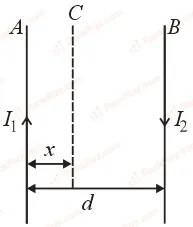
Two wires A & B are carrying currents I1_1 and I2_2 as shown in the figure. The separation between them is d. A third wire C carrying a current I is to be kept parallel to them at a distance x from A such that the net force acting on it is zero. The possible values of x are:

Figure for JEE Main 2019 Physics question on Magnetic dipole moment of current loops and torque on loops
  1. A

    x=±I1d(I1−I2)x = \pm\frac{I_1 d}{(I_1 - I_2)}

  2. B

    x=(I1I1+I2)dx = \left(\frac{I_1}{I_1 + I_2}\right)d and x=I2(I1−I2)dx = \frac{I_2}{(I_1 - I_2)}d

  3. C

    x=(I2I1+I2)dx = \left(\frac{I_2}{I_1 + I_2}\right)d and x=(I2I1−I2)dx = \left(\frac{I_2}{I_1 - I_2}\right)d

  4. D

    x=(I1I1−I2)dx = \left(\frac{I_1}{I_1 - I_2}\right)d and x=I2(I1+I2)dx = \frac{I_2}{(I_1 + I_2)}d

JEE MAIN 2019 · 09 JAN S2Motion of charged particles in a magnetic fieldTRANSCRIBED

A particle having the same charge as of electron moves in a circular path of radius 0.5 cm under the influence of a magnetic field of 0.5 T. If an electric field of 100 V/m makes it to move in a straight path, then the mass of the particle is (Given charge of electron =1.6×10−19= 1.6 \times 10^{-19} C)

  1. A

    9.1×10−319.1 \times 10^{-31} kg

  2. B

    1.6×10−271.6 \times 10^{-27} kg

  3. C

    2.0×10−242.0 \times 10^{-24} kg

  4. D

    1.6×10−191.6 \times 10^{-19} kg

JEE MAIN 2019 · 12 JAN S1Motion of charged particles in a magnetic fieldTRANSCRIBED

A proton and an α\alpha-particle (with their masses in the ratio of 1 : 4 and charges in the ratio of 1 : 2) are accelerated from rest through a potential difference V. If a uniform magnetic field (B) is set up perpendicular to their velocities, the ratio of the radii rp:rαr_p : r_{\alpha} of the circular paths described by them will be:

  1. A

    1 : 3

  2. B

    1:21 : \sqrt{2}

  3. C

    1 : 2

  4. D

    1:31 : \sqrt{3}

JEE MAIN 2019 · 12 APR S2Motion of charged particles in a magnetic fieldTRANSCRIBED

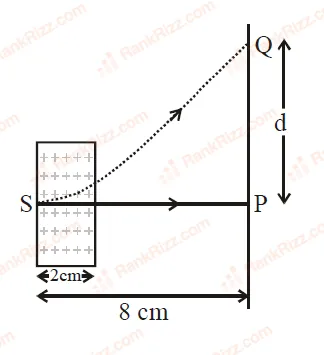
An electron, moving along the x-axis with an initial energy of 100 eV, enters a region of magnetic field B⃗=(1.5×10⁻³\vec{B} = (1.5 \times 10^{-3} T)k^\hat{k} at S (see figure). The field extends between x = 0 and x = 2 cm. The electron is detected at the point Q on a screen placed 8 cm away from the point S. The distance d between P and Q (on the screen) is:
(electron’s charge 1.6×10⁻¹⁹C1.6 ×10^{−19} C, mass of electron =9.1×10⁻³¹kg=9.1×10^{−31} kg)

Figure for JEE Main 2019 Physics question on Motion of charged particles in a magnetic field
  1. A

    1.22 cm

  2. B

    12.87 cm

  3. C

    11.65 cm

  4. D

    2.25 cm

JEE MAIN 2019 · 10 APR S1Motion of charged particles in a magnetic fieldTRANSCRIBED

A proton, an electron, and a Helium nucleus, have the same energy. They are in circular orbits in a plane due to magnetic field perpendicular to the plane. Let rpr_p, rer_e and rHer_{He} be their respective radii, then,

  1. A

    re>rp=rHer_e > r_p = r_{He}

  2. B

    re<rp=rHer_e < r_p = r_{He}

  3. C

    re<rp<rHer_e < r_p < r_{He}

  4. D

    re>rp>rHer_e > r_p > r_{He}

JEE MAIN 2019 · 09 JAN S2Biot-Savart law: straight wires and moving chargesTRANSCRIBED

One of the two identical conducting wires of length LL is bent in the form of a circular loop and the other one into a circular coil of NN identical turns. If the same current is passed in both, the ratio of the magnetic field at the centre of the loop (BL)(B_L) to that at the centre of the coil (BC)(B_C), i.e. BLBC\frac{B_L}{B_C} will be:

  1. A

    1N2\frac{1}{N^2}

  2. B

    1N\frac{1}{N}

  3. C

    NN

  4. D

    N2N^2