RankRizz

Moving Charges & Magnetism — JEE Main Previous Year Questions

Every Moving Charges & Magnetism question JEE Main has set from 2004–2026, grouped by the idea it tests rather than the order of the syllabus. 249 questions across 8 distinct ideas. Free to read, answer key on every one.

Questions

249

Distinct ideas

8

Share of marks

3.8%

Difficulty

MEDIUM

The ideas inside Moving Charges & Magnetism

A chapter is not one subject — it is a handful of procedures the examiner reuses. These are the ones Moving Charges & Magnetism questions actually test.

01Biot-Savart law: straight wires and moving chargesset 75×
02Magnetic field of circular loops, arcs and coilsset 5×
03Ampere's circuital law: cylinders, solenoids and toroidsset 19×04Motion of charged particles in a magnetic fieldset 69×
05Charged particles in combined electric and magnetic fieldsset 6×
06Force on current-carrying conductors and between parallel wiresset 4×
07Magnetic dipole moment of current loops and torque on loopsset 61×08Moving coil galvanometerset 10×

Every Moving Charges & Magnetism question

141–160 OF 249 · NEWEST FIRST

JEE MAIN 2021 · 20 JUL S1Motion of charged particles in a magnetic fieldTRANSCRIBED

A deuteron and an alpha particle having equal kinetic energy enter perpendicular into a magnetic field. Let rdr_d and rαr_\alpha be their respective radii of circular path. The value of rdrα\frac{r_d}{r_\alpha} is equal to:

  1. A

    12\frac{1}{\sqrt{2}}

  2. B

    2\sqrt{2}

  3. C

    1

  4. D

    2

JEE MAIN 2021 · 17 MAR S1Ampere's circuital law: cylinders, solenoids and toroidsTRANSCRIBED

A solenoid of 1000 turns per metre has a core with relative permeability 500. Insulated windings of the solenoid carry an electric current of 5 A. The magnetic flux density produced by the solenoid is: (Permeability of free space = 4π×10−74\pi \times 10^{-7} H m−1^{-1})

  1. A

    (π)(\pi) T

  2. B

    (2×10⁻³π)(2 \times 10^{-3}\pi) T

  3. C

    (π5)\left(\frac{\pi}{5}\right) T

  4. D

    (10−4π)(10^{-4}\pi) T

JEE MAIN 2021 · 27 AUG S2Biot-Savart law: straight wires and moving chargesTRANSCRIBED

A coaxial cable consists of an inner wire of radius aa surrounded by an outer shell of inner and outer radii bb and cc respectively. The inner wire carries an electric current i0i_0 which is distributed uniformly across cross-sectional area. The outer shell carries an equal current in opposite direction and distributed uniformly. What will be the ratio of the magnetic field at a distance xx from the axis when (i) x<ax \lt a and (ii) a<x<ba \lt x \lt b?

  1. A

    a2x2\frac{a^2}{x^2}

  2. B

    b2−a2x2\frac{b^2-a^2}{x^2}

  3. C

    x2b2−a2\frac{x^2}{b^2-a^2}

  4. D

    x2a2\frac{x^2}{a^2}

JEE MAIN 2021 · 31 AUG S2Biot-Savart law: straight wires and moving chargesTRANSCRIBED

A current of 1.5 A is flowing through a triangle, of side 9 cm each. The magnetic field at the centroid of the triangle is:
(Assume that the current is flowing in the clockwise direction.)

  1. A

    23×10−52\sqrt{3} \times 10^{-5} T, inside the plane of triangle

  2. B

    23×10−72\sqrt{3} \times 10^{-7} T, outside the plane of triangle

  3. C

    3×10−73 \times 10^{-7} T, outside the plane of triangle

  4. D

    3×10−53 \times 10^{-5} T, inside the plane of triangle

JEE MAIN 2021 · 17 MAR S2Biot-Savart law: straight wires and moving chargesTRANSCRIBED

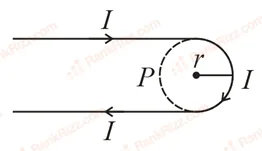
A hairpin like shape as shown in figure is made by bending a long current carrying wire. What is the magnitude of a magnetic field at point PP which lies on the centre of the semicircle?

Figure for JEE Main 2021 Physics question on Biot-Savart law: straight wires and moving charges
  1. A

    μ0I4πr(2−π)\frac{\mu_0 I}{4\pi r}(2 - \pi)

  2. B

    μ0I4πr(2+π)\frac{\mu_0 I}{4\pi r}(2 + \pi)

  3. C

    μ0I2πr(2+π)\frac{\mu_0 I}{2\pi r}(2 + \pi)

  4. D

    μ0I2πr(2−π)\frac{\mu_0 I}{2\pi r}(2 - \pi)

JEE MAIN 2021 · 25 JUL S2Motion of charged particles in a magnetic fieldTRANSCRIBED

Two ions having same mass have charges in the ratio 1 : 2. They are projected normally in a uniform magnetic field with their speeds in the ratio 2 : 3. The ratio of the radii of their circular trajectories is,

  1. A

    1 : 4

  2. B

    4 : 3

  3. C

    3 : 1

  4. D

    2 : 3

JEE MAIN 2021 · 27 JUL S2Biot-Savart law: straight wires and moving chargesTRANSCRIBED

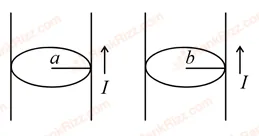
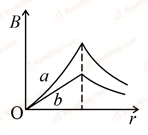
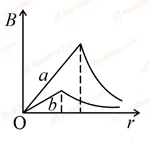
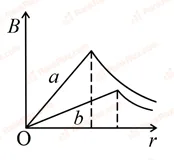
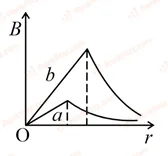
Figure A and B shown two long straight wires of circular cross-section (aa and bb with a<ba < b), carrying current II which is uniformly distributed across the cross-section. The magnitude of magnetic field BB varies with radius rr and can be represented as:

Figure for JEE Main 2021 Physics question on Biot-Savart law: straight wires and moving charges
  1. A
    Figure for JEE Main 2021 Physics question on Biot-Savart law: straight wires and moving charges
  2. B
    Figure for JEE Main 2021 Physics question on Biot-Savart law: straight wires and moving charges
  3. C
    Figure for JEE Main 2021 Physics question on Biot-Savart law: straight wires and moving charges
  4. D
    Figure for JEE Main 2021 Physics question on Biot-Savart law: straight wires and moving charges
JEE MAIN 2021 · 01 SEP S2Biot-Savart law: straight wires and moving chargesTRANSCRIBED

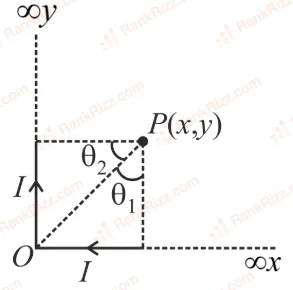
There are two infinitely long straight current-carrying conductors and they are held at right angles to each other so that their common ends meet at the origin as shown in the figure given below. The ratio of current in both conductors is 1:1. The magnetic field at point P is:

Figure for JEE Main 2021 Physics question on Biot-Savart law: straight wires and moving charges
  1. A

    μ0I4πxy(x2+y2−(x+y))\frac{\mu_0I}{4\pi xy}\left(\sqrt{x^2+y^2}-(x+y)\right)

  2. B

    μ0Ixy4π(x2+y2−(x+y))\frac{\mu_0Ixy}{4\pi}\left(\sqrt{x^2+y^2}-(x+y)\right)

  3. C

    μ0I4πxy(x2+y2+(x+y))\frac{\mu_0I}{4\pi xy}\left(\sqrt{x^2+y^2}+(x+y)\right)

  4. D

    μ0Ixy4π(x2+y2+(x+y))\frac{\mu_0Ixy}{4\pi}\left(\sqrt{x^2+y^2}+(x+y)\right)

JEE MAIN 2021 · 26 AUG S2Motion of charged particles in a magnetic fieldTRANSCRIBED

If the maximum value of accelerating potential provided by a radio frequency oscillator is 12 kV. The number of revolution made by a proton in a cyclotron to achieve one sixth the speed of light is:
[mp=1.67×10⁻²⁷m_p = 1.67 \times 10^{-27} kg, e=1.6×10⁻¹⁹e = 1.6 \times 10^{-19} C, Speed of light = 3×1083 \times 10^8 m s−1^{-1}]

JEE MAIN 2021 · 26 AUG S2Magnetic dipole moment of current loops and torque on loopsTRANSCRIBED

A coil in the shape of an equilateral triangle of side 10 cm lies in a vertical plane between the pole pieces of permanent magnet producing a horizontal magnetic field 20 mT. The torque acting on the coil when a current of 0.2 A is passed through it and its plane becomes parallel to the magnetic field will be x×10−5\sqrt{x} \times 10^{-5} Nm. The value of xx is _________

JEE MAIN 2021 · 27 AUG S1Magnetic dipole moment of current loops and torque on loopsTRANSCRIBED

A uniform conducting wire of length is 24aa, and resistance RR is wound up as a current carrying coil in the shape of an equilateral triangle of side aa and then in the form of a square of side aa. The coil is connected to a voltage source V0V_0. The ratio of magnetic moment of the coils in case of equilateral triangle to that for square is 1:y1 : \sqrt{y} where yy is _________.

JEE MAIN 2020 · 07 JAN S2Motion of charged particles in a magnetic fieldTRANSCRIBED

A particle of mass mm and charge qq has an initial velocity v⃗=v0j^\vec{v} = v_0 \hat{j}. If an electric field E⃗=E0i^\vec{E} = E_0 \hat{i} and magnetic field B⃗=B0i^\vec{B} = B_0 \hat{i} act on the particle, its speed will double after a time

  1. A

    2mv0qE0\frac{2mv_0}{qE_0}

  2. B

    3mv0qE0\frac{3mv_0}{qE_0}

  3. C

    3mv0qE0\frac{\sqrt{3}mv_0}{qE_0}

  4. D

    2mv0qE0\frac{\sqrt{2}mv_0}{qE_0}

JEE MAIN 2020 · 03 SEP S1Biot-Savart law: straight wires and moving chargesTRANSCRIBED

Magnitude of magnetic field (in SI units) at the centre of a hexagonal shape coil of side 10 cm, 50 turns and carrying current II (Ampere) in units of μ0Iπ\frac{\mu_0 I}{\pi} is:

  1. A

    2503250\sqrt{3}

  2. B

    50350\sqrt{3}

  3. C

    5003500\sqrt{3}

  4. D

    535\sqrt{3}

JEE MAIN 2020 · 09 JAN S2Magnetic dipole moment of current loops and torque on loopsTRANSCRIBED

A small circular loop of conducting wire has radius aa and carries current II. It is placed in a uniform magnetic field BB perpendicular to its plane such that when rotated slightly about its diameter and released, it starts performing simple harmonic motion of time period TT. The mass of the loop is mm then:

  1. A

    T=2mIBT = \sqrt{\frac{2m}{IB}}

  2. B

    T=πm2IBT = \sqrt{\frac{\pi m}{2IB}}

  3. C

    T=2πmIBT = \sqrt{\frac{2\pi m}{IB}}

  4. D

    T=πmIBT = \sqrt{\frac{\pi m}{IB}}

JEE MAIN 2020 · 06 SEP S1Motion of charged particles in a magnetic fieldTRANSCRIBED

A particle of charge qq and mass mm is moving with a velocity −vi^-v\hat{i} (v≠0)(v \neq 0) towards a large screen placed in the Y−ZY-Z plane at distance dd. If there is a magnetic field B⃗=B0k^\vec{B} = B_0\hat{k}, the minimum value of vv for which the particle will not hit the screen is:

  1. A

    qdB03m\frac{qdB_0}{3m}

  2. B

    2qdB0m\frac{2qdB_0}{m}

  3. C

    qdB0m\frac{qdB_0}{m}

  4. D

    qdB02m\frac{qdB_0}{2m}

JEE MAIN 2020 · 02 SEP S2Motion of charged particles in a magnetic fieldTRANSCRIBED

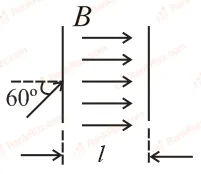
The figure shows a region of length 'l' with a uniform magnetic field of 0.3 T in it and a proton entering the region with velocity 4×1054 \times 10^5 m s−1^{-1} making an angle 60°° with the field. If proton completes 10 revolution by the time it cross the region shown, 'l' is close to (mass of proton =1.67×10−27= 1.67 \times 10^{-27} kg, charge of the proton =1.6×10−19= 1.6 \times 10^{-19} C):

Figure for JEE Main 2020 Physics question on Motion of charged particles in a magnetic field
  1. A

    0.11 m

  2. B

    0.88 m

  3. C

    0.44 m

  4. D

    0.22 m

JEE MAIN 2020 · 03 SEP S1Motion of charged particles in a magnetic fieldTRANSCRIBED

A charged particle carrying charge 1 μC\mu C is moving with velocity (2i^+3j^+4k^)\left(2\hat{i} + 3\hat{j} + 4\hat{k}\right) m s−1^{-1}. If an external magnetic field of (5i^+3j^−6k^)×10−3\left(5\hat{i} + 3\hat{j} - 6\hat{k}\right) \times 10^{-3} T exists in the region where the particle is moving then the force on the particle is F⃗×10−9\vec{F} \times 10^{-9} N. The vector F⃗\vec{F} is:

  1. A

    −0.30i^+0.32j^−0.09k^-0.30\hat{i} + 0.32\hat{j} - 0.09\hat{k}

  2. B

    −30i^+32j^−9k^-30\hat{i} + 32\hat{j} - 9\hat{k}

  3. C

    −300i^+320j^−90k^-300\hat{i} + 320\hat{j} - 90\hat{k}

  4. D

    −3.0i^+32j^−0.9k^-3.0\hat{i} + 32\hat{j} - 0.9\hat{k}

JEE MAIN 2020 · 09 JAN S2Motion of charged particles in a magnetic fieldTRANSCRIBED

An electron gun is placed inside a long solenoid of radius RR on its axis. The solenoid has nn turns/length and carries a current II. The electron gun shoots an electron along the radius of the solenoid with speed vv. If the electron does not hit the surface of the solenoid, maximum possible value of vv is (all symbols have their standard meaning):

Figure for JEE Main 2020 Physics question on Motion of charged particles in a magnetic field
  1. A

    eμ0nIRm\frac{e\mu_0 nIR}{m}

  2. B

    eμ0nIR2m\frac{e\mu_0 nIR}{2m}

  3. C

    eμ0nIR4m\frac{e\mu_0 nIR}{4m}

  4. D

    2eμ0nIRm\frac{2e\mu_0 nIR}{m}

JEE MAIN 2020 · 02 SEP S1Motion of charged particles in a magnetic fieldTRANSCRIBED

A beam of protons with speed 4×1054 \times 10^5 m s−1^{-1} enters a uniform magnetic field of 0.3 T at an angle of 60°° to the magnetic field, the pitch of the resulting helical path of protons is close to: (Mass of the proton =1.67×10−27= 1.67 \times 10^{-27} kg, charge of the proton =1.69×10−19= 1.69 \times 10^{-19} C)

  1. A

    2 cm

  2. B

    5 cm

  3. C

    12 cm

  4. D

    4 cm

JEE MAIN 2020 · 06 SEP S1Motion of charged particles in a magnetic fieldTRANSCRIBED

An electron is moving along +x+x direction with a velocity of 6×10⁶ ms−16 \times 10^6\,\text{ms}^{-1}. It enters a region of uniform electric field of 300 V/cm300\,V/cm pointing along +y+y direction. The magnitude and direction of the magnetic field set up in this region such that the electron keeps moving along the xx direction will be:

  1. A

    3×10⁻⁴ T3 \times 10^{-4}\,\text{T}, along +z+z direction

  2. B

    5×10⁻³ T5 \times 10^{-3}\,\text{T}, along −z-z direction

  3. C

    5×10⁻³ T5 \times 10^{-3}\,\text{T}, along +z+z direction

  4. D

    3×10⁻⁴ T3 \times 10^{-4}\,\text{T}, along −z-z direction