RankRizz

Motion of charged particles in a magnetic field — JEE Main Previous Year Questions

Every JEE Main question on Motion of charged particles in a magnetic field, one of the ideas inside Moving Charges & Magnetism: 69 questions from 2005–2026, 37 of them in the last five years. Newest first, answer key on every one. Free to read.

Questions

69

Years asked

15

Since

2005

Of the chapter

28%

When JEE Main asked it

Questions on Motion of charged particles in a magnetic field in each year it was asked, the latest 12 of 15.

20265
20259
20248
20234
202211
20217
20208
20197
20171
20151
20141
20131

Every Motion of charged particles in a magnetic field question

1–20 OF 69 · NEWEST FIRST

JEE MAIN 2026 · 21 JAN S1Motion of charged particles in a magnetic fieldTRANSCRIBED

A current carrying solenoid is placed vertically and a particle of mass m with charge Q is released from rest. The particle moves along the axis of solenoid. lf g is acceleration due to gravity then the acceleration (n) of the charged particle will satisfy :

  1. A

    a>ga > g

  2. B

    0<n<g0 < n < g

  3. C

    a=0

  4. D

    a=g

JEE MAIN 2026 · 02 APR S2Motion of charged particles in a magnetic fieldTRANSCRIBED

A particle having charge 10−910^{-9} C moving in the x-y plane in fields of 0.4j^0.4\hat{j} N/C and 4×10⁻³k^4 \times 10^{-3}\hat{k} T experiences a force of (4i^+2j^)×10−10(4\hat{i} + 2\hat{j}) \times 10^{-10} N. The velocity of the particle at that instant is :

  1. A

    50i^+100j^50\hat{i} + 100\hat{j} m/s

  2. B

    100i^+50j^100\hat{i} + 50\hat{j} m/s

  3. C

    −50i^+100j^-50\hat{i} + 100\hat{j} m/s

  4. D

    50i^−100j^50\hat{i} - 100\hat{j} m/s

JEE MAIN 2026 · 02 APR S1Motion of charged particles in a magnetic fieldTRANSCRIBED

1 μ\muC charge moving with velocity v⃗=(i^−2j^+3k^)\vec{v} = \left(\hat{i} - 2\hat{j} + 3\hat{k}\right) m/s in the region of magnetic field B⃗=(2i^+3j^−5k^)\vec{B} = \left(2\hat{i} + 3\hat{j} - 5\hat{k}\right) T. The magnitude of force acting on it is α×10−6\sqrt{\alpha} \times 10^{-6} N. The value of α\alpha is __________.

JEE MAIN 2026 · 08 APR S2Motion of charged particles in a magnetic fieldTRANSCRIBED

A 5 mg particle carrying a charge of 5π×10−65\pi \times 10^{-6} C is moving with velocity of (3i^+2k^)×10−2(3\hat{i} + 2\hat{k}) \times 10^{-2} m/s in a region having magnetic field B⃗=0.1k^\vec{B} = 0.1 \hat{k} Wb/m2^2. It moves a distance of aa meter along k^\hat{k} when it completes 5 revolutions. The value of aa is __________.

JEE MAIN 2026 · 05 APR S1Motion of charged particles in a magnetic fieldTRANSCRIBED

The charged particle moving in a uniform magnetic field of (3i^+2j^)(3\hat{i} + 2\hat{j}) T has an acceleration (4i^−x2j^)\left(4\hat{i} - \frac{x}{2}\hat{j}\right) m/s2^2. The value of xx is

JEE MAIN 2025 · 07 APR S1Motion of charged particles in a magnetic fieldTRANSCRIBED

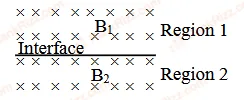
Uniform magnetic fields of different strengths (B1B_1 and B2B_2), both normal to the plane of the paper exist as shown in the figure. A charged particle of mass m and charge q, at the interface at an instant, moves into the region 2 with velocity v and returns to the interface. It continues to move into region 1 and finally reaches the interface. What is the displacement of the particle during this movement along the interface?

Figure for JEE Main 2025 Physics question on Motion of charged particles in a magnetic field

(Consider the velocity of the particle to be normal to the magnetic field and B2>B1B_2 > B_1)

  1. A

    mvqB1(1−B2B1)×2\frac{mv}{qB_1}\left(1 - \frac{B_2}{B_1}\right) \times 2

  2. B

    mvqB1(1−B1B2)\frac{mv}{qB_1}\left(1 - \frac{B_1}{B_2}\right)

  3. C

    mvqB1(1−B2B1)\frac{mv}{qB_1}\left(1 - \frac{B_2}{B_1}\right)

  4. D

    mvqB1(1−B1B2)×2\frac{mv}{qB_1}\left(1 - \frac{B_1}{B_2}\right) \times 2

JEE MAIN 2025 · 22 JAN S2Motion of charged particles in a magnetic fieldTRANSCRIBED

An electron projected perpendicular to a uniform magnetic field B moves in a circle. If Bohr's quantization is applicable, then the radius of the electronic orbit in the first excited state is :

  1. A

    hπeB\sqrt{\frac{h}{\pi eB}}

  2. B

    2hπeB\sqrt{\frac{2h}{\pi eB}}

  3. C

    h2πeB\sqrt{\frac{h}{2\pi eB}}

  4. D

    4hπeB\sqrt{\frac{4h}{\pi eB}}

JEE MAIN 2025 · 28 JAN S1Motion of charged particles in a magnetic fieldTRANSCRIBED

Consider a long thin conducting wire carrying a uniform current I. A particle having mass "M" and charge "q" is released at a distance "a" from the wire with a speed ϵ∘\epsilon_{\circ} along the direction of current in the wire. The particle gets attracted to the wire due to magnetic force. The particle turns round when it is at distance x from the wire. The value of x is [μ∘\mu_{\circ} is vacuum permeability]

  1. A

    ae−4πmv∘qμ∘lae^{-\frac{4\pi mv_{\circ}}{q\mu_{\circ}l}}

  2. B

    a[1−mv∘2qμ∘l]a\left[1-\frac{mv_{\circ}}{2q\mu_{\circ}l}\right]

  3. C

    a[1−mvqμ∘l]a\left[1-\frac{mv}{q\mu_{\circ}l}\right]

  4. D

    a2\frac{a}{2}

JEE MAIN 2025 · 07 APR S1Motion of charged particles in a magnetic fieldTRANSCRIBED

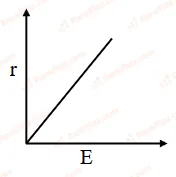
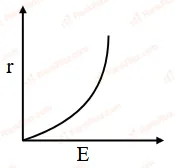
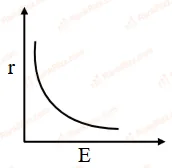
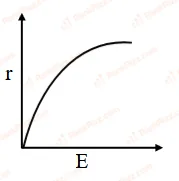
A particle of charge q, mass m and kinetic energy E enters in magnetic field perpendicular to its velocity and undergoes a circular arc of radius(r). Which of the following curves represents the variation of r with E?

  1. A
    Figure for JEE Main 2025 Physics question on Motion of charged particles in a magnetic field
  2. B
    Figure for JEE Main 2025 Physics question on Motion of charged particles in a magnetic field
  3. C
    Figure for JEE Main 2025 Physics question on Motion of charged particles in a magnetic field
  4. D
    Figure for JEE Main 2025 Physics question on Motion of charged particles in a magnetic field
JEE MAIN 2025 · 24 JAN S2Motion of charged particles in a magnetic fieldTRANSCRIBED

Given below are two statements. One is labelled as Assertion (A) and the other is labelled as Reason (R). Assertion (A) : A electron in a certain region of uniform magnetic field is moving with constant velocity in a straight line path. Reason (R): The magnetic field in that region is along the direction of velocity of the electron. In the light of the above statements, choose the correct answer from the options given below :

  1. A

    (A) is true but (R) is false

  2. B

    Both (A) and (R) are true but (R) is NOT the correct explanation of (A)

  3. C

    Both (A) and (R) are true and (R) is the correct explanation of (A)

  4. D

    (A) is false but (R) is true

JEE MAIN 2025 · 03 APR S2Motion of charged particles in a magnetic fieldTRANSCRIBED

Given below are two statements:one is labelled as Assertion A and the other is labelled as Reason R.
Assertion A: If oxygen ion (O−2O^{-2}) and Hydrogen ion (H+H^+) enter normal to the magnetic field with equal momentum, then the path of O−2O^{-2} ion has a smaller curvature than that of H+H^+.
Reason R: A proton with same linear momentum as an electron will form a path of smaller radius of curvature on entering a uniform magnetic field perpendicularly.
In the light of the above statement,Choose the correct answer from the options given below.

  1. A

    A is true but R is false

  2. B

    Both A and R are true but R is NOT the correct explanation of A

  3. C

    A is false but R is true

  4. D

    Both A and R are true and R is the correct explanation of A

JEE MAIN 2025 · 22 JAN S2Motion of charged particles in a magnetic fieldTRANSCRIBED

A proton is moving undeflected in a region of crossed electric and magnetic fields at a constant speed of 2×10⁵ms−12 \times 10^{5} ms^{-1}. When the electric field is switched off, the proton moves along a circular path of radius 2 cm .The magnitude of electric field is x×104N/Cx\times 10^{4} N/C. The value of x is________Take the mass of the proton 1.6×10⁻²⁷kg1.6\times 10^{-27}kg

JEE MAIN 2025 · 04 APR S2Motion of charged particles in a magnetic fieldTRANSCRIBED

A particle of charge 1.6 μ\muC and mass 16 μ\mug is present in a strong magnetic field of 6.28T6.28 T. The particle is then fired perpendicular to magnetic field. The time required for the particle to return to original location for the first time is ______ s. (π=3.14\pi = 3.14)

JEE MAIN 2025 · 24 JAN S2Motion of charged particles in a magnetic fieldTRANSCRIBED

A tightly wound long solenoid carries a current of  1.5 A.1.5\,A. An electron is executing uniform circular motion inside the solenoid with a time period of  75 ns.75\,ns. The number of turns per metre in the solenoid is ‾.\underline{\hspace{1cm}}. [Take mass of electron  me=9×10⁻³¹ kg,m_e=9\times10^{-31}\,kg,  change of electron ∣qe∣=1.6×10⁻¹⁹ |q_e|=1.6\times10^{-19}\, C,C, μ0=4π×10−7 N\mu_0=4\pi\times10^{-7}\,N A−2, 1 ns=10−9 s]A^{-2},\,1\,ns=10^{-9}\,s]

JEE MAIN 2024 · 09 APR S2Motion of charged particles in a magnetic fieldTRANSCRIBED

A proton and a deutron (q=+e,m=2.0uq = +e, m = 2.0u) having same kinetic energies enter a region of uniform magnetic field B⃗\vec{B}, moving perpendicular to B⃗\vec{B}. The ratio of the radius of deutron path to the radius of the proton path is:

  1. A

    2:1\sqrt{2} : 1

  2. B

    1:11 : 1

  3. C

    1:21 : \sqrt{2}

  4. D

    1:21 : 2

JEE MAIN 2024 · 27 JAN S1Motion of charged particles in a magnetic fieldTRANSCRIBED

A proton moving with a constant velocity passes through a region of space without any change in its velocity. If E⃗\vec{E} and B⃗\vec{B} represent the electric and magnetic fields respectively, then the region of space may have : 

(A) E=0,B=0E = 0, B = 0; (B) E=0,B≠0E = 0, B \neq 0; (C) E≠0,B=0E \neq 0, B = 0; (D) E≠0,B≠0E \neq 0, B \neq 0. Choose the most appropriate answer from the options given below :

  1. A

    (A), (B) and (C) only

  2. B

    (A), (C) and (D) only

  3. C

    (A), (B) and (D) only

  4. D

    (B), (C) and (D) only

JEE MAIN 2024 · 29 JAN S2Motion of charged particles in a magnetic fieldTRANSCRIBED

Two particles XX and YY having equal charges are being accelerated through the same potential difference. Thereafter, they enter normally in a region of uniform magnetic field and describes circular paths of radii R1R_1 and R2R_2 respectively. The mass ratio of XX and YY is:

  1. A

    (R2R1)2\left(\frac{R_2}{R_1}\right)^2

  2. B

    (R1R2)2\left(\frac{R_1}{R_2}\right)^2

  3. C

    R1R2\frac{R_1}{R_2}

  4. D

    R2R1\frac{R_2}{R_1}

JEE MAIN 2024 · 05 APR S2Motion of charged particles in a magnetic fieldTRANSCRIBED

The electrostatic force (F1⃗)(\vec{F_1}) and magnetic force (F2⃗)(\vec{F_2}) acting on a charge qq moving with velocity vv can be written :

  1. A

    F1⃗=qE⃗,F2⃗=q(V⃗×B⃗)\vec{F_1} = q\vec{E}, \vec{F_2} = q(\vec{V} \times \vec{B})

  2. B

    F1⃗=qB⃗,F2⃗=q(B⃗×V⃗)\vec{F_1} = q\vec{B}, \vec{F_2} = q(\vec{B} \times \vec{V})

  3. C

    F1⃗=qE⃗,F2⃗=q(B⃗×V⃗)\vec{F_1} = q\vec{E}, \vec{F_2} = q(\vec{B} \times \vec{V})

  4. D

    F1⃗=qV⃗⋅E⃗,F2⃗=q(B⃗⋅V⃗)\vec{F_1} = q\vec{V} \cdot \vec{E}, \vec{F_2} = q(\vec{B} \cdot \vec{V})

JEE MAIN 2024 · 04 APR S1Motion of charged particles in a magnetic fieldTRANSCRIBED

An electron is projected with uniform velocity along the axis inside a current carrying long solenoid. Then:

  1. A

    the electron will continue to move with uniform velocity along the axis of the solenoid

  2. B

    the electron will be accelerated along the axis

  3. C

    the electron path will be circular about the axis

  4. D

    the electron will experience a force at 45° to the axis and execute a helical path

JEE MAIN 2024 · 29 JAN S2Motion of charged particles in a magnetic fieldTRANSCRIBED

A charge of 4.0  μ4.0 \;\muC is moving with a velocity of 4.0×10⁶ m s−14.0 \times 10^6 \text{ m s}^{-1} along the positive yy-axis under a magnetic field BB of strength (2k^)\left(2\hat{k}\right) T. The force acting on the charge is xi^x\hat{i} N. The value of xx is ______.