JEE Main 2020 Physics question — Biot-Savart law: straight wires and moving charges
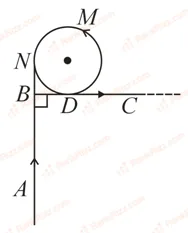
A very long wire ABDMNDC is shown in figure carrying current I. AB and BC parts are straight, long and at right angle. At D wire forms a circular turn DMND of radius R. AB, BC parts are tangential to circular turn at N and D. Magnetic field at the center of circle is:
SOLUTION
Let the centre of the circular portion be O and its radius be . We have to add the magnetic fields produced at O by
(i) the complete circular turn and
(ii) the two very long straight parts and which touch the circle tangentially at the points and respectively.
Field due to the circular turn
For a circular loop carrying current , the magnetic field at its centre is given by the well-known result
It will be directed perpendicular to the plane of the loop. Writing the same expression with a denominator (so that all later terms have a common factor) we have
Field due to the straight part AB
For a finite straight conductor the Biot-Savart result is
where is the perpendicular distance of the point from the wire and are the angles which the lines joining the point to the two ends of the conductor make with the conductor itself.
The perpendicular distance of O from AB is clearly (AB is a tangent). One end of AB (the point A) is at infinity, so the line AO is almost along AB itself; hence and . The other end is B. Because B has the coordinates while the wire AB is horizontal, the line OB makes an angle of with AB, giving and . Substituting,
Field due to the straight part BC
Exactly the same geometry holds for BC, because BC is a vertical tangent lying a distance from O. Again one end (C) is at infinity giving , while the nearer end B subtends with BC giving . Therefore
Directions of the straight-wire fields
If the current reaches the junction B from A (i.e.\ it flows to the left along AB) and then turns to flow upward along BC, the right-hand rule shows that both and point out of the plane of the paper. Hence the two contributions add:
Total field at the centre
Adding the circular and straight-wire fields (both are perpendicular to the plane and hence add algebraically)
Hence, the correct answer is Option A.
Tagged Biot-Savart law: straight wires and moving charges. Machine-assigned, so read it as a strong shortlist rather than a verdict.