JEE Main 2019 Physics question — Magnetic dipole moment of current loops and torque on loops
Two wires A & B are carrying currents I and I as shown in the figure. The separation between them is d. A third wire C carrying a current I is to be kept parallel to them at a distance x from A such that the net force acting on it is zero. The possible values of x are:
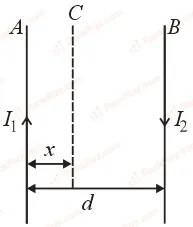
SOLUTION
Step-by-Step Solution
1. Condition for Zero Net Force on Wire C
For a third parallel current-carrying wire to experience a net magnetic force of zero, the magnetic fields produced by wire () and wire () must be equal in magnitude but opposite in direction at the position of wire .
The magnetic field at a perpendicular distance from a long straight wire carrying current is given by:
2. Analysis of Directonal Fields (Regions)
Let's analyze the directions of the currents:
- Wire carries current upwards.
- Wire carries current downwards (opposite directions).
- Between the wires (): According to the right-hand grip rule, both wires produce magnetic fields pointing into (or out of) the page in the space between them. Since the fields point in the same direction, they reinforce each other, and the net field can never be zero in this region.
- Outside the wires ( or ): The magnetic fields point in opposite directions. Therefore, the net force can only be zero outside the two wires.
- to the left of wire A (if )
- to the right of wire B (if )
Because the currents are in opposite directions:
The exact valid region depends entirely on which current has a smaller magnitude, as wire must be placed closer to the weaker current to balance the stronger current's field.
3. Setting Up the Balance Equations
Case 1: Wire C is placed to the left of Wire A ( is measured from A to the left)
Let be the distance from wire to the left. The distance from wire becomes .
Equating the field magnitudes:
Cancel out the common constant factors :
Cross-multiply and solve for :
(This solution is physically valid only if .)
Case 2: Wire C is placed to the right of Wire B ( is measured from A to the right)
If wire is placed to the right of wire at a distance from wire , its distance from wire is .
Equating the fields:
Cross-multiply and solve for :
(This solution is physically valid only if .)
Final Answer
The possible values of depend on the relative magnitudes of the currents:
Tagged Magnetic dipole moment of current loops and torque on loops. Machine-assigned, so read it as a strong shortlist rather than a verdict.