JEE Main 2023 Physics question — Photoelectric effect and Einstein's equation
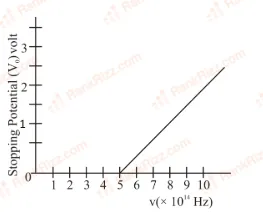
The variation of stopping potential as a function of the frequency of the incident light for a metal is shown in figure. The work function of the surface is
SOLUTION
We need to find the work function of a metal surface from the variation of stopping potential as a function of the frequency of incident light.
Einstein’s photoelectric equation relates the maximum kinetic energy of emitted electrons to the frequency of incident light:
Here, is the electron charge, is the stopping potential, is Planck’s constant, is the frequency of incident light, and is the work function of the metal.
Rearranging this equation gives , which is a linear relation in with slope and y-intercept .
By examining the graph of versus , the threshold frequency , at which , corresponds to the x-intercept. At this point, the work function satisfies:
Using Planck’s constant and converting joules to electronvolts via , and noting from the graph that , we calculate:
Converting this energy into electronvolts gives:
Therefore, the work function of the metal surface is 2.07 .
Tagged Photoelectric effect and Einstein's equation. Machine-assigned, so read it as a strong shortlist rather than a verdict.