RankRizz
JEE MAIN 2008TRANSCRIBED

JEE Main 2008 Physics question — Davisson-Germer experiment

Paragraph: Wave property of electrons implies that they will show diffraction effects. Davisson and Germer demonstrated this by diffracting electrons from crystals. The law governing the diffraction from a crystal is obtained by requiring that electron waves reflected from the planes of atoms in a crystal interfere constructively (see in figure).Figure for JEE Main 2008 Physics question on Davisson-Germer experiment
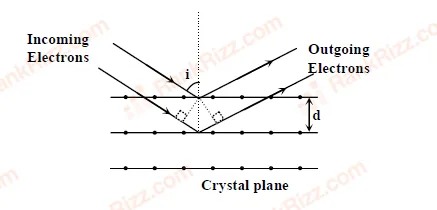
Question: Electrons accelerated by potential VV are diffracted from a crystal. If d=1 A˚d = 1\ \AA and i=30∘i = 30^\circ, VV should be about (h=6.6×10⁻³⁴ Js, me=9.1×10⁻³¹ kg, e=1.6×10⁻¹⁹ C)(h = 6.6 \times 10^{-34}\ Js,\ m_e = 9.1 \times 10^{-31}\ kg,\ e = 1.6 \times 10^{-19}\ C)

SOLUTION

For electron diffraction from a crystal we need two relations: Bragg’s law for constructive interference and the de-Broglie relation for the wavelength of an electron accelerated through a potential VV.

Step 1: Convert the given angle to the “glancing angle” used in Bragg’s law
Bragg’s law is 2d sin⁡θ=nλ2d\,\sin\theta = n\lambda, where θ\theta is the glancing angle (angle between the incident beam and the crystal plane).
The question states that the electrons strike the crystal with an angle of incidence i=30∘i = 30^\circ measured from the normal to the plane. Hence the glancing angle is
θ=90∘−i=90∘−30∘=60∘.\theta = 90^\circ - i = 90^\circ - 30^\circ = 60^\circ.
Therefore sin⁡θ=sin⁡60∘=cos⁡30∘.\sin\theta = \sin 60^\circ = \cos 30^\circ. Using this in Bragg’s law for the first order n=1n = 1:

λ=2dsin⁡θ=2dcos⁡i.\lambda = 2d\sin\theta = 2d\cos i.

With d=1 A˚=1×10⁻¹⁰ md = 1\ \text{\AA} = 1\times10^{-10}\ \text{m} and cos⁡30∘=32\cos 30^\circ = \tfrac{\sqrt3}{2}, we get
λ=2(1 A˚) ⁣(32)=3 A˚≈1.732 A˚=1.732×10⁻¹⁰ m.\lambda = 2(1\ \text{\AA})\!\left(\tfrac{\sqrt3}{2}\right) = \sqrt3\ \text{\AA} \approx 1.732\ \text{\AA} = 1.732\times10^{-10}\ \text{m}.

Step 2: Relate the wavelength to the accelerating potential
For an electron accelerated through potential VV,
λ=h2meeV.\lambda = \frac{h}{\sqrt{2m_e e V}}. Rearranging,

V=h22mee λ2.V = \frac{h^{2}}{2m_e e\,\lambda^{2}}.

Step 3: Substitute the numerical values
h=6.6×10⁻³⁴ J⋅s,  me=9.1×10⁻³¹ kg,  e=1.6×10⁻¹⁹ C,  λ=1.732×10⁻¹⁰ m.h = 6.6\times10^{-34}\ \text{J·s},\; m_e = 9.1\times10^{-31}\ \text{kg},\; e = 1.6\times10^{-19}\ \text{C},\; \lambda = 1.732\times10^{-10}\ \text{m}. V=(6.6×10⁻³⁴)22(9.1×10⁻³¹)(1.6×10⁻¹⁹)(1.732×10⁻¹⁰)2=4.356×10−678.736×10−69≈50 V.\begin{aligned} V &= \frac{(6.6\times10^{-34})^{2}} {2(9.1\times10^{-31})(1.6\times10^{-19})(1.732\times10^{-10})^{2}} \\[4pt] &= \frac{4.356\times10^{-67}} {8.736\times10^{-69}} \\[4pt] &\approx 50\ \text{V}. \end{aligned}

Hence the accelerating potential required is about 50 V50\ \text{V}.

Option B which is: 50 V

Tagged Davisson-Germer experiment. Machine-assigned, so read it as a strong shortlist rather than a verdict.

SubjectPhysics
TopicDavisson-Germer experiment
TypeMultiple choice