JEE Advanced 2008 Physics question — Potential energy, conservative forces and energy curves
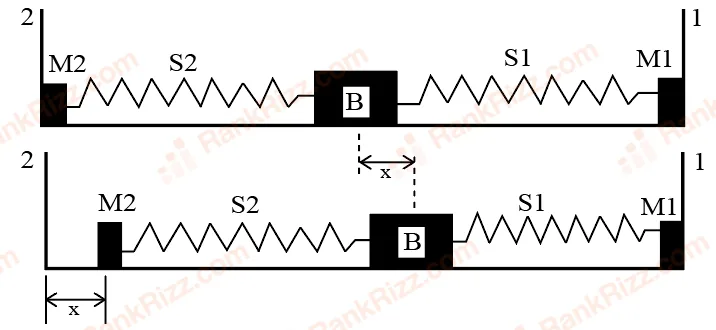
A block (B) is attached to two unstretched springs S1 and S2 with spring constants k and 4k, respectively (see figure I). The other ends are attached to identical supports M1 and M2 not attached to the walls. The springs and supports have negligible mass. There is no friction anywhere. The block B is displaced towards wall 1 by a small distance x (figure II) and released. The block returns and moves a maximum distance y towards wall 2. Displacements x and y are measured with respect to the equilibrium position of the block B. The ratio is
SOLUTION
When the block is pushed a distance towards wall 1, spring S1 is compressed against M1 and wall 1. Support M2 is free and massless, so it simply follows the block and S2 stays at natural length. The energy in S1 is .
After release the block returns to the equilibrium position with kinetic energy . S2 and M2 again move with it undeformed, and M2 reaches wall 2 just as the block passes the equilibrium position, both having moved through .
Beyond the equilibrium position S1 would have to stretch, but M1 is free and massless, so it leaves wall 1 and S1 stays at natural length. Now only S2 (constant ) is compressed, against M2 and wall 2.
With no friction the block stops when all its kinetic energy has gone into S2:
Hence, the correct option is (C).
Tagged Potential energy, conservative forces and energy curves. Machine-assigned, so read it as a strong shortlist rather than a verdict.