RankRizz

Work, Energy & Power — JEE Main Previous Year Questions

Every Work, Energy & Power question JEE Main has set from 2004–2026, grouped by the idea it tests rather than the order of the syllabus. 160 questions across 5 distinct ideas. Free to read, answer key on every one.

Questions

160

Distinct ideas

5

Share of marks

2.6%

Difficulty

MEDIUM

The ideas inside Work, Energy & Power

A chapter is not one subject — it is a handful of procedures the examiner reuses. These are the ones Work, Energy & Power questions actually test.

Every Work, Energy & Power question

141–160 OF 160 · NEWEST FIRST

JEE MAIN 2013 · 25 APR ONLINEPowerTRANSCRIBED

A wind-powered generator converts wind energy into electrical energy. Assume that the generator converts a fixed fraction of the wind energy intercepted by its blades into electrical energy. For wind speed vv, the electrical power output will be most likely proportional to

  1. A

    v4v^4

  2. B

    v2v^2

  3. C

    vv

  4. D

    v3v^3

JEE MAIN 2012Work done by constant and variable forcesTRANSCRIBED

This question has statement 1 and statement 2. Of the four choices given after the statements, choose the one that best describes the two statements. If two springs S1S_1 and S2S_2 of force constants k1k_1 and k2k_2, respectively, are stretched by the same force, it is found that more work is done on spring S1S_1 than on spring S2S_2. Statement 1: If stretched by the same amount, work done on S1S_1, will be more than that on S2S_2. Statement 2: k1<k2k_1 < k_2

  1. A

    Statement 1 is false, Statement 2 is true

  2. B

    Statement 1 is true, Statement 2 is false

  3. C

    Statement 1 is true, Statement 2 is the correct explanation for statement 1

  4. D

    Statement 1 is true, Statement 2 is true, Statement 2 is not the correct explanation for statement 1.

JEE MAIN 2012Kinetic energy and the work-energy theoremTRANSCRIBED

A particle gets displaced by Δr⃗=(2i^+3j^+4k^) m\Delta \vec{r} = (2\hat{i} + 3\hat{j} + 4\hat{k})\ \text{m} under the action of a force F⃗=(7i^+4j^+3k^)\vec{F} = (7\hat{i} + 4\hat{j} + 3\hat{k}). The change in its kinetic energy is

  1. A

    38 J

  2. B

    70 J

  3. C

    52.5 J

  4. D

    126 J

JEE MAIN 2012Work done by constant and variable forcesTRANSCRIBED

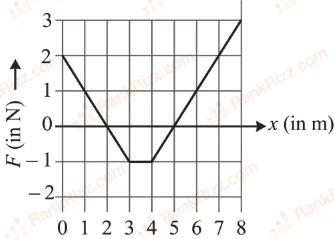
The force F⃗=Fi^\vec{F} = F\hat{i} on a particle of mass 2 kg, moving along the xx-axis is given in the figure as a function of its position xx. The particle is moving with a velocity of 5 m/s along the xx-axis at x=0x = 0. What is the kinetic energy of the particle at x=8x = 8 m?

Figure for JEE Main 2012 Physics question on Work done by constant and variable forces
  1. A

    34 J

  2. B

    34.5 J

  3. C

    4.5 J

  4. D

    29.4 J

JEE MAIN 2010Potential energy, conservative forces and energy curvesTRANSCRIBED

The potential energy function for the force between two atoms in a diatomic molecule is approximately given by U(x)=ax12−bx6U(x) = \frac{a}{x^{12}} - \frac{b}{x^6}, where aa and bb are constants and xx is the distance between the atoms. If the dissociation energy of the molecule is D=[U(x=∞)−Uat equilibrium]D = [U(x = \infty) - U_{\text{at equilibrium}}], DD is

  1. A

    b22a\frac{b^2}{2a}

  2. B

    b212a\frac{b^2}{12a}

  3. C

    b24a\frac{b^2}{4a}

  4. D

    b26a\frac{b^2}{6a}

JEE MAIN 2008Kinetic energy and the work-energy theoremTRANSCRIBED

An athlete in the olympic games covers a distance of 100 m in 10 s. His kinetic energy can be estimated to be in the range

  1. A

    200 J −- 500 J

  2. B

    2×1052 \times 10^5 J −- 3×1053 \times 10^5 J

  3. C

    20,000 J −- 50,000 J

  4. D

    2,000 J −- 5,000 J

JEE MAIN 2007Kinetic energy and the work-energy theoremTRANSCRIBED

A 2 kg block slides on a horizontal floor with a speed of 4 m/s. It strikes a uncompressed spring, and compresses it till the block is motionless. The kinetic friction force is 15 N and spring constant is 10,000 N/m. The spring compresses by

  1. A

    5.5 cm

  2. B

    2.5 cm

  3. C

    11.0 cm

  4. D

    8.5 cm

JEE MAIN 2006Kinetic energy and the work-energy theoremTRANSCRIBED

A mass of M kgM\,kg is suspended by a weightless string. The horizontal force that is required to displace it until the string makes an angle of 45∘45^\circ with the initial vertical direction is

  1. A

    Mg(2−1)Mg(\sqrt{2} - 1)

  2. B

    Mg(2+1)Mg(\sqrt{2} + 1)

  3. C

    Mg2Mg\sqrt{2}

  4. D

    Mg2\dfrac{Mg}{\sqrt{2}}

JEE MAIN 2006Work done by constant and variable forcesTRANSCRIBED

A particle of mass 100 g100\,g is thrown vertically upwards with a speed of 5 m/s5\,m/s. The work done by the force of gravity during the time the particle goes up is

  1. A

    0.5 J

  2. B

    −0.5 J-0.5\,J

  3. C

    −1.25 J-1.25\,J

  4. D

    1.25 J

JEE MAIN 2006Kinetic energy and the work-energy theoremTRANSCRIBED

A ball of mass 0.2 kg0.2\,kg is thrown vertically upwards by applying a force by hand. If the hand moves 0.2 m0.2\,m while applying the force and the ball goes upto 2 m2\,m height further, find the magnitude of the force. Consider g=10 m/s2g = 10\,m/s^2

  1. A

    22 N

  2. B

    4 N

  3. C

    16 N

  4. D

    20 N

JEE MAIN 2006Potential energy, conservative forces and energy curvesTRANSCRIBED

The potential energy of a 1 kg1\,kg particle free move along the x-axis is given by V(x)=(x44−x22)JV(x) = \left(\frac{x^4}{4} - \frac{x^2}{2}\right)JThetotalmechanicalenergyoftheparticleThe total mechanical energy of the particle2 J2\,J.Then,themaximumspeed(in. Then, the maximum speed (inm/sm/s$) is

  1. A

    2

  2. B

    3/23/\sqrt{2}

  3. C

    2\sqrt{2}

  4. D

    1/21/\sqrt{2}

JEE MAIN 2005Kinetic energy and the work-energy theoremTRANSCRIBED

A bullet fired into a fixed target loses half of its velocity after penetrating 33 cm. How much further it will penetrate before coming to rest assuming that it faces constant resistance to motion?

  1. A

    3.03.0 cm

  2. B

    2.02.0 cm

  3. C

    1.51.5 cm

  4. D

    1.01.0 cm

JEE MAIN 2005Conservation of mechanical energyTRANSCRIBED

A spherical ball of mass 2020 kg is stationary at the top of a hill of height 100100 m. It rolls down a smooth surface to the ground, then climbs up another hill of height 3030 m and finally rolls down to a horizontal base at a height of 2020 m above the ground. The velocity attained by the ball is

  1. A

    4040 m/s

  2. B

    2020 m/s

  3. C

    1010 m/s

  4. D

    103010\sqrt{30} m/s

JEE MAIN 2005PowerTRANSCRIBED

A body of mass mm is accelerated uniformly from rest to a speed vv in a time TT. The instantaneous power delivered to the body as a function of time is given by

  1. A

    mv2T2⋅t\frac{mv^2}{T^2} \cdot t

  2. B

    mv2T2⋅t2\frac{mv^2}{T^2} \cdot t^2

  3. C

    12mv2T2⋅t\frac{1}{2} \frac{mv^2}{T^2} \cdot t

  4. D

    12mv2T2⋅t2\frac{1}{2} \frac{mv^2}{T^2} \cdot t^2

JEE MAIN 2005Conservation of mechanical energyTRANSCRIBED

The block of mass MM moving on the frictionless horizontal surface collides with a spring of spring constant KK and compresses it by length LL. The maximum momentum of the block after collision is

79e6c491-01b9-414f-af27-d059458df5b89142317973412964140
  1. A

    LMKL\sqrt{MK}

  2. B

    KL22M\frac{KL^2}{2M}

  3. C

    zero

  4. D

    ML2K\frac{ML^2}{K}

JEE MAIN 2004Kinetic energy and the work-energy theoremTRANSCRIBED

A particle moves in a straight line with retardation proportional to its displacement. Its loss of kinetic energy for any displacement xx is proportional to

  1. A

    x3x^3

  2. B

    exe^x

  3. C

    xx

  4. D

    log⁡ex\log_e x

JEE MAIN 2004Work done by constant and variable forcesTRANSCRIBED

A uniform chain of length 22 m is kept on a table such that a length of 6060 cm hangs freely from the edge of the table. The total mass of the chain is 44 kg. What is the work done in pulling the entire chain on the table?

  1. A

    7.27.2 J

  2. B

    3.63.6 J

  3. C

    120120 J

  4. D

    12001200 J

JEE MAIN 2004Work done by constant and variable forcesTRANSCRIBED

A force F⃗=(5i^+3j^+2k^)N\vec{F} = (5\hat{i} + 3\hat{j} + 2\hat{k})N is applied over a particle which displaces it from origin to the point r⃗=(2i^−j^)\vec{r} = (2\hat{i} - \hat{j}) m. The work done on the particle in joules is

  1. A

    −7-7

  2. B

    +7+7

  3. C

    +10+10

  4. D

    +13+13

JEE MAIN 2004PowerTRANSCRIBED

A body of mass mm, accelerates uniformly from rest to v1v_1 in time t1t_1. The instantaneous power delivered to the body as a function of time tt is

  1. A

    mv1tt1\frac{mv_1 t}{t_1}

  2. B

    mv12tt12\frac{mv_1^2 t}{t_1^2}

  3. C

    mv1t2t1\frac{mv_1 t^2}{t_1}

  4. D

    mv12tt1\frac{mv_1^2 t}{t_1}

JEE MAIN 2004Kinetic energy and the work-energy theoremTRANSCRIBED

A particle is acted upon by a force of constant magnitude which is always perpendicular to the velocity of the particle, the motion of the particle takes place in a plane. It follows that

  1. A

    its velocity is constant

  2. B

    its acceleration is constant

  3. C

    its kinetic energy is constant

  4. D

    it moves in a straight line.