JEE MAIN 2026 · 04 APR S1PowerTRANSCRIBED
A body of mass 2 kg begins to move under the influence of time dependent force N, where and are unit vectors along and -axis respectively. The power produced by the force at s is _____ W.
Every JEE Main question on Power, one of the ideas inside Work, Energy & Power: 26 questions from 2004–2026, 14 of them in the last five years. Newest first, answer key on every one. Free to read.
Questions
26
Years asked
11
Since
2004
Of the chapter
16%
Questions on Power in each year it was asked.
1–20 OF 26 · NEWEST FIRST
A body of mass 2 kg begins to move under the influence of time dependent force N, where and are unit vectors along and -axis respectively. The power produced by the force at s is _____ W.
A body of mass 4 kg is placed on a plane at a point P having coordinate (3,4)m. Under the action of force , it moves to a new point Q having coordinates (6,10)m in 4 sec . The average power and instanteous power at the end of 4 sec are in the ratio of :
13 : 6
4 : 3
1 : 2
6 : 13
A sand dropper drops sand of mass m(t) on a conveyer belt at a rate proportional to the square root of speed (v)of the belt, i.e. . If P is the power delivered to run the belt at constant speed then which of the following relationship is true?
An object of mass 1000 g experiences a time dependent force N. The power generated by the force at time t is :
W
W
W
W
A body of mass 2 kg begins to move under the action of a time dependent force given by N. The power developed by the force at the time is given by:
W
W
W
W
A body is moving unidirectionally under the influence of a constant power source. Its displacement in time is proportional to :
The ratio of powers of two motors is , that are capable of raising kg water in minutes and kg water in minutes respectively from a well of m deep. The value of will be
A body of mass 1 kg begins to move under the action of a time dependent force N, where and are the unit vectors along and axis. The power developed by above force, at the time s, will be _____ W.
A body of mass kg is initially at rest. It starts moving unidirectionally under the influence of a source of constant power . Its displacement in s is m. The value of will be ______.
If the maximum load carried by an elevator is 1400 kg (600 kg-Passengers + 800 kg-elevator), which is moving up with a uniform speed of 3 m s and the frictional force acting on it is 2000 N, then the maximum power used by the motor is _______ kW. m s
A block of mass 5 kg starting from rest pulled up on a smooth incline plane making an angle of 30 with horizontal with an effective acceleration of 1 m s. The power delivered by the pulling force at s from the start is _______ W.
[Use m s]
A particle of mass is moving in a circular path of constant radius such that its centripetal acceleration is varying with time as , where is a constant. The power delivered to the particle by the force acting on it is
Zero
Water falls from a 40 m high dam at the rate of kg per hour. Fifty percentage of gravitational potential energy can be converted into electrical energy. Using this hydro electric energy number of 100 W lamps, that can be lit, is
(Take ms)
25
50
100
18
Sand is being dropped from a stationary dropper at a rate of on a conveyor belt moving with a velocity of . The power needed to keep belt moving with the same velocity will be
A body at rest is moved along a horizontal straight line by a machine delivering a constant power. The distance moved by the body in time is proportional to:
An automobile of mass accelerates starting from the origin and initially at rest, while the engine supplies constant power . The position is given as a function of time by:
A 60HP electric motor lifts an elevator having a maximum total load capacity of 2000 kg. If the frictional force on the elevator is 4000 N, the speed of the elevator at full load is close to: (1 HP = 746 W, m s)
1.7 m s
1.9 m s
1.5 m s
2.0 m s
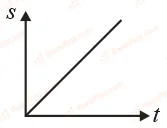
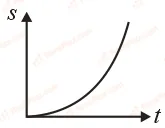
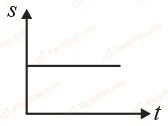
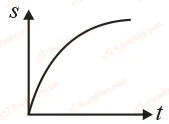
A particle is moving unidirectional on a horizontal plane under the action of a constant power supplying energy source. The displacement (s) - time (t) graph that describes the motion of the particle is (graphs are drawn schematically and are not to scale):
An elevator in a building can carry a maximum of 10 persons, with the average mass of each person being 68 kg. The mass of the elevator itself is 920 kg and it moves with a constant speed of 3 m/s. The frictional force opposing the motion is 6000 N. If the elevator is moving up with its full capacity, the power delivered by the motor to the elevator (g = 10 m/s) must be at least:
56300 W
62360 W
48000 W
66000 W
A body of mass is driven by an engine delivering a constant power of . The body starts from rest and moves in a straight line. After , the body has moved a distance (in m)....