RankRizz

Potential energy, conservative forces and energy curves — JEE Main Previous Year Questions

Every JEE Main question on Potential energy, conservative forces and energy curves, one of the ideas inside Work, Energy & Power: 9 questions from 2006–2026, 2 of them in the last five years. Newest first, answer key on every one. Free to read.

Questions

9

Years asked

7

Since

2006

Of the chapter

6%

When JEE Main asked it

Questions on Potential energy, conservative forces and energy curves in each year it was asked.

20261
20221
20183
20151
20131
20101
20061

Every Potential energy, conservative forces and energy curves question

1–9 OF 9 · NEWEST FIRST

JEE MAIN 2026 · 21 JAN S1Potential energy, conservative forces and energy curvesTRANSCRIBED

Potential energy (V) versus distance (x) is given by the graph. Rank various regions as per the magnitudes of the force (F) acting on a particle from high lo low.
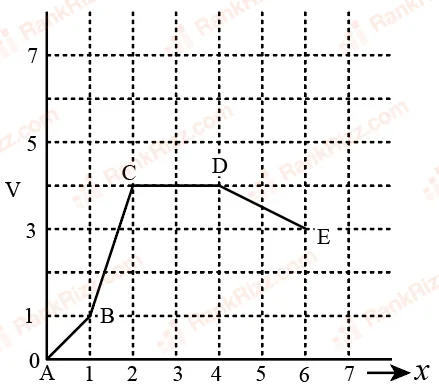
Screenshot_4
  1. A

    FCD>FDE>FAB>FBCF_{CD} > F_{DE} > F_{AB} > F_{BC}

  2. B

    FCD>FAB>FBC>FDEF_{CD} > F_{AB} > F_{BC} > F_{DE}

  3. C

    FBC>FCD>FDE>FABF_{BC} > F_{CD} > F_{DE} > F_{AB}

  4. D

    FBC>FAB>FDE>FCDF_{BC} > F_{AB} > F_{DE} > F_{CD}

JEE MAIN 2022 · 24 JUN S2Potential energy, conservative forces and energy curvesTRANSCRIBED

Potential energy as a function of rr is given by U=Ar10−Br5U = \frac{A}{r^{10}} - \frac{B}{r^5}, where rr is the interatomic distance, AA and BB are positive constants. The equilibrium distance between the two atoms will be :

  1. A

    (AB)15\left(\frac{A}{B}\right)^{\frac{1}{5}}

  2. B

    (BA)15\left(\frac{B}{A}\right)^{\frac{1}{5}}

  3. C

    (2AB)15\left(\frac{2A}{B}\right)^{\frac{1}{5}}

  4. D

    (B2A)15\left(\frac{B}{2A}\right)^{\frac{1}{5}}

JEE MAIN 2018 · 08 APR OFFLINEPotential energy, conservative forces and energy curvesTRANSCRIBED

A particle is moving in a circular path of radius a under the action of an attractive potential U=−k2r2U = -\frac{k}{2r^2}. Its total energy is:

  1. A

    −32ka2-\frac{3}{2}\frac{k}{a^2}

  2. B

    −k4a2-\frac{k}{4a^2}

  3. C

    k2a2\frac{k}{2a^2}

  4. D

    Zero

JEE MAIN 2018 · 16 APR ONLINEPotential energy, conservative forces and energy curvesTRANSCRIBED

Two particles of the same mass m are moving in circular orbits because of force, given by F(r)=−16r−r3F(r) = -\frac{16}{r} - r^3. The first particle is at a distance r = 1, and the second, at r = 4. The best estimate for the ratio of kinetic energies of the first and the second particle is closest to:

  1. A

    3×10⁻³³ \times 10^{-3}

  2. B

    6×1026 \times 10^2

  3. C

    6×10⁻²⁶ \times 10^{-2}

  4. D

    10−210^{-2}

JEE MAIN 2018 · 08 APR OFFLINEPotential energy, conservative forces and energy curvesTRANSCRIBED

In a collinear collision, a particle with an initial speed v0v_0 strikes a stationary particle of the same mass. If the final total kinetic energy is 50% greater than the original kinetic energy, the magnitude of the relative velocity between the two particles, after the collision, is:

  1. A

    v02\frac{v_0}{\sqrt{2}}

  2. B

    v04\frac{v_0}{4}

  3. C

    2 v0\sqrt{2}\, v_0

  4. D

    v02\frac{v_0}{2}

JEE MAIN 2015 · 11 APR ONLINEPotential energy, conservative forces and energy curvesTRANSCRIBED

A particle is moving in a circle of radius rr under the action of a force F=αr2F = \alpha r^2 which is directed towards centre of the circle. Total mechanical energy (kinetic energy + potential energy) of the particle is (take potential energy = 0 for r=0r = 0):

  1. A

    56αr3\frac{5}{6}\alpha r^3

  2. B

    αr3\alpha r^3

  3. C

    12αr3\frac{1}{2}\alpha r^3

  4. D

    43αr3\frac{4}{3}\alpha r^3

JEE MAIN 2013 · 09 APR ONLINEPotential energy, conservative forces and energy curvesTRANSCRIBED

Two springs of force constants 300 N/m (Spring A) and 400 N/m (Spring B) are joined together in series. The combination is compressed by 8.75 cm. The ratio of energy stored in A and B is EAEB\frac{E_A}{E_B}. Then EAEB\frac{E_A}{E_B} is equal to:

  1. A

    43\frac{4}{3}

  2. B

    169\frac{16}{9}

  3. C

    34\frac{3}{4}

  4. D

    916\frac{9}{16}

JEE MAIN 2010Potential energy, conservative forces and energy curvesTRANSCRIBED

The potential energy function for the force between two atoms in a diatomic molecule is approximately given by U(x)=ax12−bx6U(x) = \frac{a}{x^{12}} - \frac{b}{x^6}, where aa and bb are constants and xx is the distance between the atoms. If the dissociation energy of the molecule is D=[U(x=∞)−Uat equilibrium]D = [U(x = \infty) - U_{\text{at equilibrium}}], DD is

  1. A

    b22a\frac{b^2}{2a}

  2. B

    b212a\frac{b^2}{12a}

  3. C

    b24a\frac{b^2}{4a}

  4. D

    b26a\frac{b^2}{6a}

JEE MAIN 2006Potential energy, conservative forces and energy curvesTRANSCRIBED

The potential energy of a 1 kg1\,kg particle free move along the x-axis is given by V(x)=(x44−x22)JV(x) = \left(\frac{x^4}{4} - \frac{x^2}{2}\right)JThetotalmechanicalenergyoftheparticleThe total mechanical energy of the particle2 J2\,J.Then,themaximumspeed(in. Then, the maximum speed (inm/sm/s$) is

  1. A

    2

  2. B

    3/23/\sqrt{2}

  3. C

    2\sqrt{2}

  4. D

    1/21/\sqrt{2}