The rain drop of mass 1 g, starts with zero velocity from a height of 1 km. It hits the ground with a speed of 5 m/s. The work done by the unknown resistive force is _______ J.
(take g = 10 m/s)
- A
- B
- C
- D
Every JEE Main question on Kinetic energy and the work-energy theorem, one of the ideas inside Work, Energy & Power: 25 questions from 2004–2026, 8 of them in the last five years. Newest first, answer key on every one. Free to read.
Questions
25
Years asked
14
Since
2004
Of the chapter
16%
Questions on Kinetic energy and the work-energy theorem in each year it was asked, the latest 12 of 14.
1–20 OF 25 · NEWEST FIRST
The rain drop of mass 1 g, starts with zero velocity from a height of 1 km. It hits the ground with a speed of 5 m/s. The work done by the unknown resistive force is _______ J.
(take g = 10 m/s)
A block of mass 1 kg, moving along x with speed m/s enters a rough region ranging from m to m. The retarding force acting on the block in this range is N, with N/m. Then the final speed of the block as it crosses rough region is
10 m/s
4 m/s
6 m/s
8 m/s
A bullet is fired into a fixed target looses one third of its velocity after travelling 4 cm. It penetrates further m before coming to rest. The value of is :
32
5
3
4
A body is dropped on ground from a height and after hitting the ground, it rebounds to a height . If the ratio of velocities of the body just before and after hitting ground is 4, then percentage loss in kinetic energy of the body is . The value of is ______.
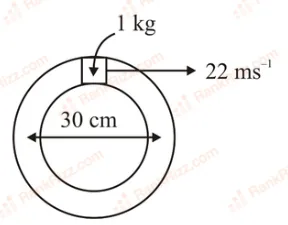
A closed circular tube of average radius 15 cm, whose inner walls are rough, is kept in vertical plane. A block of mass 1 kg just fit inside the tube. The speed of block is 22 m s, when it is introduced at the top of tube. After completing five oscillations, the block stops at the bottom region of tube. The work done by the tube on the block is _______ J. (Given m s).

A particle of mass 10 g moves in a straight line with retardation 2x, where is the displacement in SI units. Its loss of kinetic energy for above displacement is J. The value of will be ______.
A block of mass 2 kg moving on a horizontal surface with speed of 4 m s enters a rough surface ranging from m to m. The retarding force in this range of rough surface is related to distance by where N m. The speed of the block as it just crosses the rough surface will be
m s
m s
m s
zero
If momentum of a body is increased by 20%, then its kinetic energy increases by:
36%
40%
44%
48%
If the kinetic energy of a moving body becomes four times its initial kinetic energy, then the percentage change in its momentum will be:
100%
200%
300%
400%
Two particles having masses 4 g and 16 g respectively are moving with equal kinetic energies. The ratio of the magnitudes of their linear momentum is . The value of will be ______.
A pendulum bob has a speed of 3 m s at its lowest position. The pendulum is 50 cm long. The speed of bob, when the length makes an angle of 60 to the vertical will be ___ m s. ( m s)
A block starts moving up an inclined plane of inclination 30° with an initial velocity of . It comes back to its initial position with velocity . The value of the coefficient of kinetic friction between the block and the inclined plane is close to . The nearest integer to I is:
A small block starts slipping down from a point B on an inclined plane AB, which is making an angle with the horizontal section BC is smooth and the remaining section CA is rough with a coefficient of friction . It is found that the block comes to rest as it reaches the bottom (point A) of the inclined plane. If , the coefficient of friction is given by . The value of is ___________.

A bullet loses of its velocity passing through one plank. Considering uniform retardation, the number of such planks that are required to stop the bullet can be:
Infinite
A small ball of mass m starts at a point A with speed and moves along a frictionless track AB as shown. The track BC has coefficient of friction . The ball comes to stop at C after travelling a distance L which is:

A spring of unstretched length l has a mass m with one end fixed to a rigid support. Assuming spring to be made of a uniform wire, the kinetic energy possessed by it if its free end is pulled with uniform velocity v is:
The average mass of rain drops is kg and their average terminal velocity is 9 m/s. Calculate the energy transferred by rain to each square metre of the surface at a place which receives 100 cm of rain in a year.
J
J
J
J
A particle gets displaced by under the action of a force . The change in its kinetic energy is
38 J
70 J
52.5 J
126 J
An athlete in the olympic games covers a distance of 100 m in 10 s. His kinetic energy can be estimated to be in the range
200 J 500 J
J J
20,000 J 50,000 J
2,000 J 5,000 J
A 2 kg block slides on a horizontal floor with a speed of 4 m/s. It strikes a uncompressed spring, and compresses it till the block is motionless. The kinetic friction force is 15 N and spring constant is 10,000 N/m. The spring compresses by
5.5 cm
2.5 cm
11.0 cm
8.5 cm