RankRizz

Chemical Thermodynamics — JEE Main Previous Year Questions

Every Chemical Thermodynamics question JEE Main has set from 2004–2026, grouped by the idea it tests rather than the order of the syllabus. 229 questions across 7 distinct ideas. Free to read, answer key on every one.

Questions

229

Distinct ideas

7

Share of marks

4.6%

Difficulty

MEDIUM

The ideas inside Chemical Thermodynamics

A chapter is not one subject — it is a handful of procedures the examiner reuses. These are the ones Chemical Thermodynamics questions actually test.

Every Chemical Thermodynamics question

21–40 OF 229 · NEWEST FIRST

JEE MAIN 2026 · 08 APR S2Enthalpies of reaction and Hess's lawTRANSCRIBED

Consider the reaction
2H2S(g)+3O2(g)→2H2O(l)+2SO2(g)2\text{H}_2\text{S(g)} + 3\text{O}_2\text{(g)} \to 2\text{H}_2\text{O(l)} + 2\text{SO}_2\text{(g)}
The magnitude of enthalpy change for the reaction in kJ mol−1^{-1} is __________. (Nearest integer)
Given :
ΔfH⊖(H2S)=−20.1\Delta_f H^\ominus(\text{H}_2\text{S}) = -20.1 kJ mol−1^{-1}
ΔfH⊖(H2O)=−286.0\Delta_f H^\ominus(\text{H}_2\text{O}) = -286.0 kJ mol−1^{-1}
ΔfH⊖(SO2)=−297.0\Delta_f H^\ominus(\text{SO}_2) = -297.0 kJ mol−1^{-1}

JEE MAIN 2026 · 02 APR S1Gibbs energy and spontaneityTRANSCRIBED

At the transition temperature T, A ⇌\rightleftharpoons B and ΔG0^0 = 105 − 35 log T where A and B are two states of substance X. The transition temperature in °C when pressure is 1 atm is __________. (Nearest integer)

JEE MAIN 2026 · 06 APR S1Gibbs energy and spontaneityTRANSCRIBED

Consider the reaction X ⇌\rightleftharpoons Y at 300 K. If ΔHθ\Delta H^\theta and K are 28.40 kJ mol−1^{-1} and 1.8×10−71.8 \times 10^{-7} at the same temperature, then the magnitude of ΔSθ\Delta S^\theta for the reaction in J K−1^{-1} mol−1^{-1} is _______. (Nearest integer)
(Given: R = 8.3 J K−1^{-1} mol−1^{-1}, ln 10 = 2.3, log 3 = 0.48, log 2 = 0.30)

JEE MAIN 2025 · 29 JAN S1First law: work, heat and internal energyTRANSCRIBED

500J of energy is transferred as heat to 0.5 mol of Argon gas at 298 K and 1.00 atm. The final temperature and the change in internal energy respectively are: Given : R=8.3JK−1mol−1R = 8.3 J K^{-1}mol^{-1}

  1. A

    378 K and 500 J

  2. B

    368 K and 500 J

  3. C

    348 K and 300 J

  4. D

    378 K and 300 J

JEE MAIN 2025 · 04 APR S1Gibbs energy and spontaneityTRANSCRIBED

Let us consider a reversible reaction at temperature, T. In this reaction, both ΔH\Delta H and ΔS\Delta S were observed to have positive values. If the equilibrium temperature is TeT_e, then the reaction becomes spontaneous at:

  1. A

    T=TeT = T_e

  2. B

    Te>TT_e \gt T

  3. C

    T>TeT \gt T_e

  4. D

    Te=5TT_e = 5T

JEE MAIN 2025 · 22 JAN S1First law: work, heat and internal energyTRANSCRIBED

A liquid when kept inside a thermally insulated closed vessel 25oC25^{o}C at was mechanically stirred from outside. What will be the correct option for the following thermodynamic parameters ?

  1. A

    △U<0,q=0,w>0\triangle U \lt 0, q=0, w\gt 0

  2. B

    △U=0,q=0,w=0\triangle U = 0, q=0, w=0

  3. C

    △U>0,q=0,w>0\triangle U \gt 0, q=0, w\gt 0

  4. D

    △U=0,q<0,w>0\triangle U = 0, q\lt 0, w\gt 0

JEE MAIN 2025 · 23 JAN S2Gibbs energy and spontaneityTRANSCRIBED

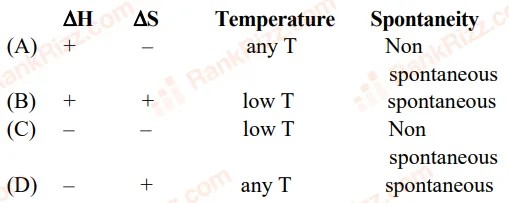
The effect of temperature on spontaneity of reactions are represented as :
page8_img5
  1. A

    (B) and (C) only

  2. B

    (B) and (D) only

  3. C

    (A) and (D) only

  4. D

    (A) and (C) only

JEE MAIN 2025 · 07 APR S2Bond enthalpy, atomisation, phase-change and solution enthalpiesTRANSCRIBED

The hydration energies of K+K^+ and Cl−Cl^- are −x-x and −y-y kJ/mol respectively. If lattice energy of KCl is −z-z kJ/mol, then the heat of solution of KCl is :

  1. A

    +x−y−z+x - y - z

  2. B

    x+y+zx + y + z

  3. C

    z−(x+y)z - (x + y)

  4. D

    −z−(x+y)-z - (x + y)

JEE MAIN 2025 · 07 APR S1Enthalpies of reaction and Hess's lawTRANSCRIBED

Total enthalpy change for freezing of 1 mol water at 10 degrees C to ice at -10 degrees C is ______
(Given : ΔfusH=x\Delta_{fus}H = x kJ/mol, Cp[H2O(l)]=yC_p[H_2O(l)] = y J mol−1^{-1} K−1^{-1}, Cp[H2O(s)]=zC_p[H_2O(s)] = z J mol−1^{-1} K−1^{-1})

  1. A

    −x−10y−10z-x - 10y - 10z

  2. B

    −10(100x+y+z)-10(100x + y + z)

  3. C

    10(100x+y+z)10(100x + y + z)

  4. D

    x−10y−10zx - 10y - 10z

JEE MAIN 2025 · 04 APR S1First law: work, heat and internal energyTRANSCRIBED

One mole of an ideal gas expands isothermally and reversibly from 10 dm3dm^3 to 20 dm3dm^3 at 300 K. ΔU\Delta U, q and work done in the process respectively are: (Given: R=8.3JK−1mol−1R = 8.3 J K^{-1} mol^{-1}, ln⁡10=2.3\ln 10 = 2.3, log⁡2=0.30\log 2 = 0.30, log⁡3=0.48\log 3 = 0.48)

  1. A

    0, 21.84 kJ, -1.26 kJ

  2. B

    0, -17.18 kJ, 1.718 J

  3. C

    0, 21.84 kJ, 21,84 kJ

  4. D

    0, 1718 kJ, -1.718 kJ

JEE MAIN 2025 · 24 JAN S1Gibbs energy and spontaneityTRANSCRIBED

Let us consider an endothermic reaction which is non-spontaneous at the freezing point of water. However, the reaction is spontaneous at boiling point of water. Choose the correct option.
  1. A

    Both ΔH and ΔS are (−ve)\text{Both } \Delta H \text{ and } \Delta S \text{ are } (-\text{ve})

  2. B

    ΔH is (−ve) but ΔS is (+ve)\Delta H \text{ is } (-\text{ve}) \text{ but } \Delta S \text{ is } (+\text{ve})

  3. C

    ΔH is (+ve) but ΔS is (−ve)\Delta H \text{ is } (+\text{ve}) \text{ but } \Delta S \text{ is } (-\text{ve})

  4. D

    Both ΔH and ΔS are (+ve)\text{Both } \Delta H \text{ and } \Delta S \text{ are } (+\text{ve})

JEE MAIN 2025 · 02 APR S1First law: work, heat and internal energyTRANSCRIBED
Figure for JEE Main 2025 Chemistry question on First law: work, heat and internal energy

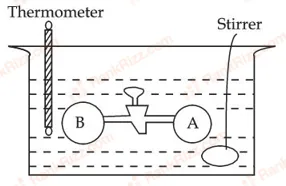
Two vessels A and B are connected via stopcock. The vessel A is filled with a gas at a certain pressure. The entire assembly is immersed in water and is allowed to come to thermal equilibrium with water. After opening the stopcock the gas from vessel A expands into vessel B and no change in temperature is observed in the thermometer. Which of the following statement is true?

  1. A

    dw≠0dw \neq 0

  2. B

    dq≠0dq \neq 0

  3. C

    dU≠0dU \neq 0

  4. D

    The pressure in the vessel B before opening the stopcock is zero.

JEE MAIN 2025 · 07 APR S2Enthalpies of reaction and Hess's lawTRANSCRIBED

The correct statement amongst the following is :

  1. A

    The term 'standard state' implies that the temperature is 0°C

  2. B

    The standard state of pure gas is the pure gas at a pressure of 1 bar and temperature 273 K

  3. C

    ΔfH298θ\Delta_f H^\theta_{298} is zero for O(g)

  4. D

    ΔfH500θ\Delta_f H^\theta_{500} is zero for O2(g)O_2(g)

JEE MAIN 2025 · 22 JAN S2Gibbs energy and spontaneityTRANSCRIBED
Figure for JEE Main 2025 Chemistry question on Gibbs energy and spontaneity


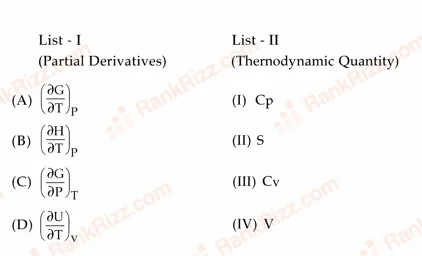
Match List - I with List - II.
Choose the correct answer from the options given below :

  1. A

    (A)-(II), (B)-(I), (C)-(III), (D)-(IV)

  2. B

    (A)-(I), (B)-(II), (C)-(IV), (D)-(III)

  3. C

    (A)-(II), (B)-(I), (C)-(IV), (D)-(III)

  4. D

    (A)-(II), (B)-(III), (C)-(I), (D)-(IV)

JEE MAIN 2025 · 03 APR S1Heat capacity and calorimetryTRANSCRIBED

Which of the following properties will change when system containing solution 1 will become solution 2 ?
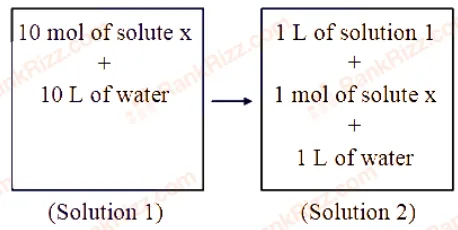
Figure for JEE Main 2025 Chemistry question on Heat capacity and calorimetry
  1. A

    Molar heat capacity

  2. B

    Density

  3. C

    Concentration

  4. D

    Gibbs free energy

JEE MAIN 2025 · 04 APR S2Enthalpies of reaction and Hess's lawTRANSCRIBED

Consider the given data :
(a) HCl(g)+10H2O(l)→HCl⋅10H2OHCl(g) + 10H_2O(l) \rightarrow HCl \cdot 10H_2O, ΔH=−69.01\Delta H = -69.01 kJ mol−1^{-1}
(b) HCl(g)+40H2O(l)→HCl⋅40H2OHCl(g) + 40H_2O(l) \rightarrow HCl \cdot 40H_2O, ΔH=−72.79\Delta H = -72.79 kJ mol−1^{-1}
Choose the correct statement :

  1. A

    Dissolution of gas in water is an endothermic process

  2. B

    The heat of solution depends on the amount of solvent.

  3. C

    The heat of dilution for HCl (HCl.10H2OHCl.10H_{2}O to HCl.40H2OHCl.40H_{2}O)is 3.78 kJ/mol−1mol^{-1}

  4. D

    The heat of formation of HCl solution is represented by both (a) and (b)

JEE MAIN 2025 · 02 APR S2Heat capacity and calorimetryTRANSCRIBED

Arrange the following in order of magnitude of work done by the system / on the system at constant temperature :
(a) ∣wreversible∣|w_{\text{reversible}}| for expansion in infinite stage.
(b) ∣wirreversible∣|w_{\text{irreversible}}| for expansion in single stage.
(c) ∣wreversible∣|w_{\text{reversible}}| for compression in infinite stage.
(d) ∣wirreversible∣|w_{\text{irreversible}}| for compression in single stage.

Choose the correct answer from the options given below :

  1. A

    a>b>c>da \gt b \gt c \gt d

  2. B

    d>c=a>bd \gt c = a \gt b

  3. C

    c=a>d>bc = a \gt d \gt b

  4. D

    a>c>b>da \gt c \gt b \gt d

JEE MAIN 2025 · 23 JAN S1Gibbs energy and spontaneityTRANSCRIBED

Ice at −5∘C-5^{\circ}C is heated to become vapor with temperature of 110∘C110^{\circ}C at atmospheric pressure. The entropy change associated with this process can be obtained from

  1. A

    ∫268K273KCp ,mdT+ΔHm,fusionTf+ΔHm,vaporisationTb+∫273K373KCp m dT+∫373K383KCp m dT\int_{268K}^{273K} C_p\,, _{m}{dT} + \frac{\Delta H_{m,\text{fusion}}}{T_f} + \frac{\Delta H_{m,\text{vaporisation}}}{T_b} + \int_{273K}^{373K} C_p\, m\, dT + \int_{373K}^{383K} C_p\, m\, dT

  2. B

    ∫268K273KCp ,mT dT+ΔHm,fusionTf+ΔHm,vaporisationTb+∫273K373KCp. mT dT+∫373K383KCp. mdTT\int_{268K}^{273K} \frac{C_p\,, m}{T}\, dT + \frac{\Delta H_{m,\text{fusion}}}{T_f} + \frac{\Delta H_{m,\text{vaporisation}}}{T_b} + \int_{273K}^{373K} \frac{C_p.\, m}{T}\, dT + \int_{373K}^{383K} \frac{C_p.\, m dT}{T}

  3. C

    ∫268K383KCp dT+qrevT\int_{268K}^{383K} C_p\, dT + \frac{q_{\text{rev}}}{T}

  4. D

    ∫268K383KCp dT+ΔHmelting273+ΔHboiling373\int_{268K}^{383K} C_p\, dT + \frac{\Delta H_{\text{melting}}}{273} + \frac{\Delta H_{\text{boiling}}}{373}

JEE MAIN 2025 · 03 APR S2Heat capacity and calorimetryTRANSCRIBED

Given below are two statements:
Statement I: When a system containing ice in equilibrium with water (liquid) is heated, heat is absorbed by the system and there is no change in the temperature until whole ice gets melted.
Statement II: At melting point of ice, there is absorption of heat in order to overcome intermolecular forces of attraction within the molecules of water in ice and kinetic energy of molecules is not increased at melting point.
In the light of above statements, Choose the correct answer from the options given below :

  1. A

    Statement I is true but Statement II is false

  2. B

    Both Statement I and Statement II are false

  3. C

    Both Statement I and Statement II are true

  4. D

    Statement I is false but Statement II is true
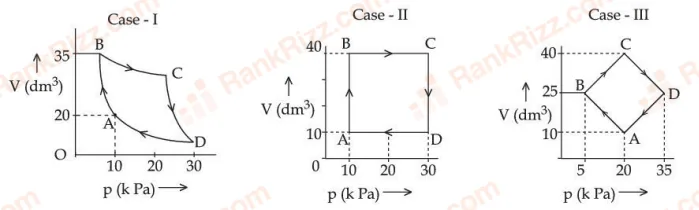
JEE MAIN 2025 · 28 JAN S2First law: work, heat and internal energyTRANSCRIBED
page11_img2

An ideal gas undergoes a cyclic transformation starting from the point A and coming back to the same point by tracing the path A→B→C→D→AA \rightarrow B \rightarrow C \rightarrow D \rightarrow A as shown in the three cases above. Choose the correct option regarding ΔU\Delta U :

  1. A

    ΔU(Case-I)=ΔU(Case-II)=ΔU(Case-III)\Delta U(\text{Case-I}) = \Delta U(\text{Case-II}) = \Delta U(\text{Case-III})

  2. B

    ΔU(Case-I)>ΔU(Case-III)>ΔU(Case-II)\Delta U(\text{Case-I}) > \Delta U(\text{Case-III}) > \Delta U(\text{Case-II})

  3. C

    ΔU(Case-III)>ΔU(Case-II)>ΔU(Case-I)\Delta U(\text{Case-III}) > \Delta U(\text{Case-II}) > \Delta U(\text{Case-I})

  4. D

    ΔU(Case-I)>ΔU(Case-II)>ΔU(Case-III)\Delta U(\text{Case-I}) > \Delta U(\text{Case-II}) > \Delta U(\text{Case-III})