RankRizz

Chemical Thermodynamics — JEE Main Previous Year Questions

Every Chemical Thermodynamics question JEE Main has set from 2004–2026, grouped by the idea it tests rather than the order of the syllabus. 229 questions across 7 distinct ideas. Free to read, answer key on every one.

Questions

229

Distinct ideas

7

Share of marks

4.6%

Difficulty

MEDIUM

The ideas inside Chemical Thermodynamics

A chapter is not one subject — it is a handful of procedures the examiner reuses. These are the ones Chemical Thermodynamics questions actually test.

Every Chemical Thermodynamics question

81–100 OF 229 · NEWEST FIRST

JEE MAIN 2023 · 30 JAN S2First law: work, heat and internal energyTRANSCRIBED

1 mole of ideal gas is allowed to expand reversibly and adiabatically from a temperature of 27°27°C. The work done is 33 kJ mol−1^{-1}. The final temperature of the gas is ______ K (Nearest integer). Given Cv=20C_v = 20 J mol−1^{-1} K−1^{-1}

JEE MAIN 2023 · 24 JAN S1Gibbs energy and spontaneityTRANSCRIBED

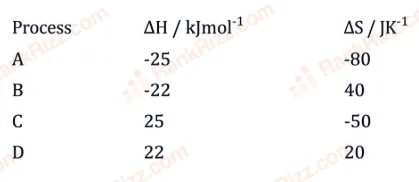
For independent process at 300 K.

Figure for JEE Main 2023 Chemistry question on Gibbs energy and spontaneity


The number of non-spontaneous process from the following is _____.

JEE MAIN 2023 · 24 JAN S1Gibbs energy and spontaneityTRANSCRIBED

For independent process at 300 K.

ProcessΔH\Delta H / kJmol−1^{-1}ΔS\Delta S / JK−1^{-1}
A-25-80
B-2240
C25-50
D2220

The number of non-spontaneous process from the following is _____.
JEE MAIN 2023 · 30 JAN S1First law: work, heat and internal energyTRANSCRIBED

When 2 litre of ideal gas expands isothermally into vacuum to a total volume of 6 litre, the change in internal energy is ______ J. (Nearest integer)

JEE MAIN 2023 · 15 APR S1Gibbs energy and spontaneityTRANSCRIBED

30.430.4 kJ of heat is required to melt one mole of sodium chloride and the entropy change at the melting point is 28.428.4 J K−1^{-1} mol−1^{-1} at 1 atm. The melting point of sodium chloride is _____ K (Nearest Integer)

JEE MAIN 2023 · 11 APR S1Enthalpies of reaction and Hess's lawTRANSCRIBED

Solid fuel used in rocket is a mixture of Fe2_2O3_3 and Al (in ratio 1 : 2). The heat evolved (kJ) per gram of the mixture is _______
Given ΔHf0\Delta H_f^0 Al2_2O3_3 = -1700 kJ mol−1^{-1}
ΔHf0\Delta H_f^0 Fe2_2O3_3 = -840 kJ mol−1^{-1}
Molar mass of Fe, Al and O are 56, 27 and 16 g mol−1^{-1} respectively

JEE MAIN 2023 · 31 JAN S1Enthalpies of reaction and Hess's lawTRANSCRIBED

The enthalpy change for the conversion of 12\dfrac{1}{2}Cl2_2(g) to Cl−^-(aq) is (-) ______ kJmol−1^{-1} (Nearest integer)
Given: ΔdisHCl2(g)0=240\Delta_{dis}H^0_{Cl_2(g)} = 240 kJmol−1^{-1}
ΔegHCl(g)o=−350\Delta_{eg}H^o_{Cl(g)} = -350 kJmol−1^{-1}
ΔhydHCl−(g)o=−380\Delta_{hyd}H^o_{Cl^-(g)} = -380 kJmol−1^{-1}

JEE MAIN 2023 · 12 APR S1Entropy and the second lawTRANSCRIBED

One mole of an ideal gas at 350350 K is in a 2.02.0 L vessel of thermally conducting walls, which are in contact with the surroundings. It undergoes isothermal reversible expansion from 2.02.0 L to 3.03.0 L against a constant pressure of 44 atm. The change in entropy of the surroundings (ΔS\Delta S) is _____ J K−1^{-1} (Nearest integer)
Given: R=8.314R = 8.314 J K−1^{-1} mol−1^{-1}.

JEE MAIN 2023 · 24 JAN S2First law: work, heat and internal energyTRANSCRIBED

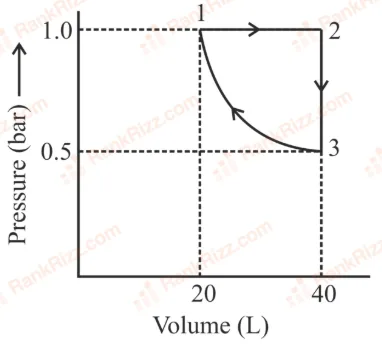
One mole of an ideal monoatomic gas is subjected to changes as shown in the graph. The magnitude of the work done (by the system or on the system) is _____ J (nearest integer)

Figure for JEE Main 2023 Chemistry question on First law: work, heat and internal energy

Given: log 2 = 0.3, ln 10 = 2.3

JEE MAIN 2023 · 13 APR S1Enthalpies of reaction and Hess's lawTRANSCRIBED

A2_2 + B2_2 →\to 2AB. ΔHf=−200\Delta H_f = -200 kJ mol−1^{-1}
AB, A2_2 and B2_2 are diatomic molecules. If the bond enthalpies of A2_2, B2_2 and AB are in the ratio 1 : 0.5 : 1, then the bond enthalpy of A2_2 is _____ kJ mol−1^{-1} (Nearest integer)

JEE MAIN 2023 · 31 JAN S2Enthalpies of reaction and Hess's lawTRANSCRIBED

Enthalpies of formation of CCl4_4(g), H2_2O(g), CO2_2(g) and HCl are -105, -242, -394 and -92 kJ mol−1^{-1} respectively. The magnitude of enthalpy of the reaction given below is kJmol−1^{-1}. (nearest integer)
CCl4(g)+2H2O(g)→CO2(g)+4HCl(g)CCl_4(g) + 2H_2O(g) \rightarrow CO_2(g) + 4HCl(g)

JEE MAIN 2023 · 25 JAN S2Enthalpies of reaction and Hess's lawTRANSCRIBED

28.0 L of CO2_2 is produced on complete combustion of 16.8 L gaseous mixture of ethene and methane at 25°C and 1 atm. Heat evolved during the combustion process is _____ kJ
Given: ΔHC\Delta H_C(CH4_4) = -900 kJ mol−1^{-1}
ΔHC\Delta H_C(C2_2H4_4) = -1400 kJ mol−1^{-1}.

JEE MAIN 2023 · 06 APR S2Enthalpies of reaction and Hess's lawTRANSCRIBED

Consider the following data
Heat of combustion of H2_2(g) = -241.8 kJ mol−1^{-1}
Heat of combustion of C(s) = -393.5 kJ mol−1^{-1}
Heat of combustion of C2_2H5_5OH(l) = -1234.7 kJ mol−1^{-1}
The heat of formation of C2_2H5_5OH(l) is (-) ______ kJ mol−1^{-1} (Nearest integer)

JEE MAIN 2023 · 01 FEB S1Enthalpies of reaction and Hess's lawTRANSCRIBED

At 25°C, the enthalpy of the following processes are given:
H2_2(g) + O2_2(g) →\to 2OH(g) Δ\DeltaH0^0 = 78 kJ mol−1^{-1}
H2_2(g) + 1/2O2_2(g) →\to H2_2O(g) Δ\DeltaH0^0 = -242 kJ mol−1^{-1}
H2_2(g) →\to 2H(g) Δ\DeltaH0^0 = 436 kJ mol−1^{-1}
1/2O2_2(g) →\to O(g) Δ\DeltaH0^0 = 249 kJ mol−1^{-1}
H2_2O(g) →\to Hg + OHg Δ\DeltaH0^0 = X kJmol−1^{-1}
What would be the value of X for the following reaction? (Nearest integer)

JEE MAIN 2023 · 01 FEB S2Enthalpies of reaction and Hess's lawTRANSCRIBED

0.30.3 g of ethane undergoes combustion at 27°27°C in a bomb calorimeter. The temperature of calorimeter system (including the water) is found to rise by 0.5°0.5°C. The heat evolved during combustion of ethane at constant pressure is ______ kJ mol−1^{-1}. (Nearest integer)
[Given: The heat capacity of the calorimeter system is 2020 kJ K−1^{-1}, R =8.3= 8.3 JK−1^{-1} mol−1^{-1}. Assume ideal gas behaviour. Atomic mass of C and H are 12 and 1 g mol−1^{-1} respectively]

JEE MAIN 2023 · 06 APR S1Gibbs energy and spontaneityTRANSCRIBED

The value of log K for the reaction A ⇌\rightleftharpoons B at 298 K is ______. (Nearest integer)
Given: ΔH°=−54.07\Delta H° = -54.07 kJ mol−1^{-1}, ΔS°=10\Delta S° = 10 J K−1^{-1} mol−1^{-1}
(Taken 2.303×8.314×298=57052.303 \times 8.314 \times 298 = 5705)

JEE MAIN 2023 · 11 APR S2System, surroundings and state functionsTRANSCRIBED

The total number of intensive properties from the following is _______
Volume, Molar heat capacity, molarity, Ecell∘E^\circ_{cell}, Gibbs free energy change, Molar mass, Mole

JEE MAIN 2023 · 06 APR S1Gibbs energy and spontaneityTRANSCRIBED

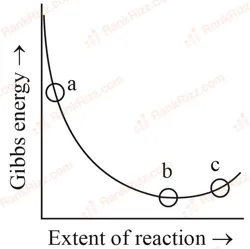
Consider the graph of Gibbs free energy G vs extent of reaction. The number of statement/s from the following which are true with respect to points (a), (b) and (c) is ______

Figure for JEE Main 2023 Chemistry question on Gibbs energy and spontaneity


A. Reaction is spontaneous at (a) and (b)
B. Reaction is at equilibrium at point (b) and non-spontaneous at point (c)
C. Reaction is spontaneous at (a) and non-spontaneous at (c)
D. Reaction is non-spontaneous at (a) and (b)

JEE MAIN 2023 · 08 APR S1First law: work, heat and internal energyTRANSCRIBED

When a 60 W electric heater is immersed in a gas for 100 s in a constant volume container with adiabatic walls, the temperature of the gas rises by 5°C. The heat capacity of the given gas is JK−1^{-1} (Nearest integer)

JEE MAIN 2023 · 10 APR S2Enthalpies of reaction and Hess's lawTRANSCRIBED

The number of endothermic process/es from the following is _______.
A. I2(g)→2I(g)I_2(g) \to 2I(g)
B. HCl(g)→H(g)+Cl(g)HCl(g) \to H(g) + Cl(g)
C. H2O(l)→H2O(g)H_2O(l) \to H_2O(g)
D. C(s)+O2(g)→CO2(g)C(s) + O_2(g) \to CO_2(g)
E. Dissolution of ammonium chloride in water