JEE MAIN 2026 · 05 APR S2Gibbs energy and spontaneityTRANSCRIBED
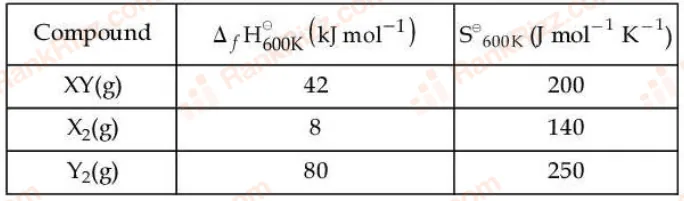
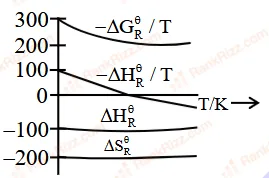
Consider the following data for the reaction
at 600 K. The (in ) for the reaction is :
- A
- B
- C
- D
Every JEE Main question on Gibbs energy and spontaneity, one of the ideas inside Chemical Thermodynamics: 54 questions from 2007–2026, 27 of them in the last five years. Newest first, answer key on every one. Free to read.
Questions
54
Years asked
16
Since
2007
Of the chapter
24%
Questions on Gibbs energy and spontaneity in each year it was asked, the latest 12 of 16.
1–20 OF 54 · NEWEST FIRST
Consider the following data for the reaction
at 600 K. The (in ) for the reaction is :
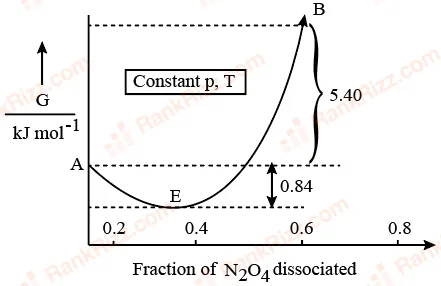
For the reaction , graph is plotted as shown below. Identify correct statements.
A. Standard free energy change for the reaction is .
B. As in graph is positive, will not dissociate into at all.
C. Reverse reaction will go to completion.
D. When 1 mole of changes into equilibrium mixture, value of = -0.84kJ .
E. When 2 mole of changes into equilibrium mixture, for equilibrium mixture is -6.24kJ .
Choose the correct answer from the options given below:
D andE only
B andC only
A and D only
C and E only
Use the following data :
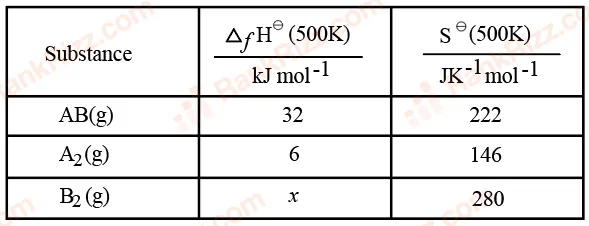
One mole each of and are taken in a 1 L closed flask and allowed to establish the equilibrium at 500K
The value of x in is ____ . (Nearest integer)
(Given: log K=2.2 R= 8.3 kJ )
At the transition temperature T, A B and ΔG = 105 − 35 log T where A and B are two states of substance X. The transition temperature in °C when pressure is 1 atm is __________. (Nearest integer)
Consider the reaction X Y at 300 K. If and K are 28.40 kJ mol and at the same temperature, then the magnitude of for the reaction in J K mol is _______. (Nearest integer)
(Given: R = 8.3 J K mol, ln 10 = 2.3, log 3 = 0.48, log 2 = 0.30)
Let us consider a reversible reaction at temperature, T. In this reaction, both and were observed to have positive values. If the equilibrium temperature is , then the reaction becomes spontaneous at:
The effect of temperature on spontaneity of reactions are represented as :
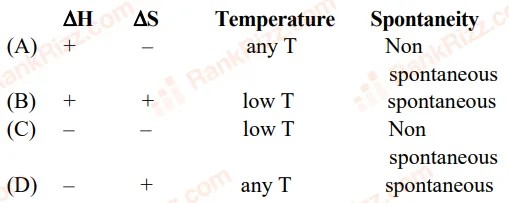
(B) and (C) only
(B) and (D) only
(A) and (D) only
(A) and (C) only
Let us consider an endothermic reaction which is non-spontaneous at the freezing point of water. However, the reaction is spontaneous at boiling point of water. Choose the correct option.
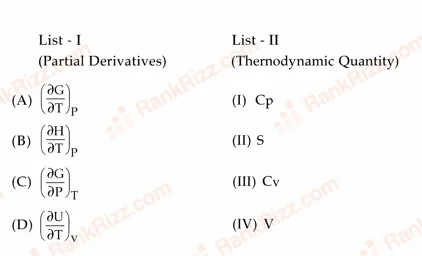
Match List - I with List - II.
Choose the correct answer from the options given below :
(A)-(II), (B)-(I), (C)-(III), (D)-(IV)
(A)-(I), (B)-(II), (C)-(IV), (D)-(III)
(A)-(II), (B)-(I), (C)-(IV), (D)-(III)
(A)-(II), (B)-(III), (C)-(I), (D)-(IV)
Ice at is heated to become vapor with temperature of at atmospheric pressure. The entropy change associated with this process can be obtained from
Which of the following graphs correctly represents the variation of thermodynamic properties of Haber's process ?
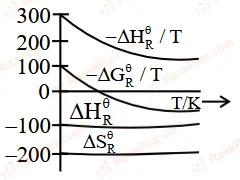
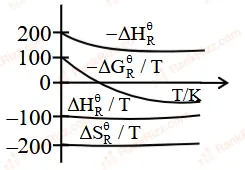
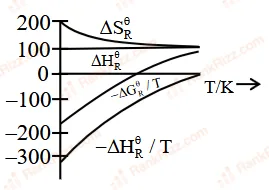
The standard enthalpy and standard entropy of decomposition of to are 55.0 kJ and 175.0 J/K/mol respectively. The standard free energy change for this reaction at in J is ______ (Nearest integer)
Standard entropies of and are and respectively. The temperature in Kelvin at which the reaction will be at equilibrium is (Nearest integer).}
Which of the following is not correct?
is negative for a spontaneous reaction
is positive for a spontaneous reaction
is zero for a reversible reaction
is positive for a non-spontaneous reaction
For a certain reaction at 300 K, K = 10, then for the same reaction is - ______ . (Given )
When and , then the temperature of vapour, at one atmosphere is ______ K.
Consider the following reaction at 298 K. , . for the reaction is _________ kJ. (Given ) Round off your answer to the nearest integer.
For the reaction at , . and . The reaction will become spontaneous above ___________ K.
For a certain thermochemical reaction at K, kJ mol, J K, log equilibrium constant () is _____ .
For complete combustion of ethene,
the amount of heat produced as measured in bomb calorimeter is 1406 kJ mol at 300 K. The minimum value of TS needed to reach equilibrium is () kJ. (Nearest integer)
Given: R = 8.3 J K mol