5 moles of unknown gas is heated at constant volume from 10 °C to 20 °C. The molar specific heat of this gas at constant pressure cal/mol.°C and J/mol.°C. The change in internal energy of the gas is _________ calorie.
Every JEE Main question on Heat capacity and calorimetry, one of the ideas inside Chemical Thermodynamics: 21 questions from 2005–2026, 11 of them in the last five years. Newest first, answer key on every one. Free to read.
Questions
21
Years asked
13
Since
2005
Of the chapter
9%
Questions on Heat capacity and calorimetry in each year it was asked, the latest 12 of 13.
1–20 OF 21 · NEWEST FIRST
5 moles of unknown gas is heated at constant volume from 10 °C to 20 °C. The molar specific heat of this gas at constant pressure cal/mol.°C and J/mol.°C. The change in internal energy of the gas is _________ calorie.
The correct order of molar heat capacities measured at 298 K and 1 bar is :
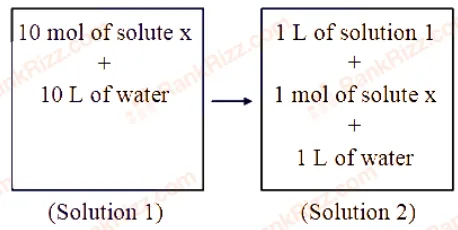
Which of the following properties will change when system containing solution 1 will become solution 2 ?

Molar heat capacity
Density
Concentration
Gibbs free energy
Arrange the following in order of magnitude of work done by the system / on the system at constant temperature :
(a) for expansion in infinite stage.
(b) for expansion in single stage.
(c) for compression in infinite stage.
(d) for compression in single stage.
Choose the correct answer from the options given below :
Given below are two statements:
Statement I: When a system containing ice in equilibrium with water (liquid) is heated, heat is absorbed by the system and there is no change in the temperature until whole ice gets melted.
Statement II: At melting point of ice, there is absorption of heat in order to overcome intermolecular forces of attraction within the molecules of water in ice and kinetic energy of molecules is not increased at melting point.
In the light of above statements, Choose the correct answer from the options given below :
Statement I is true but Statement II is false
Both Statement I and Statement II are false
Both Statement I and Statement II are true
Statement I is false but Statement II is true
The heat of combustion of solid benzoic acid at constant volume is at . The heat of combustion at constant pressure is , the value of is ______.
Which of the following relations are correct?
(A)
(B)
(C)
(D)
Choose the most appropriate answer from the options given below:
C and D only
B and C only
A and B only
B and D only
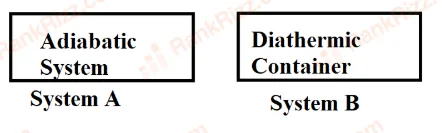
What happens when methane undergoes combustion in systems A and B respectively?

System A: Temperature rises; System B: Temperature remains same
System A: Temperature remains same; System B: Temperature rises
System A: Temperature falls; System B: Temperature remains same
System A: Temperature falls; System B: Temperature rises
Match List - I with List - II.
| List-I | List-II |
|---|---|
| (A) Spontaneous process | (I) |
| (B) Process with | (II) |
| (C) | (III) Isothermal and isobaric process |
| (D) Exothermic Process | (IV) [Bond energies in reactants] - [Bond energies in products] |
Choose the correct answer from the options given below
A-(III), B-(II), C-(IV), D-(I)
A-(II), B-(III), C-(IV), D-(I)
A-(II), B-(III), C-(I), D-(IV)
A-(II), B-(I), C-(III), D-(IV)
Which of the following relation is not correct?
When 5 moles of He gas expand isothermally and reversibly at K from litre to litre, the magnitude of the maximum work obtained is ______ J. [nearest integer] (Given : J K mol and )
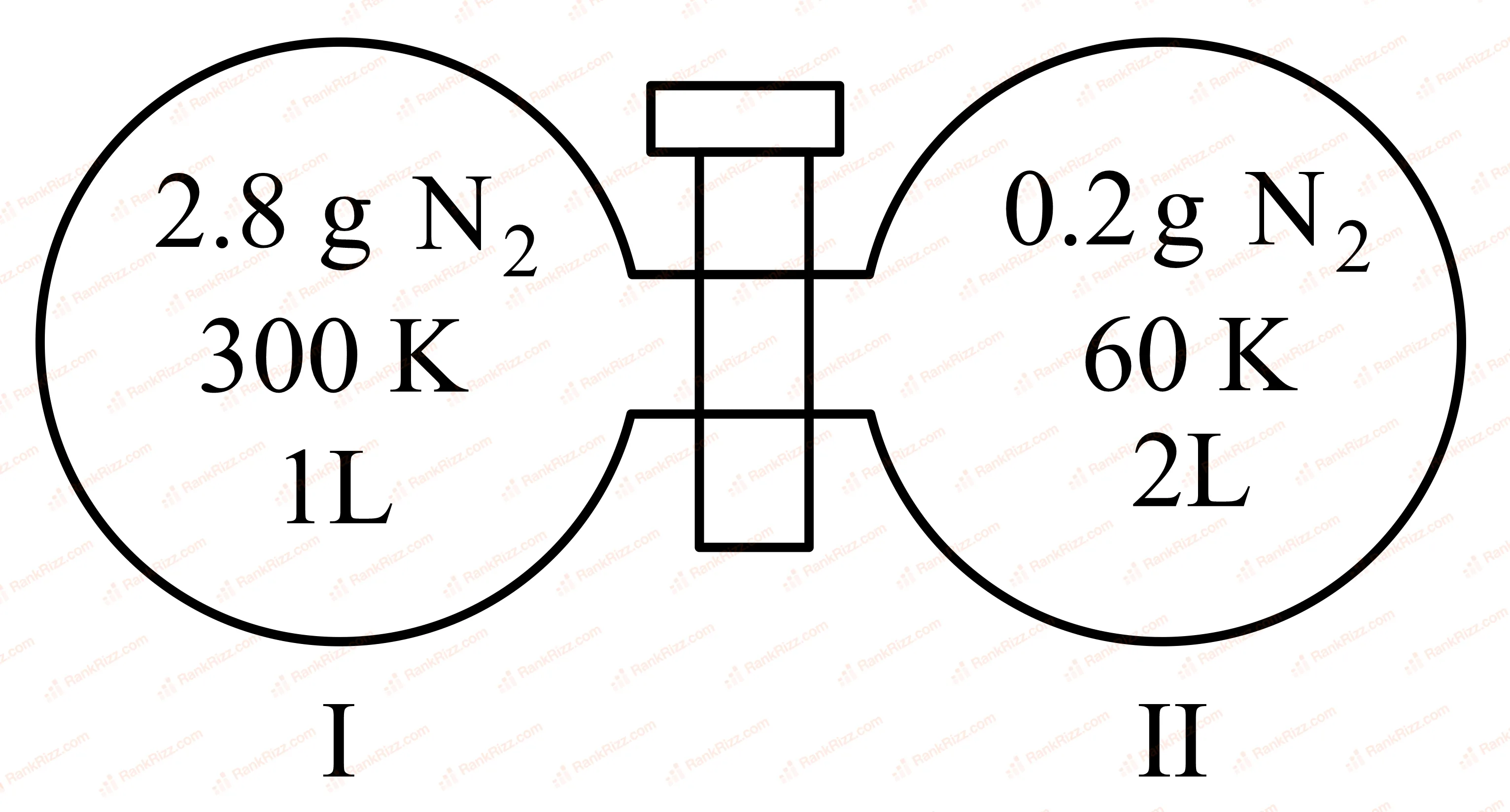
Two flasks I and II shown below are connected by a valve of negligible volume.
When the valve is opened, the final pressure of the system in bar is . The value of x is _________. (Integer answer)
[Assume : Ideal gas; 1 bar = Pa; Molar mass of N = 28.0 mol; R = 8.31 J mol K]
For one mole of an ideal gas, which of these statements must be true?
(a) Internal energy (U) and enthalpy (H) each depends on temperature.
(b) Compressibility factor Z is not equal to 1
(c)
(d) for any process
(a) and (c)
(b), (c) and (d)
(c) and (d)
(a), (c) and (d)
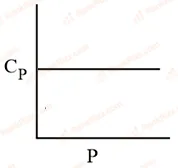
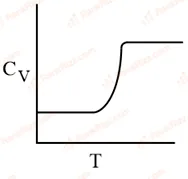
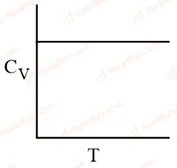
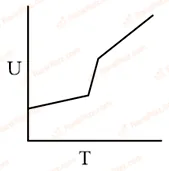
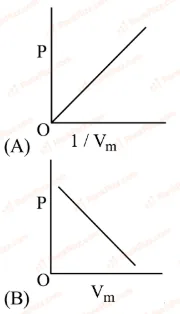
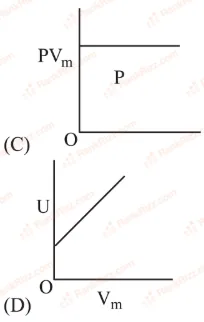
For a diatomic ideal gas in a closed system, which of the following plots does not correctly describe the relation between various thermodynamic quantities?


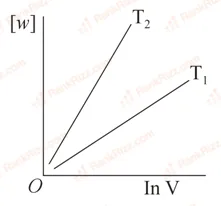
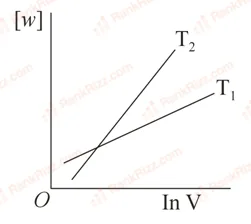
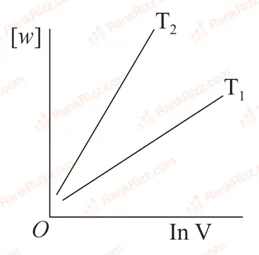
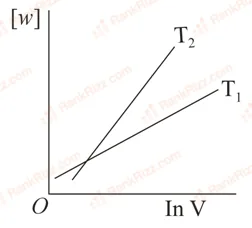
Consider the reversible isothermal expansion of an ideal gas in a closed system at two different temperatures and (). The correct graphical depiction of the dependence of work done vs the final volume is:


The combination of plots which does not represent isothermal expansion of an ideal gas is

(A) and (D)
(B) and (C)
(B) and (D)
(A) and (C)
An ideal gas undergoes isothermal expansion at constant pressure. During the process:
Enthalpy remains constant but entropy increases
Enthalpy decreases but entropy increases
Enthalpy increases but entropy decreases
Both enthalpy and entropy remain constant
The difference between the reaction enthalpy change () and reaction internal energy change () for the reaction: $ at K is ( J mol K)
J mol
J mol
J mol
J mol
Assuming that water vapour is an ideal gas, the internal energy () when 1 mol of water is vapourised at 1 bar pressure and , (Given: Molar enthalpy of vapourization of water at 1 bar and 373 K = 41 kJ and R = 8.3 J ) will be
4.100 kJ
3.7904 kJ
37.904 kJ
41.00 kJ
for the formation of carbon monoxide (CO) from its elements at is