JEE MAIN 2026First law: work, heat and internal energyTRANSCRIBED
For an isothermal free expansion of an ideal gas into vacuum, which one of the following set of values is correct?
- A
- B
- C
- D
Every JEE Main question on First law: work, heat and internal energy, one of the ideas inside Chemical Thermodynamics: 55 questions from 2004–2026, 34 of them in the last five years. Newest first, answer key on every one. Free to read.
Questions
55
Years asked
14
Since
2004
Of the chapter
24%
Questions on First law: work, heat and internal energy in each year it was asked, the latest 12 of 14.
1–20 OF 55 · NEWEST FIRST
For an isothermal free expansion of an ideal gas into vacuum, which one of the following set of values is correct?
Given below are two statements:
Statement I: For an ideal gas, heat capacity at constant volume is always greater than the heat capacity at constant pressure.
Statement II: In a constant volume process, no work is produced and all the heat withdrawn goes into the chaotic motion and is reflected by a temperature increase of the ideal gas.
In the light of the above statement, choose the correct answer from the options given below.
Both Statement I and Statement II are true
Both Statement I and Statement II are false
Statement I is true but Statement II is false
Statement I is false but Statement II is true
Match List - I with List - II.
Given and are initial and final volumes respectively.
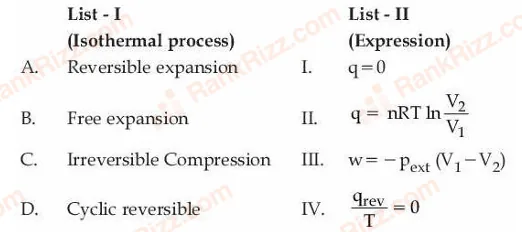
Choose the correct answer from the options given below :
A-II, B-III, C-I, D-IV
A-II, B-I, C-IV, D-III
A-II, B-I, C-III, D-IV
A-I, B-II, C-III, D-IV
Match the LIST-I with LIST-II
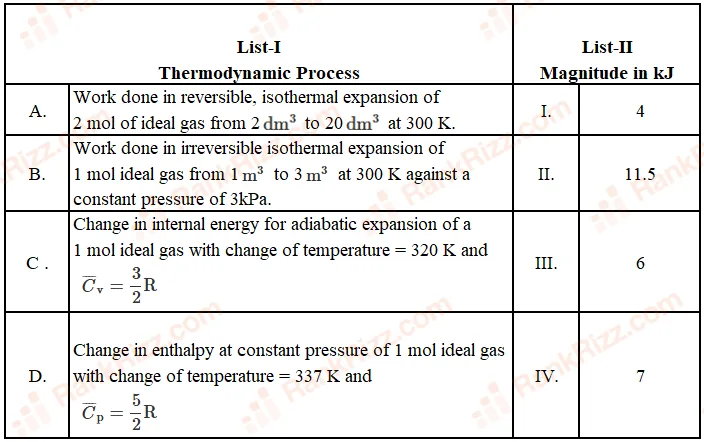
Choose the correct answer from the options given below:
A-I, B-II, C-III, D-IV
A-II, B-III, C-I, D-IV
A-II, B-I, C-III, D-IV
A-III, B-II, C-IV, D-1
Arrange the following isothermal processes in order of the magnitude of the work (p - V) involved between states 1 and 2.
A. Expansion in single stage
B. Expansion in multi stages
C. Compression in single stage
D. Compression in multi stages
Choose the correct option.
Gas 'A' undergoes change from state 'X' to state 'Y'. In this process, the heat absorbed and work done by the gas is 10 J and 18 J respectively. Now gas is brought back to state 'X' by another process during which 6 J of heat is evolved. In the reverse process of 'Y' to 'X' :
18 J of the work is done by the gas 'A'
2 J of the work is done by the gas 'A'
12 J of the work is done on the gas 'A' by the surrounding
14 J of the work is done on the gas 'A' by the surrounding
20.0 of an ideal gas 'X' at 600 K and 0.5 MPa undergoes isothermal reversible expansion until pressure of the gas is 0.2 MPa. Which of the following option is correct?
(Given: )
w = +4.1kJ, U = 0, H = 0; q = -4.1kJ
w = 9.1kJ, U = 9.1J, H = 0; q = 0
w = -3.9kJ, U = 0, H = 0; q = 3.9kJ
w = -9.1kJ, U = 0, H = 0; q = 9.1kJ
Which of the following graphs between pressure 'p' versus volume 'V' represents the maximum work done?
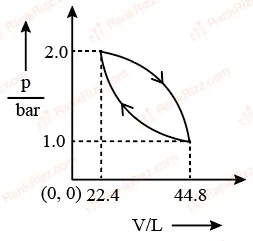
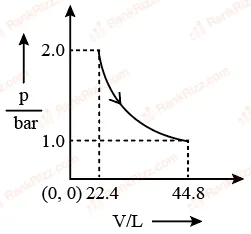
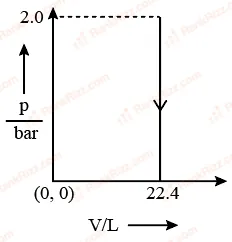
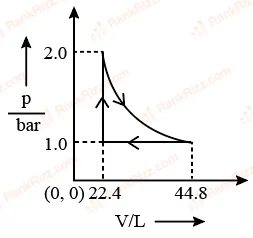
A cup of water at 5°C (system) is placed in a microwave oven and the oven is turned on for one minute during which the water begins to boil. Which of the following option is true ?
q = + ve, w = 0, = - ve
q = + ve, w = - ve, = - ve
q = + ve, w = - ve, = + ve
q = - ve, w = - ve, = - ve
Match the LIST-I with LIST-II
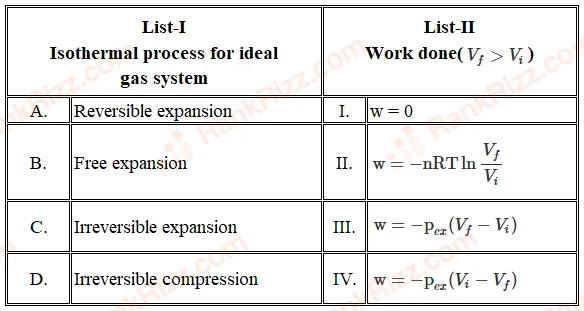
Choose the correct answer from the options given befow:
A-IV, B-II, C-III, D-I
A-II, B-I, C-III, D-IV
A-IV, B-I, C-III, D-II
A-I, B-III, C-II, D-IV
500J of energy is transferred as heat to 0.5 mol of Argon gas at 298 K and 1.00 atm. The final temperature and the change in internal energy respectively are: Given :
378 K and 500 J
368 K and 500 J
348 K and 300 J
378 K and 300 J
A liquid when kept inside a thermally insulated closed vessel at was mechanically stirred from outside. What will be the correct option for the following thermodynamic parameters ?
One mole of an ideal gas expands isothermally and reversibly from 10 to 20 at 300 K. , q and work done in the process respectively are: (Given: , , , )
0, 21.84 kJ, -1.26 kJ
0, -17.18 kJ, 1.718 J
0, 21.84 kJ, 21,84 kJ
0, 1718 kJ, -1.718 kJ
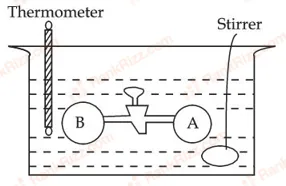
Two vessels A and B are connected via stopcock. The vessel A is filled with a gas at a certain pressure. The entire assembly is immersed in water and is allowed to come to thermal equilibrium with water. After opening the stopcock the gas from vessel A expands into vessel B and no change in temperature is observed in the thermometer. Which of the following statement is true?
The pressure in the vessel B before opening the stopcock is zero.
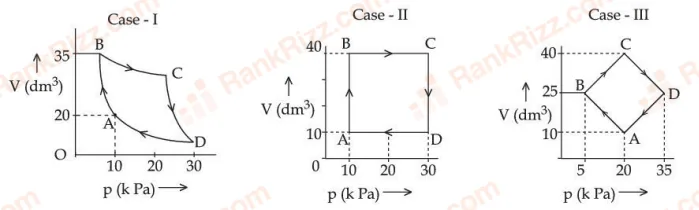
An ideal gas undergoes a cyclic transformation starting from the point A and coming back to the same point by tracing the path as shown in the three cases above. Choose the correct option regarding :
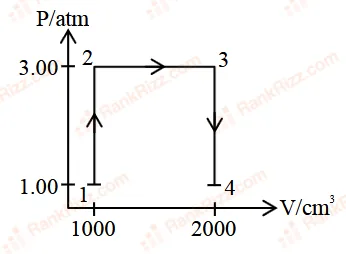
A perfect gas (0.1 mol) having (independent of temperature) undergoes the transformation from point 1 to point 4 as shown in the P-V diagram. If each step is reversible, the total work done (w) while going from point 1 to point 4 is (-) \text{____} J (nearest integer).
[Given: L atm ]
A sample of n-octane (1.14 g) was completely burnt in excess of oxygen in a bomb calorimeter, whose heat capacity is 5 kJ . As a result of combustion reaction, the temperature of the calorimeter is increased by 5 K. The magnitude of the heat of combustion of octane at constant volume is ________ kJ mol (nearest integer).
Choose the correct option for free expansion of an ideal gas under adiabatic condition from the following :
If 5 moles of an ideal gas expands from 10 L to a volume of 100 L at 300 K under isothermal and reversible condition then work, , is J. The value of is (Given J K mol)
Three moles of an ideal gas are compressed isothermally from L to L using constant pressure of atm. Heat exchange for the compression is ______ Lit. atm.