JEE MAIN 2022 · 25 JUL S2Enthalpies of reaction and Hess's lawTRANSCRIBED
While performing a thermodynamics experiment, a student made the following observations:
The enthalpy of ionization of as calculated by the student is ______ .
Every Chemical Thermodynamics question JEE Main has set from 2004–2026, grouped by the idea it tests rather than the order of the syllabus. 229 questions across 7 distinct ideas. Free to read, answer key on every one.
Questions
229
Distinct ideas
7
Share of marks
4.6%
Difficulty
MEDIUM
A chapter is not one subject — it is a handful of procedures the examiner reuses. These are the ones Chemical Thermodynamics questions actually test.
121–140 OF 229 · NEWEST FIRST
While performing a thermodynamics experiment, a student made the following observations:
The enthalpy of ionization of as calculated by the student is ______ .
coal is burnt in a bomb calorimeter in excess of oxygen at and pressure. The temperature of the calorimeter rises from to . The enthalpy change during the combustion of coal is . The value of is ______ (Given: Heat capacity of bomb calorimeter . Assume coal to be pure carbon)
The incorrect expression among the following is:
For isothermal process
(at constant P)
During which of the following processes, does entropy decrease?
(A) Freezing of water to ice at 0°C
(B) Freezing of water to ice at -10°C
(C) N(g) + 3H(g) 2NH(g)
(D) Adsorption of CO(g) and lead surface
(E) Dissolution of NaCl in water
(A), (B), (C) and (D) only
(B) and (C) only
(A) and (E) only
(A), (C) and (E) only
The reaction of cyanamide, with oxygen was run in a bomb calorimeter and was found to be kJ mol. The magnitude of for the reaction
is ______ kJ. (Rounded off to the nearest integer) [Assume ideal gases and R = 8.314 J mol K]
For a given chemical reaction A B at 300 K the free energy change is -49.4 kJ mol and the enthalpy of reaction is 51.4 kJ mol. The entropy change of the reaction is ___ JK mol.
Five moles of an ideal gas at 293 K is expanded isothermally from an initial pressure of 2.1 MPa to 1.3 MPa against at constant external pressure 4.3 MPa. The heat transferred in this process is ______ kJ mol.
(Rounded-off to the nearest integer)
[Use J mol K]
For water kJ mol at 373 K and 1 bar pressure. Assuming that water vapour is an ideal gas that occupies a much larger volume than liquid water, the internal energy change during evaporation of water is _________ (kJ mol):
[Use: R = 8.3 J mol K]
At 25°C, 50 g of iron reacts with HCl to form . The evolved hydrogen gas expands against a constant pressure of 1 bar. The work done by the gas during this expansion is ________ J. (Round off to the Nearest Integer)
[Given: J mol K. Assume, hydrogen is an ideal gas]
[Atomic mass of Fe is 55.85 u]
An average person needs about 10000 kJ energy per day. The amount of glucose (molar mass = 180.0 g mol) needed to meet this energy requirement is ___ g.
(Use : H (glucose) = -2700 kJ mol)
The ionization enthalpy of Na formation from is 495.8 kJ mol, while the electron gain enthalpy of Br is kJ mol. Given the lattice enthalpy of NaBr is kJ mol. The energy for the formation of NaBr ionic solid is kJ mol
When 400 mL of 0.2 M HSO solution is mixed with 600 mL of 0.1 M NaOH solution, the increase in temperature of the final solution is _________ K. (Round off to the nearest integer).
[Use: H(aq) + OH(aq) HO: kJ mol
Specific heat of HO = 4.18 J K g, density of HO = 1.0 g cm
Assume no change in volume of solution on mixing.]
The Born-Haber cycle for KCl is evaluated with the following data:
for KCl = kJ mol; for K = 89.2 kJ mol;
for K = 419.0 kJ mol; for Cl = kJ mol
for Cl = 243.0 kJ mol
The magnitude of lattice enthalpy of KCl in kJ mol is _________ (Nearest integer)
If the standard molar enthalpy change for combustion of graphite powder is kJ mol, the amount of heat generated on combustion of 1 g of graphite powder in kJ (Nearest integer):
The average S - F bond energy in kJ mol of is ______. (Rounded off to the nearest integer)
[Given: The values of standard enthalpy of formation of , and are , 275 and 80 kJ mol respectively.]
A system does 200 J of work and at the same time absorbs 150 J of heat. The magnitude of the change in internal energy is _________J. (Nearest integer)
Assuming ideal behaviour, the magnitude of log K for the following reaction at 25°C is . The value of x is ______. (Integer answer)
[Given: J mol; J mol; R = 8.314 J K mol]
For water at 100°C and 1 bar,
J mol
(Round off to the Nearest Integer)
[Use: R = 8.31 J mol K]
[Assume volume of HO(l) is much smaller than volume of HO(g). Assume HO(g) treated as an ideal gas]
Two flasks I and II shown below are connected by a valve of negligible volume.
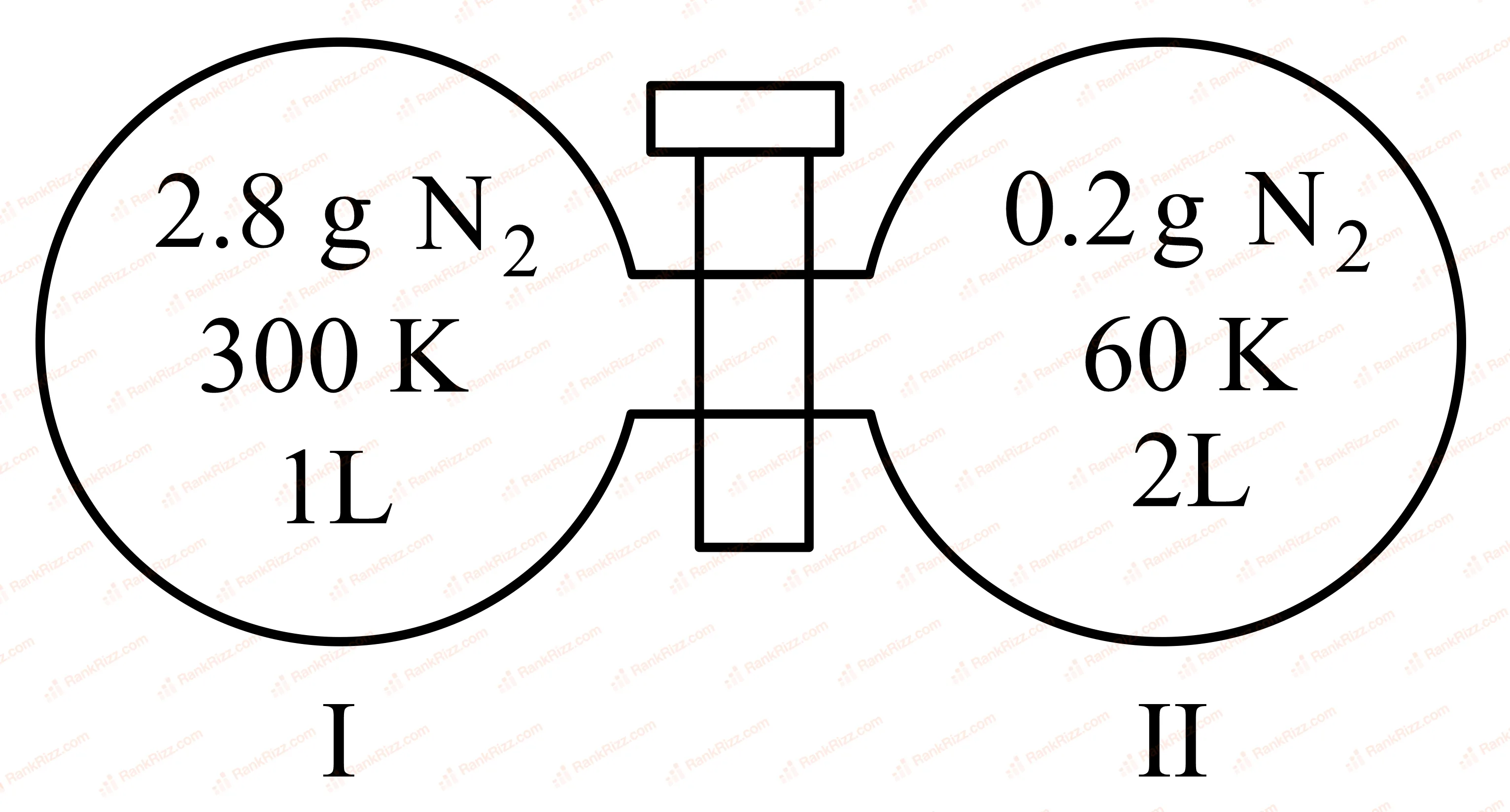
When the valve is opened, the final pressure of the system in bar is . The value of x is _________. (Integer answer)
[Assume : Ideal gas; 1 bar = Pa; Molar mass of N = 28.0 mol; R = 8.31 J mol K]
At 298 K, the enthalpy of fusion of a solid X is 2.8 kJ mol and the enthalpy of vaporisation of the liquid X is 98.2 kJ mol. The enthalpy of sublimation of the substance X in kJ mol is ___. (in nearest integer)
JEE Advanced has set 40 Chemical Thermodynamics questions too. Chemical Thermodynamics JEE Advanced PYQs →
OTHER CHEMISTRY CHAPTERS