JEE Main 2025 Chemistry question — First law: work, heat and internal energy
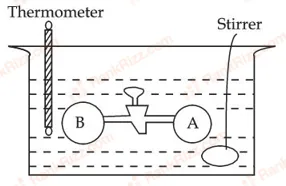
Two vessels A and B are connected via stopcock. The vessel A is filled with a gas at a certain pressure. The entire assembly is immersed in water and is allowed to come to thermal equilibrium with water. After opening the stopcock the gas from vessel A expands into vessel B and no change in temperature is observed in the thermometer. Which of the following statement is true?
SOLUTION
The given setup represents Joule's free expansion experiment.
According to the first law of thermodynamics,
The temperature of the water bath remains unchanged. Hence, there is no heat exchange between the system and the surroundings.
For an ideal gas, internal energy depends only on temperature. Since no change in temperature is observed,
therefore,
Substituting these values into the first law,
The expression for pressure-volume work is
During expansion,
Since and , the external pressure must be zero.
Hence, vessel B must initially be a vacuum.
Therefore,
- Option (A) is incorrect because .
- Option (B) is incorrect because .
- Option (C) is incorrect because .
- Option (D) is correct because the pressure inside vessel B before opening the stopcock is zero.
Therefore, the correct answer is
Tagged First law: work, heat and internal energy. Machine-assigned, so read it as a strong shortlist rather than a verdict.