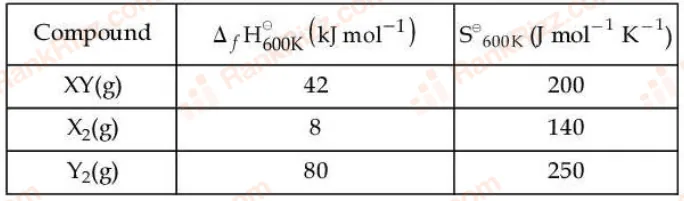
To determine the standard Gibbs free energy change ΔrG∘ for the reaction
X2(g)+Y2(g)⇌2XY(g)
at 600 K, we use the thermodynamic relation
ΔrG∘=ΔrH∘−TΔrS∘.
The standard enthalpy change of the reaction is calculated using the standard enthalpies of formation as
ΔrH∘=∑ΔfH∘(products)−∑ΔfH∘(reactants).
Substituting the given values,
ΔrH∘=[2×ΔfH∘(XY)]−[ΔfH∘(X2)+ΔfH∘(Y2)],
ΔrH∘=[2×42]−(8+80),
ΔrH∘=84−88=−4 kJ mol−1.
The standard entropy change of the reaction is obtained from the standard molar entropies:
ΔrS∘=∑S∘(products)−∑S∘(reactants).
Substituting the given values,
ΔrS∘=[2×S∘(XY)]−[S∘(X2)+S∘(Y2)],
ΔrS∘=[2×200]−(140+250),
ΔrS∘=400−390=10 J K−1 mol−1.
To maintain consistent units, convert entropy into kJ K−1 mol−1:
ΔrS∘=100010=0.01 kJ K−1 mol−1.
Substituting the values into the Gibbs free energy equation at T=600 K,
ΔrG∘=ΔrH∘−TΔrS∘,
ΔrG∘=−4−(600×0.01),
ΔrG∘=−4−6=−10 kJ mol−1.
Therefore, the standard Gibbs free energy change for the reaction is
ΔrG∘=−10 kJ mol−1.