JEE Main 2026 Chemistry question — First law: work, heat and internal energy
Match the LIST-I with LIST-II
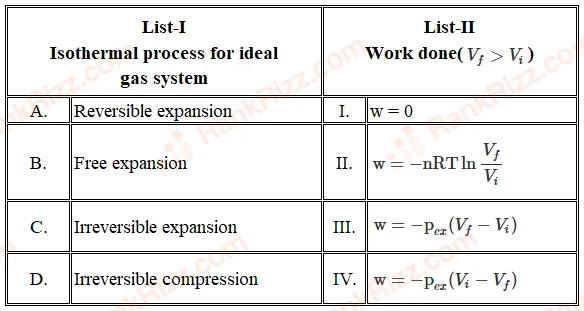
Choose the correct answer from the options given befow:
SOLUTION
1. Reversible Expansion (A II)
In a reversible process, the expansion happens infinitely slowly such that the external pressure () is always nearly equal to the internal pressure (). To find the work, we integrate the pressure over the volume change.
- Formula:
- Key Detail: Because the temperature is constant (isothermal), the work is defined by the logarithmic ratio of final to initial volume.
2. Free Expansion (B I)
Free expansion occurs when a gas expands into a vacuum. By definition, a vacuum exerts zero external pressure ().
- Formula:
- Key Detail: Since there is no opposing force to push against, the gas does no work, regardless of how much the volume increases.
3. Irreversible Expansion (C III)
This occurs when a gas expands against a constant external pressure that is significantly lower than the initial internal pressure (like suddenly removing a weight from a piston).
- Formula:
- Key Detail: The work is simply the product of the constant external pressure and the change in volume (). Since , the work value is negative, indicating energy is leaving the system.
4. Irreversible Compression (D IV)
Compression is the opposite of expansion; an external force is used to decrease the volume of the gas.
- Formula:
- Key Detail: In compression, . This formula is mathematically structured to ensure that work done on the system results in a positive value, reflecting an increase in the system's energy.
Tagged First law: work, heat and internal energy. Machine-assigned, so read it as a strong shortlist rather than a verdict.