JEE Main 2021 Physics question — Biot-Savart law: straight wires and moving charges
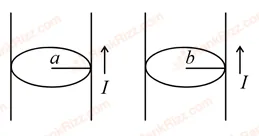
Figure A and B shown two long straight wires of circular cross-section ( and with ), carrying current which is uniformly distributed across the cross-section. The magnitude of magnetic field varies with radius and can be represented as:
SOLUTION
Upon reviewing the mathematical syntax in the previous derivation, a formatting error was found in the "Inside the Wire" bullet point where the enclosed current fraction failed to render properly. Here is the fully corrected, clean solution:
1. Derive the Magnetic Field Equations using Ampere's Law
For a long straight wire of radius carrying a uniformly distributed current :
-
Inside the Wire ():
The current enclosed by an Amperian loop of radius is proportional to its cross-sectional area:Applying Ampere's Law ():
This shows that inside the wire, the magnetic field increases linearly with radius ().
-
Outside the Wire ():
The entire current is enclosed (). Applying Ampere's Law:This shows that outside the wire, the magnetic field decreases hyperbolically ().
-
At the Surface ():
The magnetic field reaches its maximum value:Since is inversely proportional to the wire's radius (), the thinner wire () will reach a higher peak magnetic field than the thicker wire () because .
2. Analyze the Graph Options
Let's compile the features our graph must show:
- From up to the respective surfaces, both lines must be straight lines starting from the origin ( at ).
- Since , the linear peak for wire must be higher than the linear peak for wire .
- Beyond their respective surfaces ( and ), both curves must decay non-linearly following a hyperbolic curve (). Outside both wires (), the two curves merge because the total current is identical.
Reviewing the choices
- Option A: Correctly shows the peak for wire occurring earlier and higher than the peak for wire , with both curves sloping linearly from the origin and merging asymptotically in the outer region.
Conclusion
The correct graphical representation of the magnetic field variation is given by Option A.
Tagged Biot-Savart law: straight wires and moving charges. Machine-assigned, so read it as a strong shortlist rather than a verdict.