RankRizz

Vectors & Basic Mathematics — JEE Main Previous Year Questions

Every Vectors & Basic Mathematics question JEE Main has set from 2015–2026, grouped by the idea it tests rather than the order of the syllabus. 49 questions across 3 distinct ideas. Free to read, answer key on every one.

Questions

49

Distinct ideas

3

Share of marks

1.2%

Difficulty

EASY

The ideas inside Vectors & Basic Mathematics

A chapter is not one subject — it is a handful of procedures the examiner reuses. These are the ones Vectors & Basic Mathematics questions actually test.

Every Vectors & Basic Mathematics question

41–49 OF 49 · NEWEST FIRST

JEE MAIN 2021 · 22 JUL S1Dot and cross product of vectorsTRANSCRIBED

Three particles P, Q and R are moving along the vectors A⃗=i^+j^\vec{A} = \hat{i} + \hat{j}, B⃗=j^+k^\vec{B} = \hat{j} + \hat{k} and C⃗=−i^+j^\vec{C} = -\hat{i} + \hat{j}, respectively. They strike on a point and start to move in different directions. Now particle P is moving normal to the plane which contains vector A⃗\vec{A} and B⃗\vec{B}. Similarly particle Q is moving normal to the plane which contains vector A⃗\vec{A} and C⃗\vec{C}. The angle between the direction of motion of P and Q is cos⁡−1(1x)\cos^{-1}\left(\dfrac{1}{\sqrt{x}}\right). Then the value of xx is ___.

JEE MAIN 2021 · 16 MAR S1Vectors: addition, subtraction, resolution and unit vectorsTRANSCRIBED

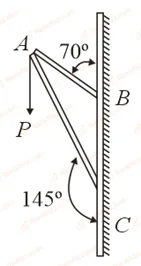
Consider a frame that is made up of two thin massless rods ABAB and ACAC as shown in the figure. A vertical force P⃗\vec{P} of magnitude 100 N is applied at point AA of the frame.

Figure for JEE Main 2021 Physics question on Vectors: addition, subtraction, resolution and unit vectors


Suppose the force P⃗\vec{P} is resolved parallel to the arms ABAB and ACAC of the frame. The magnitude of the resolved component along the arm ACAC is xx N. The value of xx, to the nearest integer, is ________.
[Given: sin⁡(35∘)=0.573,cos⁡(35∘)=0.819,sin⁡(110∘)=0.939,cos⁡(110∘)=−0.342\sin(35^\circ) = 0.573, \cos(35^\circ) = 0.819, \sin(110^\circ) = 0.939, \cos(110^\circ) = -0.342]

JEE MAIN 2020 · 07 JAN S2Vectors: addition, subtraction, resolution and unit vectorsTRANSCRIBED

The sum of two forces P⃗\vec{P} and Q⃗\vec{Q} is R⃗\vec{R} such that ∣R⃗∣=∣P⃗∣|\vec{R}| = |\vec{P}|. Find the angle between resultant of 2P⃗2\vec{P} and Q⃗\vec{Q}, and Q⃗\vec{Q},________

JEE MAIN 2019 · 08 APR S2Dot and cross product of vectorsTRANSCRIBED

Let A1⃗=3\vec{A_1} = 3, A2⃗=5\vec{A_2} = 5 and A1⃗+A2⃗=5\vec{A_1} + \vec{A_2} = 5. The value of (2A1⃗+3A2⃗)⋅(3A1⃗−2A2⃗)\left(2\vec{A_1} + 3\vec{A_2}\right) \cdot \left(3\vec{A_1} - 2\vec{A_2}\right) is:

  1. A

    -112.5

  2. B

    -118.5

  3. C

    -106.5

  4. D

    -99.5

JEE MAIN 2019 · 10 JAN S1Vectors: addition, subtraction, resolution and unit vectorsTRANSCRIBED

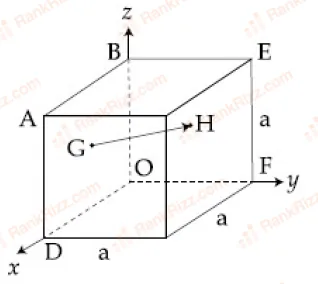
In the cube of side 'a' shown in the figure, the vector from the central point of the face ABOD to the central point of the face BEFO will be:

Figure for JEE Main 2019 Physics question on Vectors: addition, subtraction, resolution and unit vectors
  1. A

    12a(k^−i^)\frac{1}{2}a(\hat{k} - \hat{i})

  2. B

    12a(i^−k^)\frac{1}{2}a(\hat{i} - \hat{k})

  3. C

    12a(j^−i^)\frac{1}{2}a(\hat{j} - \hat{i})

  4. D

    12a(j^−k^)\frac{1}{2}a(\hat{j} - \hat{k})

JEE MAIN 2019 · 10 JAN S2Vectors: addition, subtraction, resolution and unit vectorsTRANSCRIBED

Two vectors A⃗\vec{A} and B⃗\vec{B} have equal magnitudes. The magnitude of (A⃗+B⃗)(\vec{A} + \vec{B}) is 'nn' times the magnitude of (A⃗−B⃗)(\vec{A} - \vec{B}). The angle between A⃗\vec{A} and B⃗\vec{B} is:

  1. A

    cos⁡−1[n2−1n2+1]\cos^{-1}\left[\frac{n^2 - 1}{n^2 + 1}\right]

  2. B

    sin⁡−1[n−1n+1]\sin^{-1}\left[\frac{n-1}{n+1}\right]

  3. C

    cos⁡−1[n−1n+1]\cos^{-1}\left[\frac{n-1}{n+1}\right]

  4. D

    sin⁡−1[n2−1n2+1]\sin^{-1}\left[\frac{n^2 - 1}{n^2 + 1}\right]

JEE MAIN 2019 · 10 JAN S2Vectors: addition, subtraction, resolution and unit vectorsTRANSCRIBED

Two forces P and Q, of magnitude 2F and 3F, respectively, are at an angle θ\theta with each other. If the force Q is doubled, then their resultant also gets doubled. Then, the angle θ\theta is:

  1. A

    120∘^{\circ}

  2. B

    60∘^{\circ}

  3. C

    30∘^{\circ}

  4. D

    90∘^{\circ}

JEE MAIN 2018 · 16 APR ONLINEDot and cross product of vectorsTRANSCRIBED

Let A⃗=(i^+j^)\vec{A} = (\hat{i} + \hat{j}) and B⃗=(2i^−j^)\vec{B} = (2\hat{i} - \hat{j}). The magnitude of a coplanar vector C⃗\vec{C} such that A⃗⋅C⃗=B⃗⋅C⃗=A⃗⋅B⃗\vec{A} \cdot \vec{C} = \vec{B} \cdot \vec{C} = \vec{A} \cdot \vec{B} is given by:

  1. A

    912\sqrt{\frac{9}{12}}

  2. B

    209\sqrt{\frac{20}{9}}

  3. C

    59\sqrt{\frac{5}{9}}

  4. D

    109\sqrt{\frac{10}{9}}

JEE MAIN 2015 · 11 APR ONLINEVectors: addition, subtraction, resolution and unit vectorsTRANSCRIBED

A vector A⃗\vec{A} is rotated by a small angle Δθ\Delta\theta radians (Δθ≪1)(\Delta\theta \ll 1) to get a new vector B⃗\vec{B}. In that case ∣B⃗−A⃗∣\left|\vec{B} - \vec{A}\right| is:

  1. A

    ∣A⃗∣[1−(Δθ)22]\left|\vec{A}\right|\left[1 - \frac{(\Delta\theta)^2}{2}\right]

  2. B

    0

  3. C

    ∣A⃗∣Δθ\left|\vec{A}\right|\Delta\theta

  4. D

    ∣B⃗∣Δθ−∣A⃗∣\left|\vec{B}\right|\Delta\theta - \left|\vec{A}\right|