JEE MAIN 2026 · 02 APR S1 Vectors: addition, subtraction, resolution and unit vectors TRANSCRIBED
The velocity of a particle is given as v ⃗ = − x i ^ + 2 y j ^ − z k ^ \vec{v} = -x\hat{i} + 2y\hat{j} - z\hat{k} v = − x i ^ + 2 y j ^ − z k ^ ( 1 , 2 , 4 ) (1, 2, 4) ( 1 , 2 , 4 ) 2 ^2 2
A B C D JEE MAIN 2024 · 31 JAN S2 Vectors: addition, subtraction, resolution and unit vectors TRANSCRIBED
If two vectors A ⃗ \vec{A} A B ⃗ \vec{B} B R R R θ \theta θ
A ∣ A ⃗ − B ⃗ ∣ = 2 R sin θ 2 |\vec{A} - \vec{B}| = \sqrt{2}R\sin\frac{\theta}{2} ∣ A − B ∣ = 2 R sin 2 θ
B ∣ A ⃗ + B ⃗ ∣ = 2 R sin θ 2 |\vec{A} + \vec{B}| = 2R\sin\frac{\theta}{2} ∣ A + B ∣ = 2 R sin 2 θ
C ∣ A ⃗ + B ⃗ ∣ = 2 R cos θ 2 |\vec{A} + \vec{B}| = 2R\cos\frac{\theta}{2} ∣ A + B ∣ = 2 R cos 2 θ
D ∣ A ⃗ − B ⃗ ∣ = 2 R cos θ 2 |\vec{A} - \vec{B}| = 2R\cos\frac{\theta}{2} ∣ A − B ∣ = 2 R cos 2 θ
JEE MAIN 2024 · 05 APR S1 Vectors: addition, subtraction, resolution and unit vectors TRANSCRIBED
The angle between vector Q ⃗ \vec{Q} Q ( 2 Q ⃗ + 2 P ⃗ ) (2\vec{Q} + 2\vec{P}) ( 2 Q + 2 P ) ( 2 Q ⃗ − 2 P ⃗ ) (2\vec{Q} - 2\vec{P}) ( 2 Q − 2 P )
A tan − 1 ( 2 Q ⃗ − 2 P ⃗ ) 2 Q ⃗ + 2 P ⃗ \tan^{-1}\frac{(2\vec{Q}-2\vec{P})}{2\vec{Q}+2\vec{P}} tan − 1 2 Q + 2 P ( 2 Q − 2 P )
B C tan − 1 ( P / Q ) \tan^{-1}(P/Q) tan − 1 ( P / Q )
D tan − 1 ( 2 Q / P ) \tan^{-1}(2Q/P) tan − 1 ( 2 Q / P )
JEE MAIN 2024 · 04 APR S1 Vectors: addition, subtraction, resolution and unit vectors TRANSCRIBED
Two forces F 1 ⃗ \vec{F_1} F 1 F 2 ⃗ \vec{F_2} F 2 F 1 ⃗ \vec{F_1} F 1 F 2 ⃗ \vec{F_2} F 2 cos − 1 ( 1 n ) \cos^{-1}\left(\frac{1}{n}\right) cos − 1 ( n 1 )
JEE MAIN 2024 · 30 JAN S2 Vectors: addition, subtraction, resolution and unit vectors TRANSCRIBED
A vector has magnitude same as that of A ⃗ = 3 i ^ + 4 j ^ \vec{A} = 3\hat{i} + 4\hat{j} A = 3 i ^ + 4 j ^ B ⃗ = 4 i ^ + 3 j ^ \vec{B} = 4\hat{i} + 3\hat{j} B = 4 i ^ + 3 j ^ x x x y y y x x x x x x
JEE MAIN 2024 · 08 APR S1 Vectors: addition, subtraction, resolution and unit vectors TRANSCRIBED
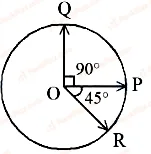
Three vectors O P ⃗ \vec{OP} O P O Q ⃗ \vec{OQ} O Q O R ⃗ \vec{OR} O R A A A A x A\sqrt{x} A x x x x
JEE MAIN 2023 · 15 APR S1 Vectors: addition, subtraction, resolution and unit vectors TRANSCRIBED
A vector in x − y x - y x − y 30 ° 30° 30° y y y y y y 2 3 2\sqrt{3} 2 3 x x x
A B C D JEE MAIN 2023 · 11 APR S2 Vectors: addition, subtraction, resolution and unit vectors TRANSCRIBED
When vector A ⃗ = 2 i ^ + 3 j ^ + 2 k ^ \vec{A} = 2\hat{i} + 3\hat{j} + 2\hat{k} A = 2 i ^ + 3 j ^ + 2 k ^ B ⃗ \vec{B} B 2 j ^ 2\hat{j} 2 j ^ B ⃗ \vec{B} B
A B C D JEE MAIN 2023 · 08 APR S1 Vectors: addition, subtraction, resolution and unit vectors TRANSCRIBED
Two forces having magnitude A and A 2 \dfrac{A}{2} 2 A
A 5 A 4 \dfrac{\sqrt{5}A}{4} 4 5 A
B 5 A 2 \dfrac{\sqrt{5}A}{2} 2 5 A
C D 5 A 2 2 \dfrac{\sqrt{5}A^2}{2} 2 5 A 2
JEE MAIN 2023 · 25 JAN S1 Vectors: addition, subtraction, resolution and unit vectors TRANSCRIBED
If P ⃗ = 3 i ^ + 3 j ^ + 2 k ^ \vec{P} = 3\hat{i} + \sqrt{3}\hat{j} + 2\hat{k} P = 3 i ^ + 3 j ^ + 2 k ^ Q ⃗ = 4 i ^ + 3 j ^ + 2.5 k ^ \vec{Q} = 4\hat{i} + \sqrt{3}\hat{j} + 2.5\hat{k} Q = 4 i ^ + 3 j ^ + 2.5 k ^ P ⃗ × Q ⃗ \vec{P} \times \vec{Q} P × Q 1 x ( 3 i ^ + j ^ − 2 3 k ^ ) \frac{1}{x}(\sqrt{3}\hat{i} + \hat{j} - 2\sqrt{3}\hat{k}) x 1 ( 3 i ^ + j ^ − 2 3 k ^ ) x x x
JEE MAIN 2022 · 29 JUN S1 Vectors: addition, subtraction, resolution and unit vectors TRANSCRIBED
Two vectors A ⃗ \vec{A} A B ⃗ \vec{B} B A ⃗ + B ⃗ \vec{A} + \vec{B} A + B A ⃗ − B ⃗ \vec{A} - \vec{B} A − B A ⃗ \vec{A} A B ⃗ \vec{B} B
A cos − 1 ( 3 5 ) \cos^{-1}\left(\frac{3}{5}\right) cos − 1 ( 5 3 )
B cos − 1 ( 1 3 ) \cos^{-1}\left(\frac{1}{3}\right) cos − 1 ( 3 1 )
C sin − 1 ( 1 3 ) \sin^{-1}\left(\frac{1}{3}\right) sin − 1 ( 3 1 )
D sin − 1 ( 3 5 ) \sin^{-1}\left(\frac{3}{5}\right) sin − 1 ( 5 3 )
JEE MAIN 2022 · 25 JUN S1 Vectors: addition, subtraction, resolution and unit vectors TRANSCRIBED
Which of the following relations is true for two unit vectors A ^ \hat{A} A ^ B ^ \hat{B} B ^ θ \theta θ
A ∣ A ^ + B ^ ∣ = ∣ A ^ − B ^ ∣ tan θ 2 |\hat{A} + \hat{B}| = |\hat{A} - \hat{B}|\frac{\tan\theta}{2} ∣ A ^ + B ^ ∣ = ∣ A ^ − B ^ ∣ 2 t a n θ
B ∣ A ^ − B ^ ∣ = ∣ A ^ + B ^ ∣ tan θ 2 |\hat{A} - \hat{B}| = |\hat{A} + \hat{B}|\frac{\tan\theta}{2} ∣ A ^ − B ^ ∣ = ∣ A ^ + B ^ ∣ 2 t a n θ
C ∣ A ^ + B ^ ∣ = ∣ A ^ − B ^ ∣ cos θ 2 |\hat{A} + \hat{B}| = |\hat{A} - \hat{B}|\frac{\cos\theta}{2} ∣ A ^ + B ^ ∣ = ∣ A ^ − B ^ ∣ 2 c o s θ
D ∣ A ^ − B ^ ∣ = ∣ A ^ + B ^ ∣ cos θ 2 |\hat{A} - \hat{B}| = |\hat{A} + \hat{B}|\frac{\cos\theta}{2} ∣ A ^ − B ^ ∣ = ∣ A ^ + B ^ ∣ 2 c o s θ
JEE MAIN 2022 · 26 JUL S2 Vectors: addition, subtraction, resolution and unit vectors TRANSCRIBED
If A ⃗ = 2 i ^ + 3 j ^ − k ^ m \vec{A} = 2\hat{i} + 3\hat{j} - \hat{k} \text{ m} A = 2 i ^ + 3 j ^ − k ^ m B ⃗ = i ^ + 2 j ^ + 2 k ^ m \vec{B} = \hat{i} + 2\hat{j} + 2\hat{k} \text{ m} B = i ^ + 2 j ^ + 2 k ^ m A ⃗ \vec{A} A B ⃗ \vec{B} B
JEE MAIN 2022 · 28 JUL S1 Vectors: addition, subtraction, resolution and unit vectors TRANSCRIBED
If the projection of 2 i ^ + 4 j ^ − 2 k ^ 2\hat{i} + 4\hat{j} - 2\hat{k} 2 i ^ + 4 j ^ − 2 k ^ i ^ + 2 j ^ + α k ^ \hat{i} + 2\hat{j} + \alpha\hat{k} i ^ + 2 j ^ + α k ^ α \alpha α
JEE MAIN 2021 · 25 JUL S2 Vectors: addition, subtraction, resolution and unit vectors TRANSCRIBED
Two vectors X ⃗ \vec{X} X Y ⃗ \vec{Y} Y ( X ⃗ − Y ⃗ ) \left(\vec{X} - \vec{Y}\right) ( X − Y ) n n n ( X ⃗ + Y ⃗ ) \left(\vec{X} + \vec{Y}\right) ( X + Y ) X ⃗ \vec{X} X Y ⃗ \vec{Y} Y
A cos − 1 ( − n 2 − 1 n 2 − 1 ) \cos^{-1}\left(\frac{-n^2 - 1}{n^2 - 1}\right) cos − 1 ( n 2 − 1 − n 2 − 1 )
B cos − 1 ( n 2 − 1 − n 2 − 1 ) \cos^{-1}\left(\frac{n^2 - 1}{-n^2 - 1}\right) cos − 1 ( − n 2 − 1 n 2 − 1 )
C cos − 1 ( n 2 + 1 − n 2 − 1 ) \cos^{-1}\left(\frac{n^2 + 1}{-n^2 - 1}\right) cos − 1 ( − n 2 − 1 n 2 + 1 )
D cos − 1 ( n 2 + 1 n 2 − 1 ) \cos^{-1}\left(\frac{n^2 + 1}{n^2 - 1}\right) cos − 1 ( n 2 − 1 n 2 + 1 )
JEE MAIN 2021 · 27 AUG S1 Vectors: addition, subtraction, resolution and unit vectors TRANSCRIBED
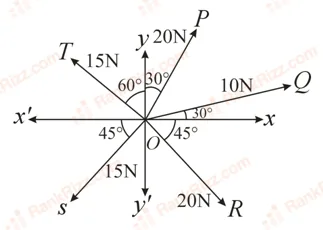
The resultant of these forces O P ⃗ , O Q ⃗ , O R ⃗ , O S ⃗ \vec{OP}, \vec{OQ}, \vec{OR}, \vec{OS} O P , O Q , O R , O S O T ⃗ \vec{OT} O T 3 = 1.7 , 2 = 1.4 \sqrt{3} = 1.7, \sqrt{2} = 1.4 3 = 1.7 , 2 = 1.4 i ^ \hat{i} i ^ j ^ \hat{j} j ^ x , y x, y x , y
A − 1.5 i ^ − 15.5 j ^ -1.5\hat{i} - 15.5\hat{j} − 1.5 i ^ − 15.5 j ^
B 9.25 i ^ + 5 j ^ 9.25\hat{i} + 5\hat{j} 9.25 i ^ + 5 j ^
C 3 i ^ + 15 j ^ 3\hat{i} + 15\hat{j} 3 i ^ + 15 j ^
D 2.5 i ^ − 14.5 j ^ 2.5\hat{i} - 14.5\hat{j} 2.5 i ^ − 14.5 j ^
JEE MAIN 2021 · 27 JUL S1 Vectors: addition, subtraction, resolution and unit vectors TRANSCRIBED
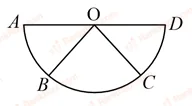
Assertion A A A A , B , C , D A, B, C, D A , B , C , D O O O ∣ A B → ∣ = ∣ B C → ∣ = ∣ C D → ∣ \left|\overrightarrow{AB}\right| = \left|\overrightarrow{BC}\right| = \left|\overrightarrow{CD}\right| A B = B C = C D A B → + A C → + A D → = 4 A O → + O B → + O C → \overrightarrow{AB} + \overrightarrow{AC} + \overrightarrow{AD} = 4\overrightarrow{AO} + \overrightarrow{OB} + \overrightarrow{OC} A B + A C + A D = 4 A O + O B + O C R R R A B → + B C → + C D → = A D → = 2 A O → \overrightarrow{AB} + \overrightarrow{BC} + \overrightarrow{CD} = \overrightarrow{AD} = 2\overrightarrow{AO} A B + B C + C D = A D = 2 A O
A A A A R R R
B A A A R R R
C Both A A A R R R R R R A A A
D Both A A A R R R R R R A A A
JEE MAIN 2021 · 25 FEB S1 Vectors: addition, subtraction, resolution and unit vectors TRANSCRIBED
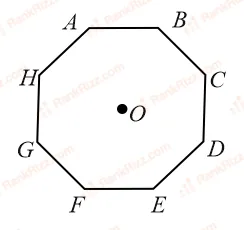
In an octagon A B C D E F G H ABCDEFGH A B C D E F G H A B ⃗ + A C ⃗ + A D ⃗ + A E ⃗ + A F ⃗ + A G ⃗ + A H ⃗ \vec{AB} + \vec{AC} + \vec{AD} + \vec{AE} + \vec{AF} + \vec{AG} + \vec{AH} A B + A C + A D + A E + A F + A G + A H A O ⃗ = 2 i ^ + 3 j ^ − 4 k ^ \vec{AO} = 2\hat{i} + 3\hat{j} - 4\hat{k} A O = 2 i ^ + 3 j ^ − 4 k ^
A 16 i ^ + 24 j ^ − 32 k ^ 16\hat{i} + 24\hat{j} - 32\hat{k} 16 i ^ + 24 j ^ − 32 k ^
B 16 i ^ − 24 j ^ + 32 k ^ 16\hat{i} - 24\hat{j} + 32\hat{k} 16 i ^ − 24 j ^ + 32 k ^
C 16 i ^ + 24 j ^ + 32 k ^ 16\hat{i} + 24\hat{j} + 32\hat{k} 16 i ^ + 24 j ^ + 32 k ^
D − 16 i ^ − 24 j ^ + 32 k ^ -16\hat{i} - 24\hat{j} + 32\hat{k} − 16 i ^ − 24 j ^ + 32 k ^
JEE MAIN 2021 · 20 JUL S2 Vectors: addition, subtraction, resolution and unit vectors TRANSCRIBED
Two vectors P ⃗ \vec{P} P Q ⃗ \vec{Q} Q P ⃗ + Q ⃗ \vec{P} + \vec{Q} P + Q n n n P ⃗ − Q ⃗ \vec{P} - \vec{Q} P − Q P ⃗ \vec{P} P Q ⃗ \vec{Q} Q
A sin − 1 ( n − 1 n + 1 ) \sin^{-1}\left(\frac{n-1}{n+1}\right) sin − 1 ( n + 1 n − 1 )
B cos − 1 ( n − 1 n + 1 ) \cos^{-1}\left(\frac{n-1}{n+1}\right) cos − 1 ( n + 1 n − 1 )
C sin − 1 ( n 2 − 1 n 2 + 1 ) \sin^{-1}\left(\frac{n^2-1}{n^2+1}\right) sin − 1 ( n 2 + 1 n 2 − 1 )
D cos − 1 ( n 2 − 1 n 2 + 1 ) \cos^{-1}\left(\frac{n^2-1}{n^2+1}\right) cos − 1 ( n 2 + 1 n 2 − 1 )
JEE MAIN 2021 · 26 AUG S1 Vectors: addition, subtraction, resolution and unit vectors TRANSCRIBED
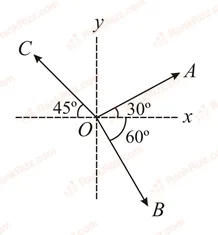
The magnitude of vectors O A → \overrightarrow{OA} O A O B → \overrightarrow{OB} O B O C → \overrightarrow{OC} O C O A → + O B → − O C → \overrightarrow{OA} + \overrightarrow{OB} - \overrightarrow{OC} O A + O B − O C
A tan − 1 ( 3 − 1 + 2 1 + 3 − 2 ) \tan^{-1}\left(\frac{\sqrt{3}-1+\sqrt{2}}{1+\sqrt{3}-\sqrt{2}}\right) tan − 1 ( 1 + 3 − 2 3 − 1 + 2 )
B tan − 1 ( 1 − 3 − 2 1 + 3 + 2 ) \tan^{-1}\left(\frac{1-\sqrt{3}-\sqrt{2}}{1+\sqrt{3}+\sqrt{2}}\right) tan − 1 ( 1 + 3 + 2 1 − 3 − 2 )
C tan − 1 ( 3 − 1 + 2 1 − 3 + 2 ) \tan^{-1}\left(\frac{\sqrt{3}-1+\sqrt{2}}{1-\sqrt{3}+\sqrt{2}}\right) tan − 1 ( 1 − 3 + 2 3 − 1 + 2 )
D tan − 1 ( 1 + 3 − 2 1 − 3 − 2 ) \tan^{-1}\left(\frac{1+\sqrt{3}-\sqrt{2}}{1-\sqrt{3}-\sqrt{2}}\right) tan − 1 ( 1 − 3 − 2 1 + 3 − 2 )